The Real Advantages of Bespoke Furniture - And What You Actually Get for the Price
Bespoke furniture is built to your exact dimensions - not the nearest catalogue size. That single distinction changes everything: recovered floor space, materials you actually choose, and a piece that can be refinished rather than binned. This guide breaks the premium down honestly, measured in centimetres, years of use, and cost per year rather than cost per invoice.
See how oak, beech and ash compare before you commit - the materials view in the configurator shows every stain on your actual piece, in real time.
The core advantages of bespoke furniture are an exact fit to your measured room, free choice of materials and finish, and a longer, repairable service life. Manufaktur X builds each piece from powder-coated steel and solid oak, beech or ash, configured online with a live fixed price, produced in the EU, and delivered to the UK in 5-6 weeks with all customs and duties handled.
Quick summary
- An exact fit recovers usable floor and wall space that standard sizes leave as gaps or dead corners - particularly in Victorian terraces, Edwardian semis and period conversions where walls are rarely straight.
- You specify the build: powder-coated steel in any RAL colour, plus solid oak, beech or ash from certified European sources.
- The higher price reflects material volume, precision cutting and finish work - judged as cost per year of use, a repairable hardwood-and-steel piece typically outlasts flat-pack replaced twice over.
- Bespoke is not the same as modular: modular combines fixed components in variable arrangements; bespoke fabricates each part to your measured geometry.
- Manufaktur X pieces are configured in a live 3D configurator with an instant fixed price and produced in the EU in 5-6 weeks, delivered to UK addresses with customs and duties included.
Key takeaways at a glance
| Insight | What it means for you |
|---|---|
| Fit is the foundation | Every other benefit - visual coherence, space recovery, longevity - follows from fabricating to your measured room geometry rather than the nearest catalogue size. |
| Material choice is a decision, not a default | You select wood species (oak, beech or ash), stain, sheen, steel profile and RAL colour up front, with solid glued-board or seamless veneer options stated clearly for table and bench tops. |
| Repairability changes the cost calculation | Oiled solid-wood surfaces can be spot-sanded and re-oiled at home; powder-coated steel frames stay structural for decades. Cost per year of use, not the price tag, is the honest comparison. |
| Modular is not bespoke | Modular systems combine fixed components in different arrangements; true bespoke fabrication builds every part to your exact dimensions, with no compromise size in between. |
The fit advantage - why your room's quirks matter more than the catalogue
British homes are famously idiosyncratic. Victorian terraces carry chimney breast recesses that no standard bookcase was ever designed to fill; Edwardian semis have alcoves of wildly varying widths on either side of the fireplace; 1930s semi-detached houses often have a short wall segment between the hallway door and the window that defeats every modular shelving system on the market. Period conversions - former warehouses, school buildings, chapels - bring ceiling heights that can top 3.5 metres, far beyond what any flat-pack range addresses. Even newer builds are rarely grid-friendly: a new-build flat in a city-centre development may have a kitchen-diner wall broken up by a radiator, a recessed cupboard and a narrow window, leaving a usable wall segment of 183 cm - a size that appears in no catalogue anywhere.
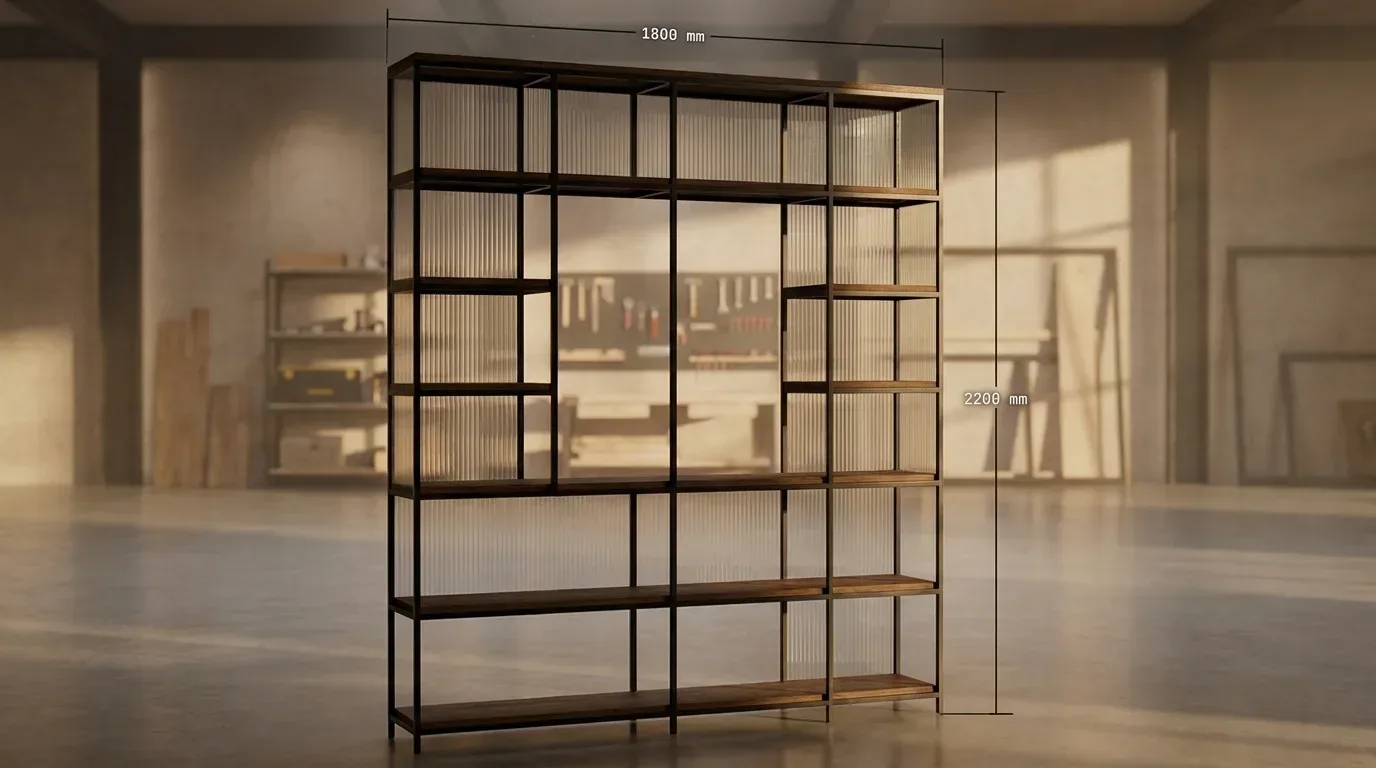
Bespoke furniture such as a full-wall shelf built to your exact width is fabricated to your measured geometry with millimetre tolerance. The same principle runs through the entire range of bespoke steel and solid-wood pieces.
Do a centimetre audit before you buy anything
Walk through one room with a tape measure and note every filler strip, every gap between cabinet and wall, every corner a standard unit could not reach. Roughly a third of the measurement sheets we receive from customers in older properties contain at least one alcove or wall segment that no catalogue size matches within 10 cm (first-hand Manufaktur X production data). A 22 cm gap beside a bookcase, 14 cm lost behind a unit pushed forward by the skirting board, a 51 cm chimney breast recess left completely empty. Add it up and half a square metre of floor space plus a full wall segment is often doing nothing. A piece built to those exact numbers puts that area back to work.
Why uneven walls catch people out
Old British masonry walls rarely run perfectly plumb. Generations of settling, lathe-and-plaster, and subsequent replastering mean the top of a wall seldom sits exactly above its base - so floor-to-ceiling shelving planned from a single centre measurement binds on one side and leaves a visible gap on the other. Bespoke fabrication absorbs this, because the piece is designed from your measured points rather than an assumed straight line. The most common reason a bespoke piece does not fit is not a production fault - it is a measurement taken from a floor plan rather than the built room itself.
One continuous piece instead of a row of near-misses
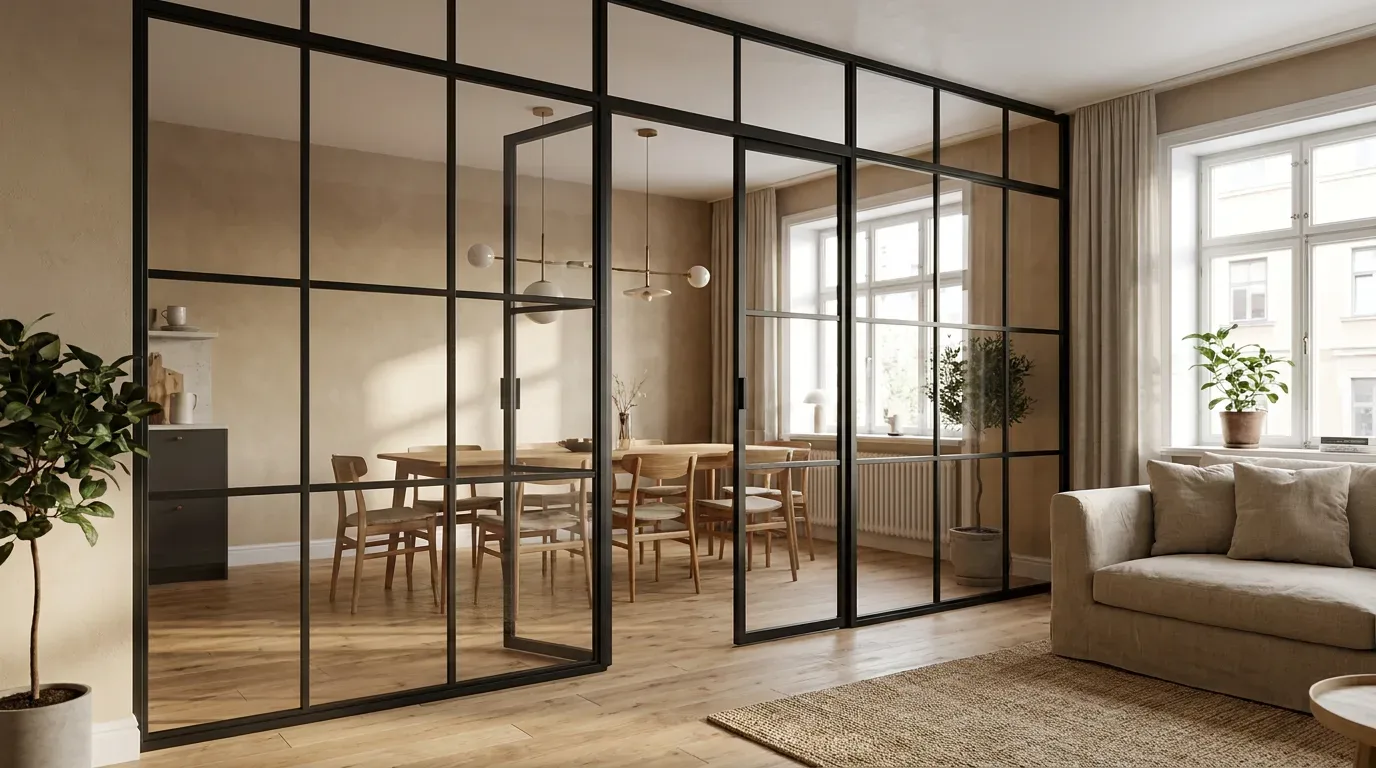
The visual case is equally concrete. One fabricated unit spanning the full width of an alcove reads as architecture - it looks as though it was always there. A row of near-fitting off-the-shelf boxes with filler panels reads immediately as a workaround. Your eye catches the uneven reveals and the seams between modules before anything else. A single steel-and-hardwood build in the exact width of the wall removes those joints entirely, and with them the dust traps that accumulate between separate modules over the years.
Specifying your own materials - what that actually means in practice
With standard furniture, the manufacturer decided on the materials months before you walked into the shop. With bespoke furniture, you make every material decision yourself: steel profile and RAL colour, wood species, stain intensity and surface sheen, and the construction of the top. The specification breaks into three layers - the structural steel, the wood you touch every day, and the certifications behind both.
Powder-coated steel frames - scratch-resistant, consistent colour, built to last
Frames are welded from S235JR structural steel, the grade defined in EN 10025 with a yield strength of 235 N/mm² (Source: EN 10025 via DIN) - sufficient reserve to carry a thick hardwood top or fully loaded shelf boards across spans of 150 to 300 cm without flex. Powder coating seals the surface through an electrostatic process that bonds the finish at a molecular level: the result is scratch-resistant, carries an even, consistent colour across the entire frame, and involves no solvent emissions during application. Every RAL colour is available, from RAL 9005 deep black to muted greens, warm greys and dusty blush tones that suit both industrial loft conversions and more restrained period interiors.
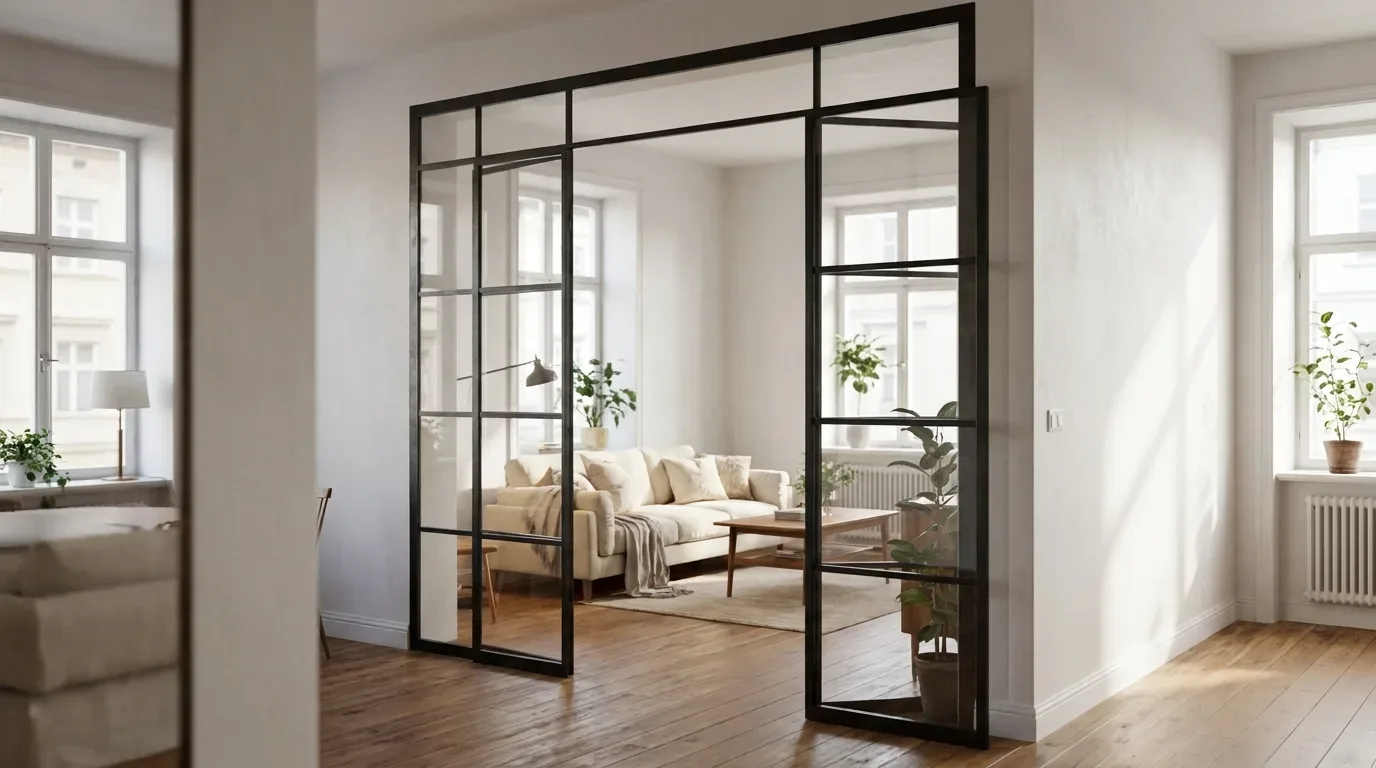
Solid oak, beech and ash - and where veneer is offered
Three species, honestly mapped. Tops for a dining table built to your exact dimensions, a coffee table or a bench come either as solid glued boards - real wood through and through - or as seamless veneer for a calmer, joint-free surface appearance. Shelf boards follow a different rule: on the large shelf and the pipe shelf, every board is always solid hardwood, never veneer, never chipboard. All three species accept any of the 50+ stains in matt or silk sheen.
Certified European hardwoods
The oak, beech and ash come from certified European forestry - PEFC or FSC chain of custody - and glued components meet formaldehyde class E1, with low-VOC oil finishes as the default. For a piece that lives in your home for decades, what it releases into the air is as relevant as what it carries on its shelves.
EN 1534 defines the Brinell indentation test used across Europe to compare wood surface hardness; dense hardwoods such as solid oak reach values around 34 N/mm², roughly double what common softwoods achieve.
On my loft conversion projects I make a conscious decision about which materials to use, rather than simply accepting what is available. That sense of ownership is what separates an ordinary industrial interior from an exceptional one.
Lukas Brandt
Interior Architect, Munich
Is bespoke furniture actually worth the higher price?
The honest answer depends on which number you use. Judged by the price tag alone, bespoke furniture costs more than a flat-pack equivalent - sometimes significantly more. Judged by cost per year of use, including one refinish cycle, the picture often reverses. A repairable hardwood-and-steel piece built to your dimensions can serve for two or three decades; a chipboard unit that cannot be refinished once the surface is breached typically needs replacing within five to ten years. Replace it twice and you have usually spent more than the bespoke piece cost once.
It is also worth being clear about what drives the price of a bespoke piece. There is no scarcity premium and no showroom margin built in - Manufaktur X sells direct from the workshop. What you pay for is measurable: more raw material in a wider top, individual cutting plans when a size sits outside the common grid, and additional curing hours for every stained or specialist-sheen surface.
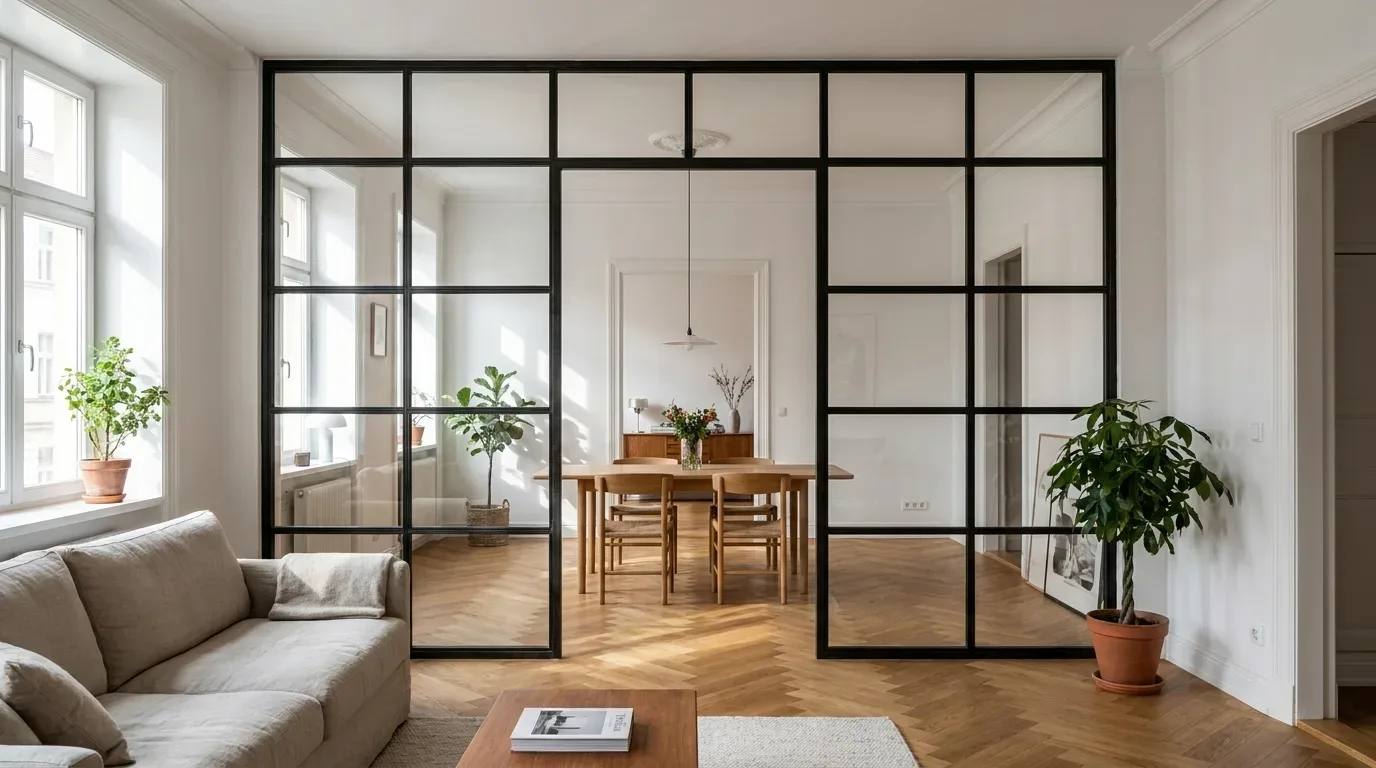
The three honest components of the price
Material volume is the largest factor: a 240 cm dining table top simply contains more hardwood than a 160 cm one, and oak is denser and more expensive than beech, with ash sitting between the two. Precision cutting is second - a non-standard size requires individual cutting plans and generates more offcut than a grid size would. Finish labour is third: each stain and sheen level adds curing time before a surface may leave production.
How bespoke compares to modular and flat-pack
A useful comparison: IKEA's modular shelving systems are excellent at what they do - they offer a huge range of combinations at a low entry price, and for a standard-sized wall in a new-build flat they can be the right choice. But modular is not the same as bespoke. Take a typical Victorian alcove at 87 cm wide: the nearest IKEA BILLY combination is 80 cm (a 7 cm gap on one side) or 120 cm (does not fit). A John Lewis bespoke shelf service will fit the space but typically requires a home visit and a longer lead time. Bespoke fabrication with a live online configurator builds the piece at 87 cm minus mounting clearance, prices it in real time, and delivers it in 5-6 weeks with no home visit required.
A fixed price shown live, without the consultation loop
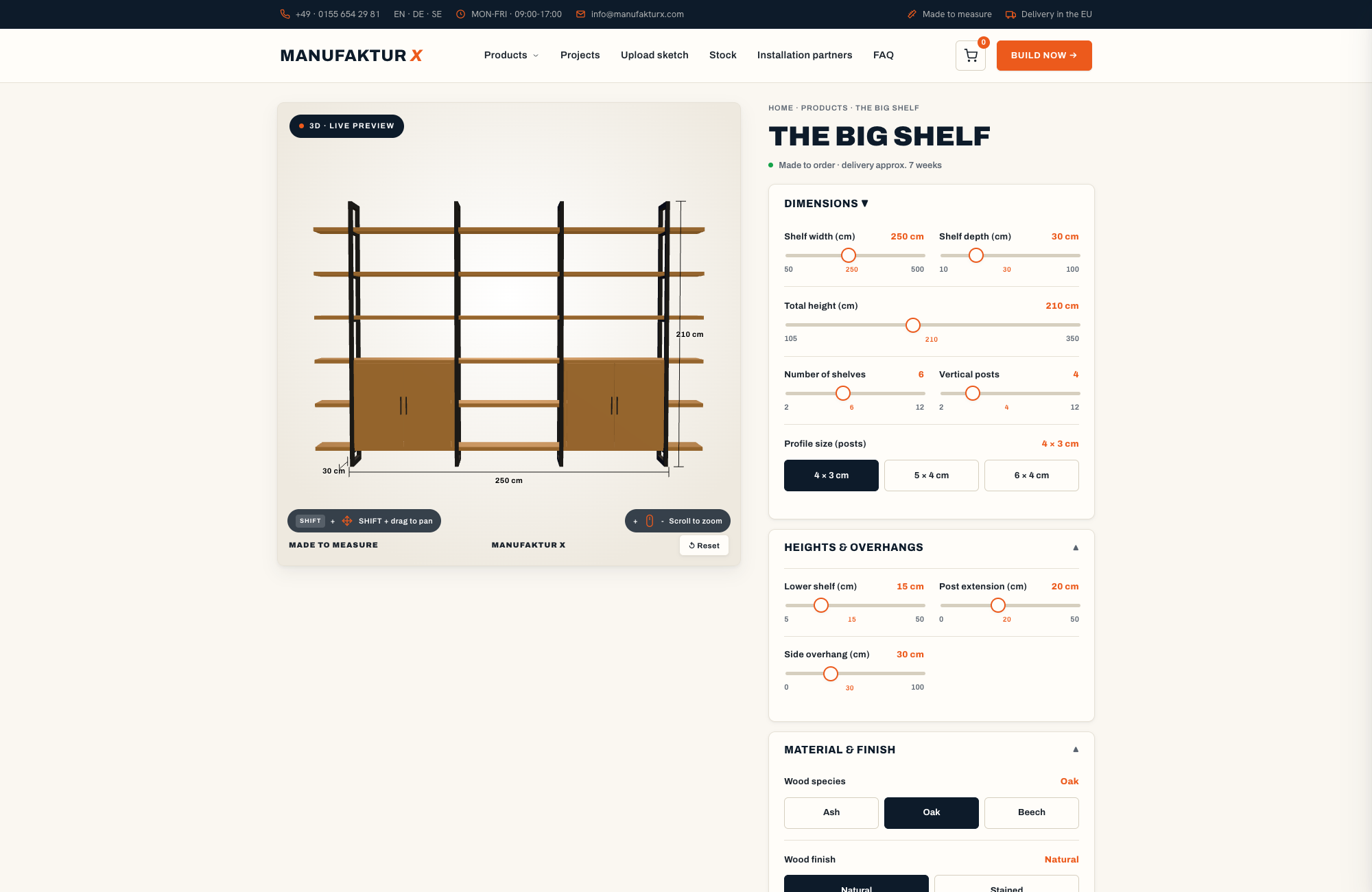
Every dimension change updates the fixed price in real time in the 3D configurator - no quote request, no callback, no showroom appointment. Change the width from 87 to 120 cm, swap oak for ash, shift from matt to silk sheen: the price updates with each input. That transparency is genuinely useful when you are weighing three different configurations against each other on a Tuesday evening.
| Product | From | Note |
|---|---|---|
| Lofttür | £995 | Lowest possible option |
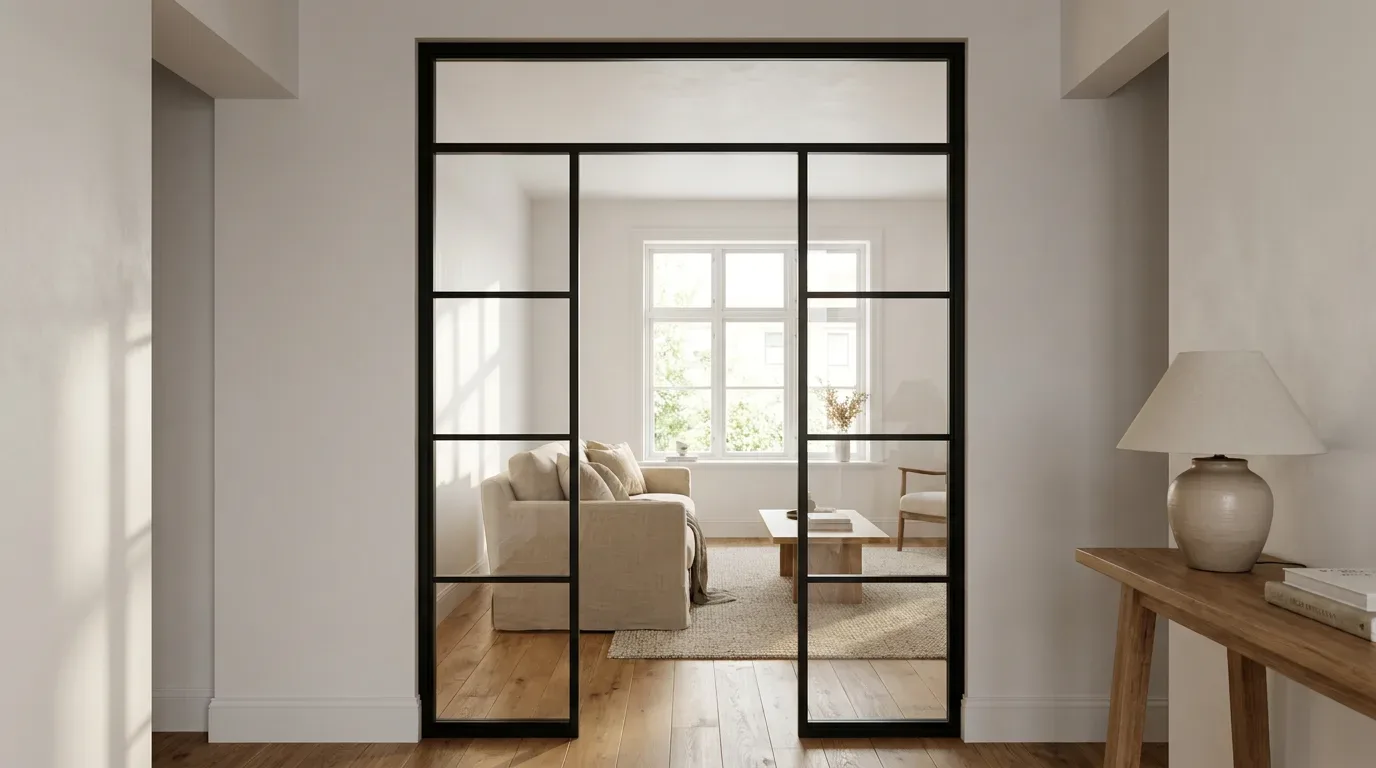
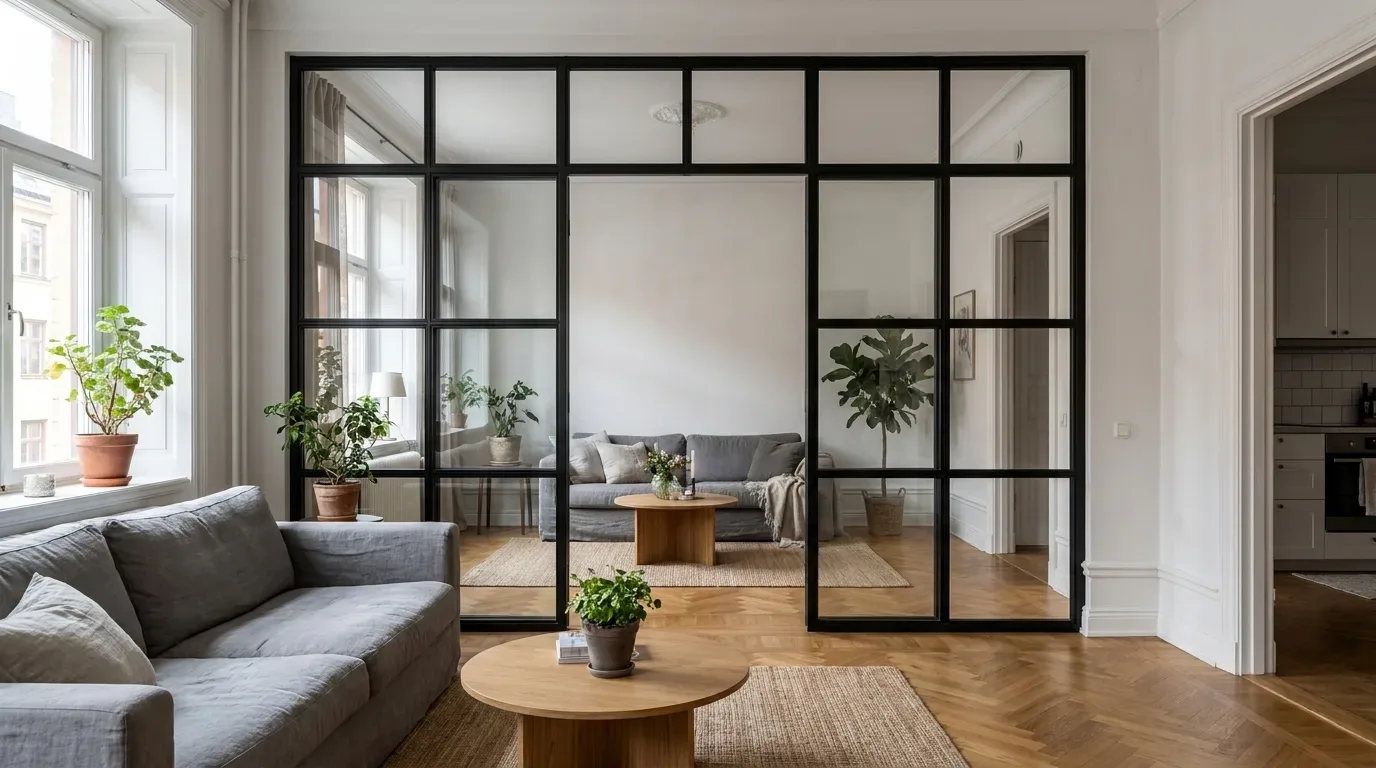
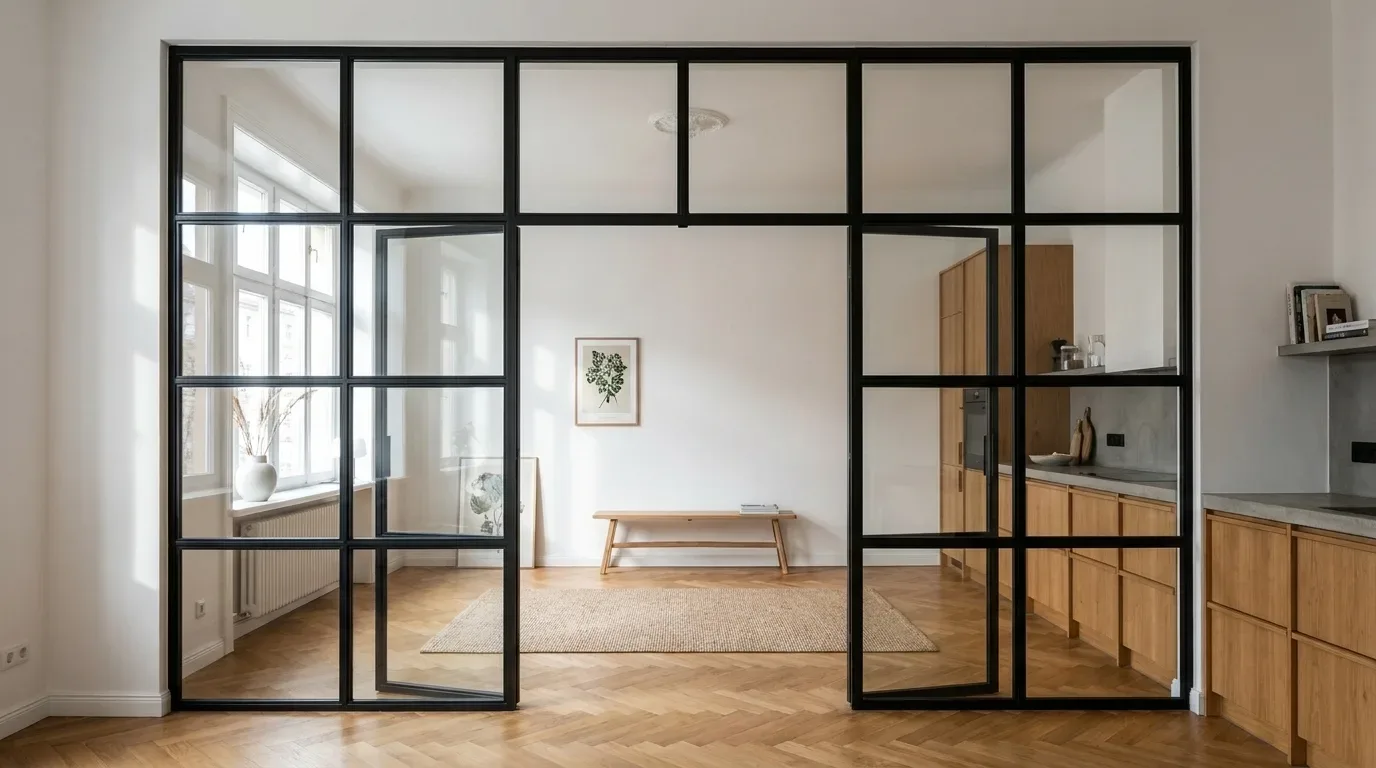
| Raumteiler | £1.900 | Steel + laminated glass, custom width |
| Großes Regal | £2.750 | Solid wood, steel frame, floor-to-ceiling |
| Esstisch | £1.360 | Solid wood, steel frame |
| Couchtisch | £995 | Solid wood, steel frame |
| Sitzbank | £945 | Solid wood, steel frame |
| TV-Board | £1.325 | Solid wood, steel frame |
| Rohrregal | £915 | Modular pipe shelf |
Open the 3D configurator for bespoke furniture and change one dimension - the fixed price updates instantly, so you can test what your exact size costs before you commit.
Bespoke vs modular vs flat-pack - a side-by-side view
The confusion between modular and bespoke costs buyers the most time. A configurator that lets you combine 60 and 80 cm modules feels custom, but the modules themselves never change size. Here is the comparison buyers weighing their options actually need:
| Criterion | Bespoke (made-to-measure) | Modular system | Standard flat-pack |
|---|---|---|---|
| Fit | Fabricated to your measured dimensions, millimetre tolerance | Nearest combination of fixed modules; gaps of 5-20 cm are typical | Fixed catalogue sizes; the room must adapt to the furniture |
| Materials | Specified per order: powder-coated steel, solid oak, beech or ash, chosen stain and RAL colour | Limited to the system's preset colours and finishes | Mostly veneered chipboard in fixed finishes |
| Lifespan and repair | Refinishable hardwood, structural steel frame, parts replaceable | Individual modules swappable while the system remains in production | Replacement is usually the only option once the surface is worn through |
| Price logic | Material volume + precision cutting + finish labour; fixed price shown live | Per-module pricing; additions accumulate quickly | Lowest entry price; repeated repurchase over the years adds up |
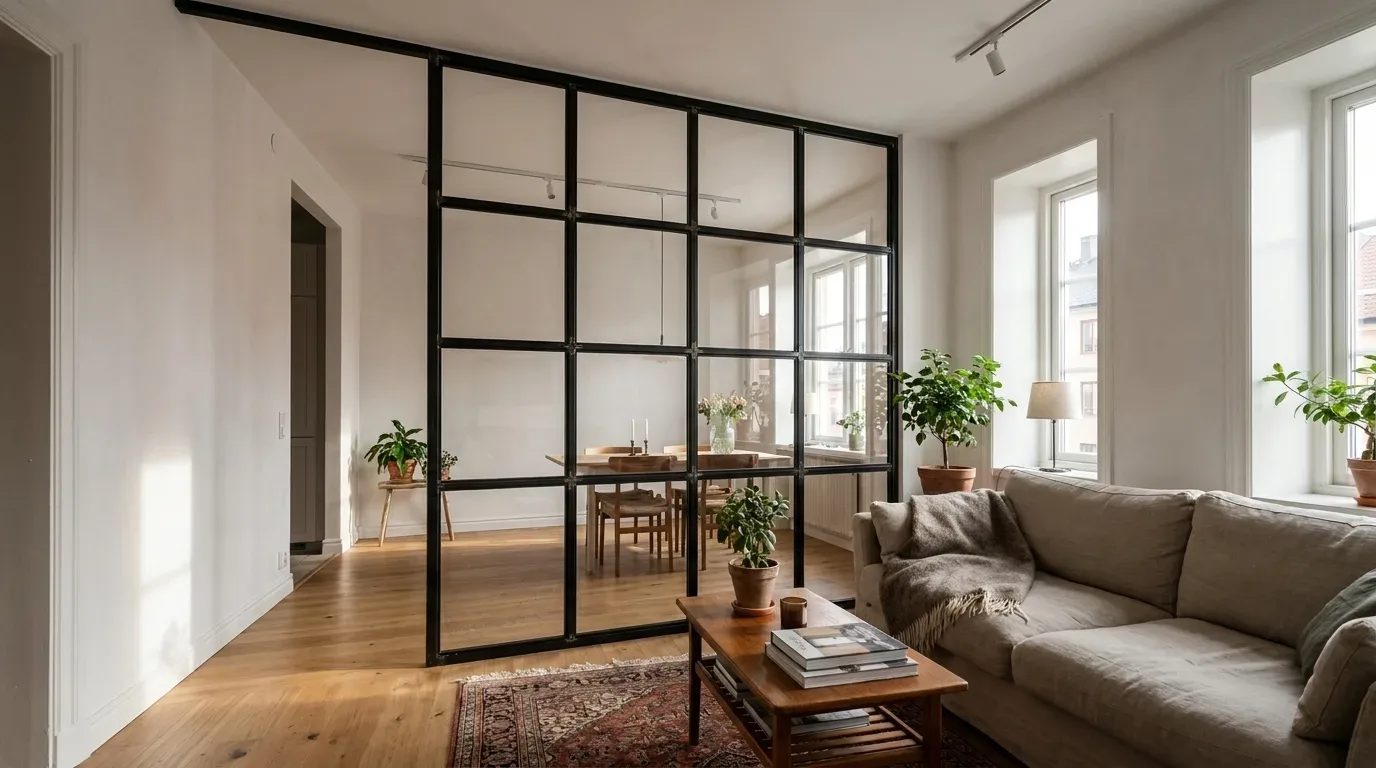
From measurement to delivery - what the process looks like
Ordering a bespoke piece takes four steps: measure your space at several points, configure the piece in the live 3D configurator, order at the fixed price shown, and receive the EU-made piece within 5-6 weeks. UK delivery is handled directly, with all customs and duties included - no surprise charges at the door. Nobody needs to visit your home first.
Measure at several points, use the smallest
One rule covers almost every situation: take each dimension at two or three points and enter the smallest value. For wall-to-wall builds, allow around 5 mm mounting clearance per side so the piece can be positioned without forcing. The most common reason a bespoke piece does not fit on delivery is not a production fault - the measurement came from a floor plan rather than the built room, and the plaster, tiles or skirting board added after that plan was drawn changed the real opening by a centimetre or more. Measure the room as it stands, not as it was designed.
Configure in 3D, watch the price update
Width, depth, height, wood species, stain, steel profile and RAL colour are all live inputs in the configurator. The fixed price recalculates with every change, so you can compare three sizes and two species in under ten minutes without speaking to anyone. There is no quote request and no callback waiting to happen.
EU production, UK delivery in 5-6 weeks
Production runs in the EU with a lead time of 5-6 weeks from order to delivery. Shipping, customs and duties to UK addresses are handled as part of the order - the total shown at checkout is the total you pay. For wall-mounted builds, installation partners are available if you prefer not to handle fixings yourself.
- Measure each dimension at several points and note the smallest value - measure the built room, not the floor plan.
- Configure size, wood species, stain, frame type and RAL colour in the live 3D configurator.
- Order at the fixed price shown - shipping, customs, duties and lead time are confirmed in the basket.
- Receive the EU-made piece in 5-6 weeks; book an installation partner for wall-mounted builds if you want one.
On loft conversion projects, online configurators save a significant amount of time - from the first sketch to production, the whole process runs in a structured way. That lets me deliver bespoke steel-and-wood furniture faster and leave clients more satisfied with the result.
Lukas Brandt
Loft Conversion Specialist
Longevity, repair and the sustainability argument
Bespoke furniture lasts longer because it is built to be repaired. Solid hardwood surfaces can be refinished; powder-coated steel frames stay structural for decades. Repairability is what converts the higher purchase price into a lower lifecycle cost - and it is also the most straightforward sustainability argument, because the greenest piece of furniture is the one you never need to throw away.
Repair instead of replace
Scratches, water rings and worn patches on a solid hardwood top are surface events, not structural ones. A coffee table with a solid-wood top - the piece in any home that collects the most daily punishment - can be brought back to new condition several times over its life with sandpaper, oil and an afternoon. Chipboard with a worn-through surface layer has no second life; disposal is its only exit. That difference is relevant whether you are furnishing a house you intend to stay in for twenty years or a rented flat where you want furniture that survives multiple moves.
Oiled vs lacquered surfaces in everyday use
The two finish types age differently in practice. An oiled surface penetrates the wood and can be renewed locally - sand the affected area, re-oil, done. A lacquered surface forms a closed protective film that works well until it is breached, at which point a full refinish is the only remedy. For a piece in daily use, oil is the more forgiving long-term choice.
Certified wood and what happens at end of life
PEFC- and FSC-certified hardwood carries its provenance; powder-coated steel is indefinitely recyclable; and a bolted steel-and-wood build can be disassembled into clean material streams rather than going to mixed waste. What we see at renovations in older properties tells the same story from the other direction - the furniture in the skip is invariably worn chipboard, not solid hardwood. The solid wood pieces were moved to the next house.
Configure your piece to the exact centimetre - the fixed price appears as you type, and UK shipping with all customs and duties included is confirmed in the basket before you commit.
Frequently asked questions about bespoke furniture
Which wood species suits a centrally heated British home?
Beech and ash are the stable choices for dry, consistently heated interiors - the kind of environment common in a well-insulated new-build flat or a recently renovated period property. Oak is the robust all-rounder that handles more variable indoor conditions equally well, including the temperature fluctuations that older, less insulated houses tend to produce. All three species move slightly with seasonal humidity shifts; the denser hardwoods keep that movement small. The climate choice never limits the look - all three come with 50+ stains.
Can I take bespoke furniture with me if I move?
Yes - freestanding pieces such as tables, benches and shelves move like any furniture. The one honest trade-off of an exact fit is that a piece sized wall-to-wall for one specific alcove in a Victorian terrace may not slot perfectly into the alcove of your next house. Steel-and-hardwood construction handles disassembly and transport better than most alternatives, and the piece can often be adapted rather than replaced if dimensions change significantly.
Do I need to get a professional to measure up?
No. Measuring each dimension at two or three points and entering the smallest value is sufficient for most pieces. The one rule worth repeating: measure the built room, not the floor plan. Skirting boards, plaster thickness and tiles added after the original drawing was made can reduce the real opening by a centimetre or more - and that centimetre is the difference between a piece that slides in cleanly and one that does not.
How does the 3D configurator calculate the price?
The fixed price updates live from your inputs: dimensions, wood species, stain, sheen level, frame type, leg profile and RAL colour. There is no quote request and no callback - shipping, customs, duties and lead time all appear transparently in the basket before you confirm the order.
Does bespoke furniture hold its value better than flat-pack?
It holds its use value longer because worn surfaces can be refinished and the structure is built for its specific load over decades rather than years. Divide the price by the realistic service life including a refinish cycle, and the cost per year of use typically undercuts the cost of replacing a flat-pack equivalent twice over.
Start with your tape measure, not the catalogue
Evaluate any furniture purchase on three criteria at once - fit, materials, lifespan - and the case for building to measure becomes arithmetic rather than a lifestyle preference. A piece matched to your actual wall recovers space that no discount can buy. The specified hardwood and steel determine how it ages over years and decades. And repairability decides what it costs per year of ownership, not just per purchase. EU production, direct-from-manufacturer delivery to UK addresses with customs and duties handled, and a fixed price shown live in the configurator complete the picture.
Compare oak, beech and ash side by side, then set your exact dimensions in the 3D configurator - the fixed price updates with every centimetre you change, production is EU-based, and UK delivery with all duties included takes 5-6 weeks.