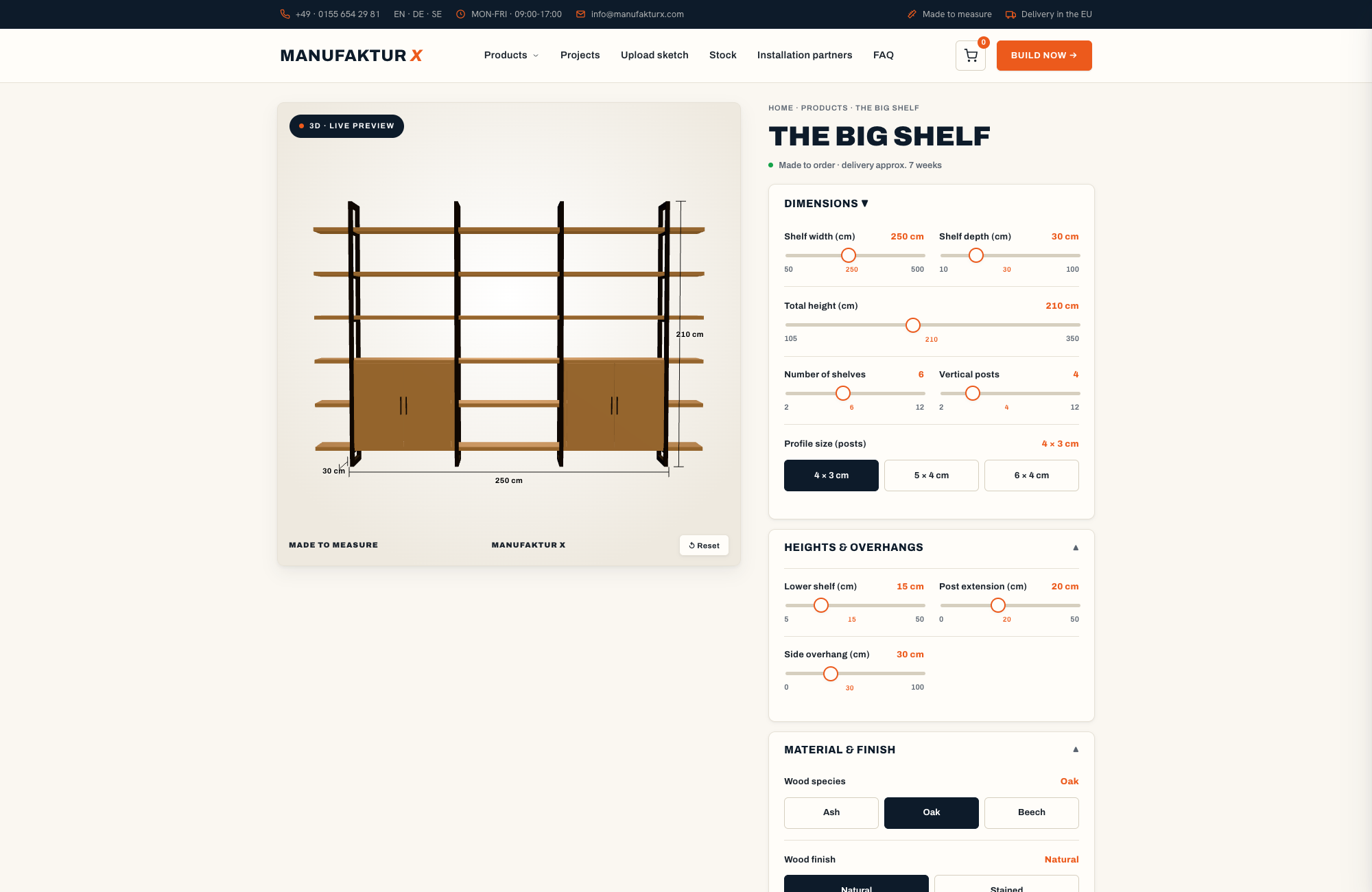
Off-the-shelf bookcases are designed around average rooms. Yours almost certainly isn't average - and that gap between a standard unit and your actual alcove, chimney breast recess, or floor-to-ceiling wall is where a made-to-measure shelving unit earns its keep. The Large Shelf from Manufaktur X pairs a powder-coated steel frame with solid hardwood shelves in oak, beech, or ash, built to the millimetre and configured entirely online. No filler panels. No wasted centimetres.
Why Bespoke Shelving Beats a Standard Unit
The Problem with Fixed Sizes
Most high-street shelving - including ranges from IKEA and John Lewis - comes in set widths and heights. A typical freestanding unit tops out at around 2,000 to 2,200 mm. That works tolerably in a new-build flat with 2,400 mm ceilings. It works considerably less well in the kind of Victorian terrace or Edwardian semi that makes up much of Britain's housing stock, where ceiling heights of 2,700 to 3,100 mm are common. At 3,000 mm ceiling height, a 2,200 mm standard unit leaves an 800 mm gap above it - enough dead wall space for an entire extra shelf, visually awkward and practically wasted.
Alcoves are an even sharper illustration. Victorian chimney-breast recesses are rarely a standard width. You either buy a unit that is too narrow and leaves a visible gap down one side, or you buy one that does not fit at all. A bespoke unit is specified to the actual opening - width, height, and depth all matched to the space, not the other way around.
Structural Honesty: Steel and Solid Wood
There is a reason flat-pack shelving often sags after a few years of real use. An 18 or 19 mm particleboard shelf spanning 800 mm will deflect visibly under a typical row of hardback books - often 3 to 5 mm under a 30 kg distributed load - and particleboard creeps further over time under sustained weight. Solid oak, beech, or ash behaves fundamentally differently. The bending stiffness of solid hardwood at equivalent thickness is meaningfully higher, and it does not exhibit the same long-term creep under load.
In the Large Shelf, the powder-coated steel frame carries all vertical loads and provides the structural rigidity. The hardwood shelves serve as the load surface - they are not doing structural work the frame should be doing. That clear separation of roles is something flat-pack construction cannot replicate.
Design Continuity Across a Room
If you already have a steel-framed loft door or a room divider in RAL 9005 matt black, you can specify exactly the same RAL colour for your shelf frame - at no extra cost. That kind of material continuity is what separates a considered interior from a room full of individual pieces that happen to coexist. Industrial and warehouse-conversion aesthetics in particular depend on it: when the steel reads as a deliberate choice repeated across the room, it lands very differently than when it appears on a single item.
Materials in Detail
Solid Hardwood Shelves: Oak, Beech, and Ash
Every shelf in the Large Shelf range is solid hardwood - no veneer, no particleboard core. Manufaktur X works with three species, each with distinct characteristics:
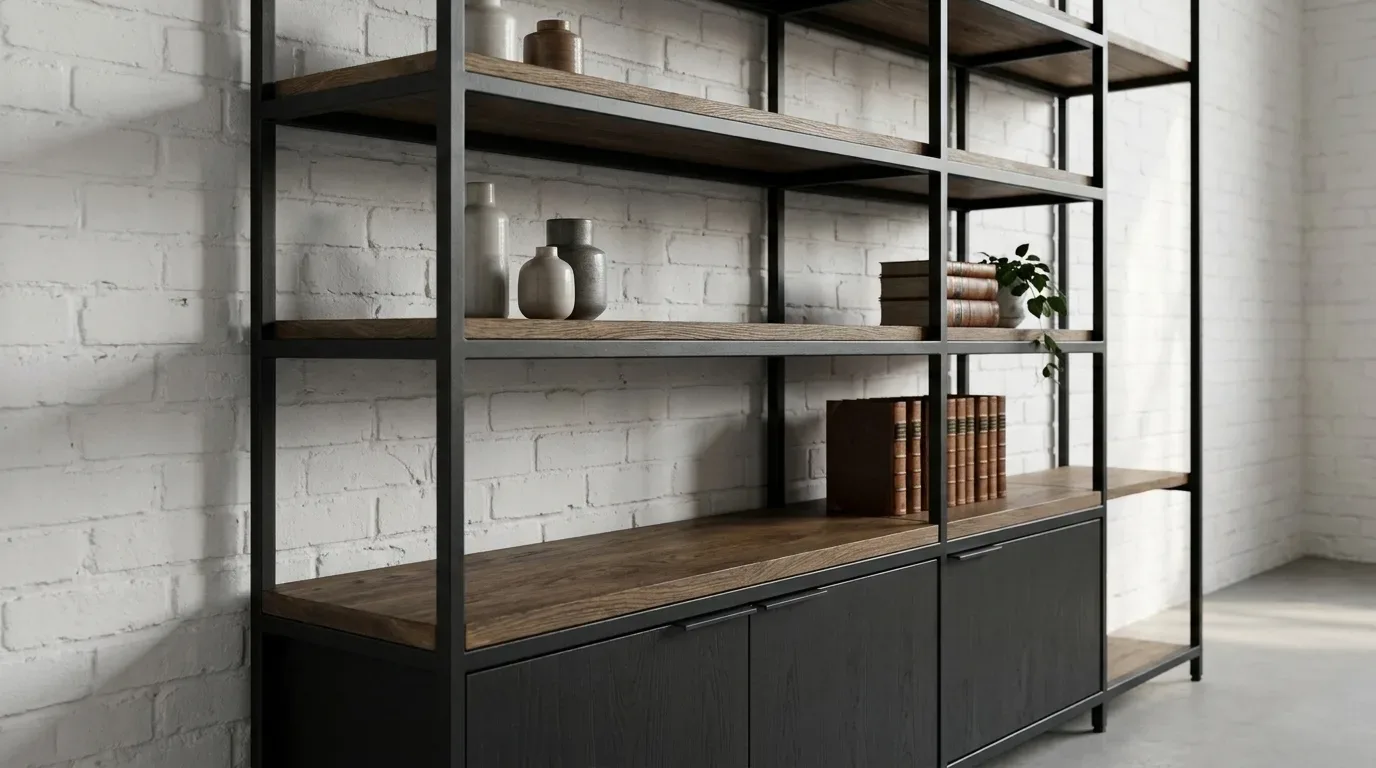
- Oak - pronounced grain with considerable visual movement, high bending stiffness, and the first choice for wide shelves carrying heavy loads such as books or ceramics. The species most associated with the current British appetite for natural, characterful timber.
- Beech - finer, more uniform grain structure, quieter visual presence. Well suited to interiors where the wood should recede rather than draw attention - a Scandi-influenced or pared-back aesthetic, for instance.
- Ash - the lightest in tone of the three, with an open grain that takes stains well. A strong choice when the brief calls for a lighter, less dominant wood presence.
Surface finish is your decision: over 50 stain options are available, from a raw, lightly oiled natural through to deeply smoked dark tones or near-any colour direction you might want. Solid hardwood develops a patina over years that deepens rather than degrades - a quality that distinguishes it from surfaces that simply wear.
Powder-Coated Steel Frame
The frames are fabricated from square-section steel profiles, welded and then powder-coated after assembly. Powder coating - as opposed to wet paint - is applied electrostatically as a dry powder and cured under heat, producing a finish that is harder, more scratch-resistant, and more consistent in colour than conventional paint. It is also a cleaner process with lower solvent emissions. The result is a frame that can be wiped down without fear of scuffing and holds its colour without fading.
Every RAL standard colour is available at no surcharge - that includes RAL 7016 anthracite grey, RAL 9010 pure white, RAL 9005 jet black, and the full standard palette. Colours outside the standard RAL range can also be specified on request.
What the Large Shelf Does Not Contain
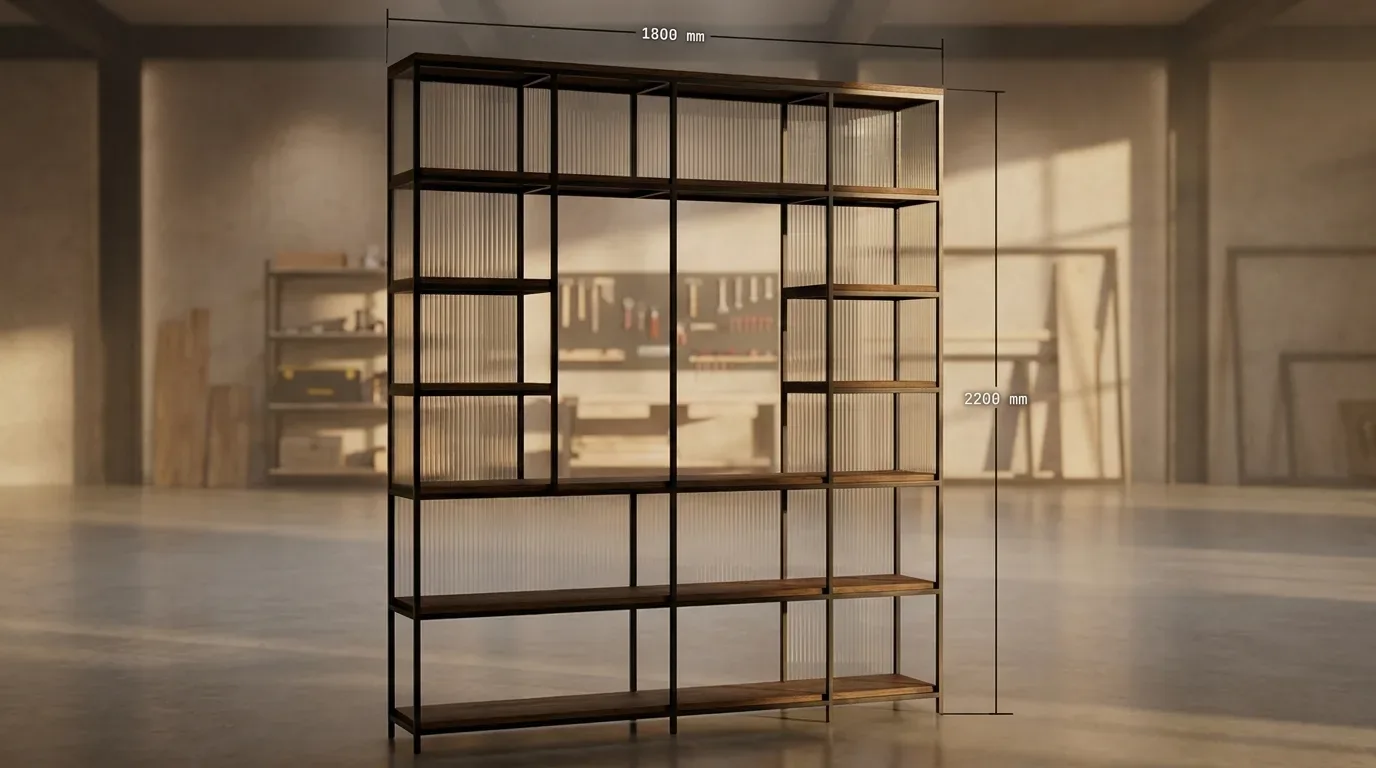
Important: the Large Shelf is a steel and solid hardwood product. It does not incorporate glass. If you are looking for steel-and-glass combinations, those are available in the loft door and room divider ranges.
Large Shelf or Pipe Shelf - Which Is Right for You?
ManufakturX offers two bespoke shelving lines in steel and solid hardwood. The right choice depends on five factors: wall type, ceiling height, desired depth, load requirements, and the look you are after.
| Consideration | Pipe Shelf | Large Shelf |
|---|---|---|
| Installation method | Wall-mounted (required) | Freestanding or wall-flush |
| Can be used as a room divider | No | Yes (without a back panel) |
| Frame aesthetic | Visible pipe frame | Welded steel box frame |
| Pricing | See configurator | See configurator |
| Wood species | Oak, beech, ash | Oak, beech, ash |
| RAL colour - any standard shade | Yes | Yes |
| Product | From | Note |
|---|---|---|
| Lofttür | £995 | Lowest possible option |
| Raumteiler | £1.900 | Steel + laminated glass, custom width |
| Großes Regal | £2.750 | Solid wood, steel frame, floor-to-ceiling |
| Esstisch | £1.360 | Solid wood, steel frame |
| Couchtisch | £995 | Solid wood, steel frame |
| Sitzbank | £945 | Solid wood, steel frame |
| TV-Board | £1.325 | Solid wood, steel frame |
| Rohrregal | £915 | Modular pipe shelf |
Both models offer the same wood species and RAL colour freedom. Matching either shelf to existing furniture or other Manufaktur X pieces involves no additional cost - the choice of colour and finish is included in the standard configuration.
Where the Large Shelf Works Best
Living Rooms and Open-Plan Spaces
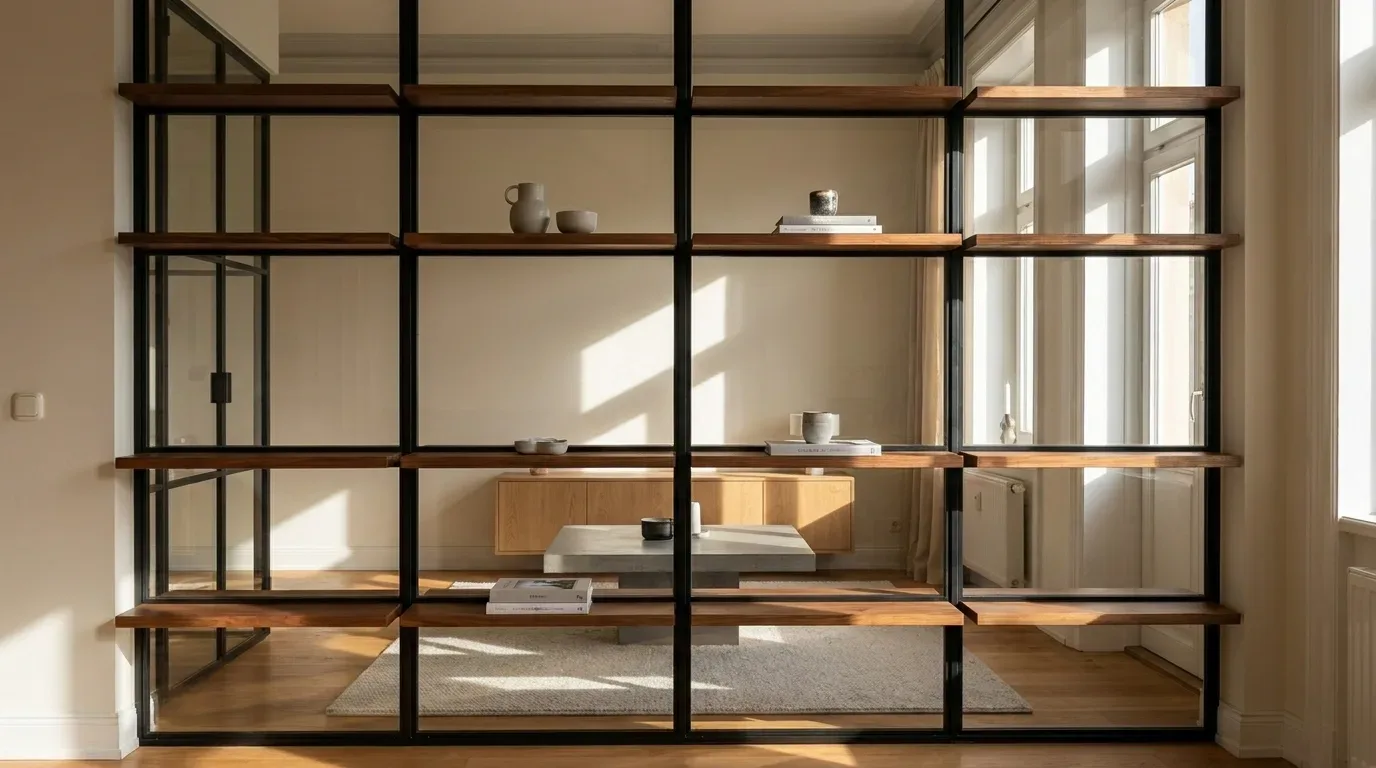
A floor-to-ceiling bespoke shelving unit structures a room and creates a sense of order without closing off space or adding a solid wall. Used without a back panel, the Large Shelf can divide an open-plan kitchen-diner or living area into distinct zones while keeping the sense of openness intact - particularly useful in period conversions where adding partition walls would be inappropriate or require planning consent. Books, objects, and collections remain visible and accessible; the frame becomes part of the room's visual language rather than a piece of storage furniture.
Home Offices
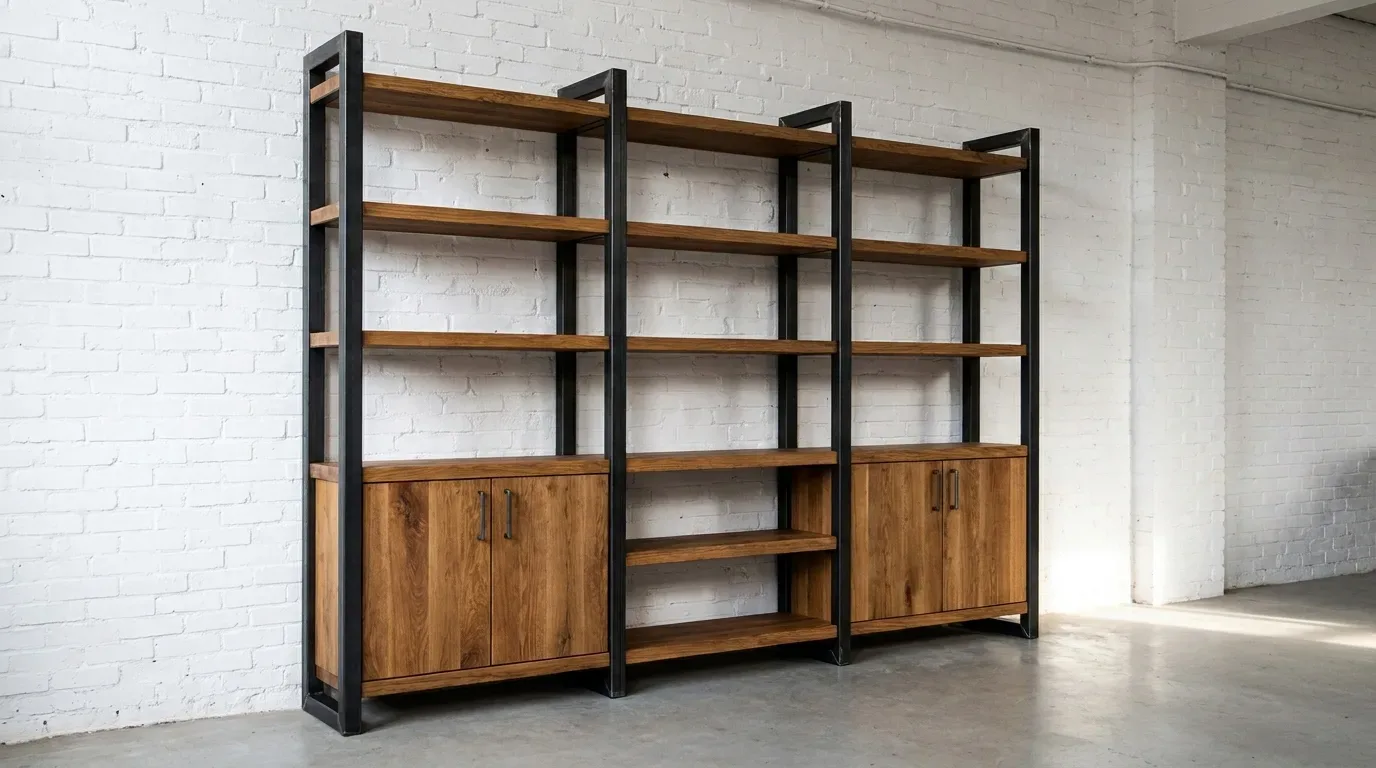
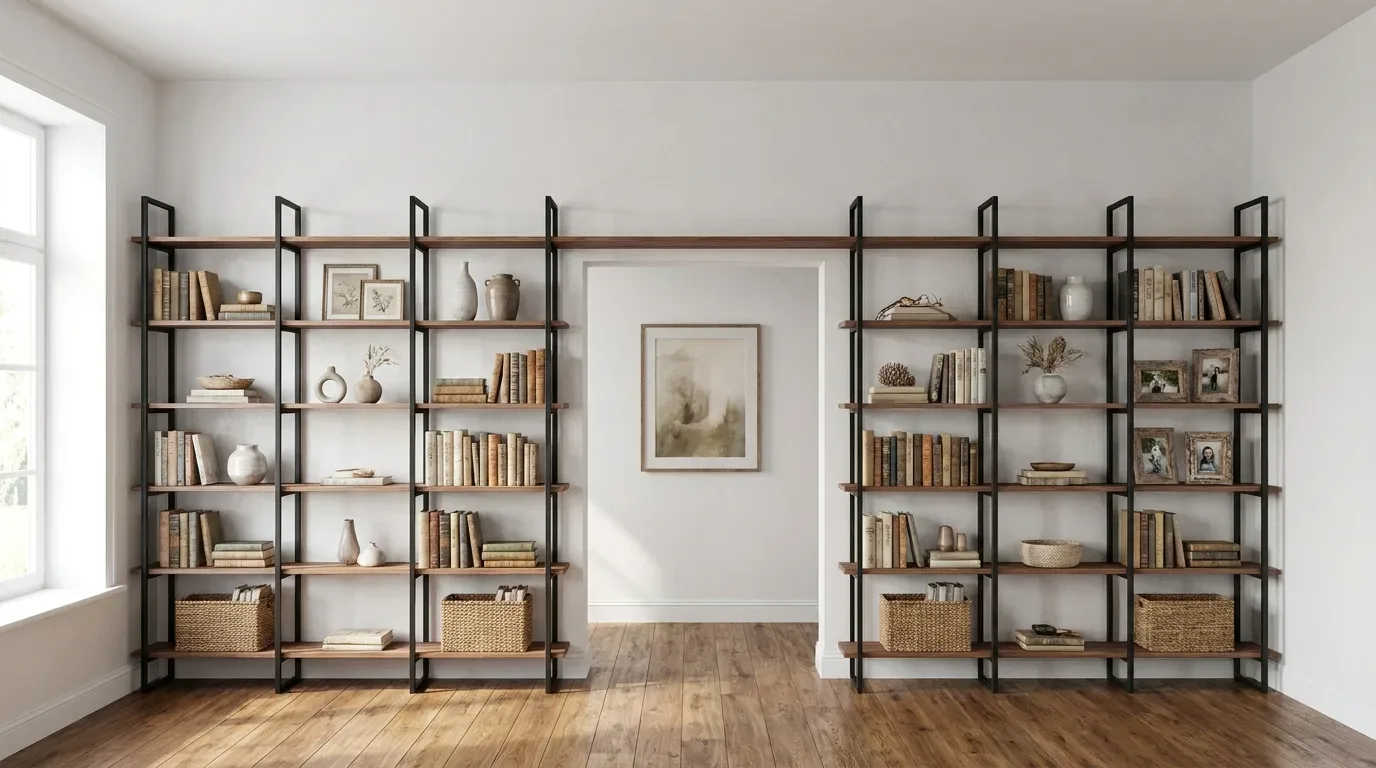
In an Edwardian semi or 1930s semi-detached where a bedroom has been converted to a home office, a bespoke unit that fills the alcove either side of the chimney breast - each built to the exact width of the recess - transforms a room that still reads as a bedroom into something that functions and feels purposefully different. The steel and hardwood combination reads as considered rather than domestic, which is a meaningful distinction when you are spending eight hours a day in the space.
Smaller Flats and Awkward Dimensions
In a compact flat - particularly a period conversion where rooms are irregular rather than the standardised rectangles of a new-build - a standard-width unit frequently leaves an unsatisfying gap. A shelf built to the exact width of the wall, and the exact height of the room, uses every centimetre. In our experience producing custom pieces, the most common reason a made-to-measure piece does not fit is inaccurate measurement, not a production fault. This is why the measuring process matters as much as the specification itself.
Commercial and Hospitality Settings
The steel and hardwood combination translates well into commercial interiors where durability and visual consistency matter. Common applications include:
- Independent cafes and restaurants - display shelving that doubles as a design element and carries real weight
- Boutique retail - product display that matches a considered brand aesthetic
- Showrooms and studios - material-consistent display that reinforces a brand identity
- Delicatessens and specialty food shops - shelving that positions product as premium
Planning Your Custom Shelf Unit: A Step-by-Step Guide
Step 1 - Understand the Space Before You Measure
Before picking up a tape measure, map the constraints of the space: windows, radiators, light switches, skirting boards, and any pipes or cables running behind the wall. Consider what the unit will store - a shelf intended for vinyl records needs different shelf spacing and depth than one for books, and both differ from a unit intended mainly for decorative display. Sketch a rough elevation of the wall, marking any obstacles, and decide upfront on the following:
- Desired height and depth of the unit overall
- Number of shelves and approximate shelf spacing
- Whether it will stand against a wall or function as a freestanding divider
- How it will relate visually to other furniture already in the room
Step 2 - Measure Accurately, and Measure More Than Once
Walls in Victorian terraces and period properties are rarely plumb or square. A wall that appears to be 1,800 mm wide may be 1,803 mm at the top and 1,796 mm at the bottom. Measure width at three heights - top, middle, and bottom. Measure the height at a minimum of two points across the width. Always use the smallest measurement as your input value: the unit is manufactured to precisely the dimensions you enter in the configurator, and a shelf that is 4 mm too wide will not sit flush in a recess.
Practical measuring checklist:
- Width measured at three heights - record all three, use the smallest
- Height checked at two or more horizontal positions across the wall
- Depth of the recess or available floor space measured and compared against desired shelf depth
- Any pipes, cables, or conduits behind the wall located before drilling
- Skirting board height noted if the unit will sit against a skirted wall - this affects the base clearance
Step 3 - Choose Your Materials
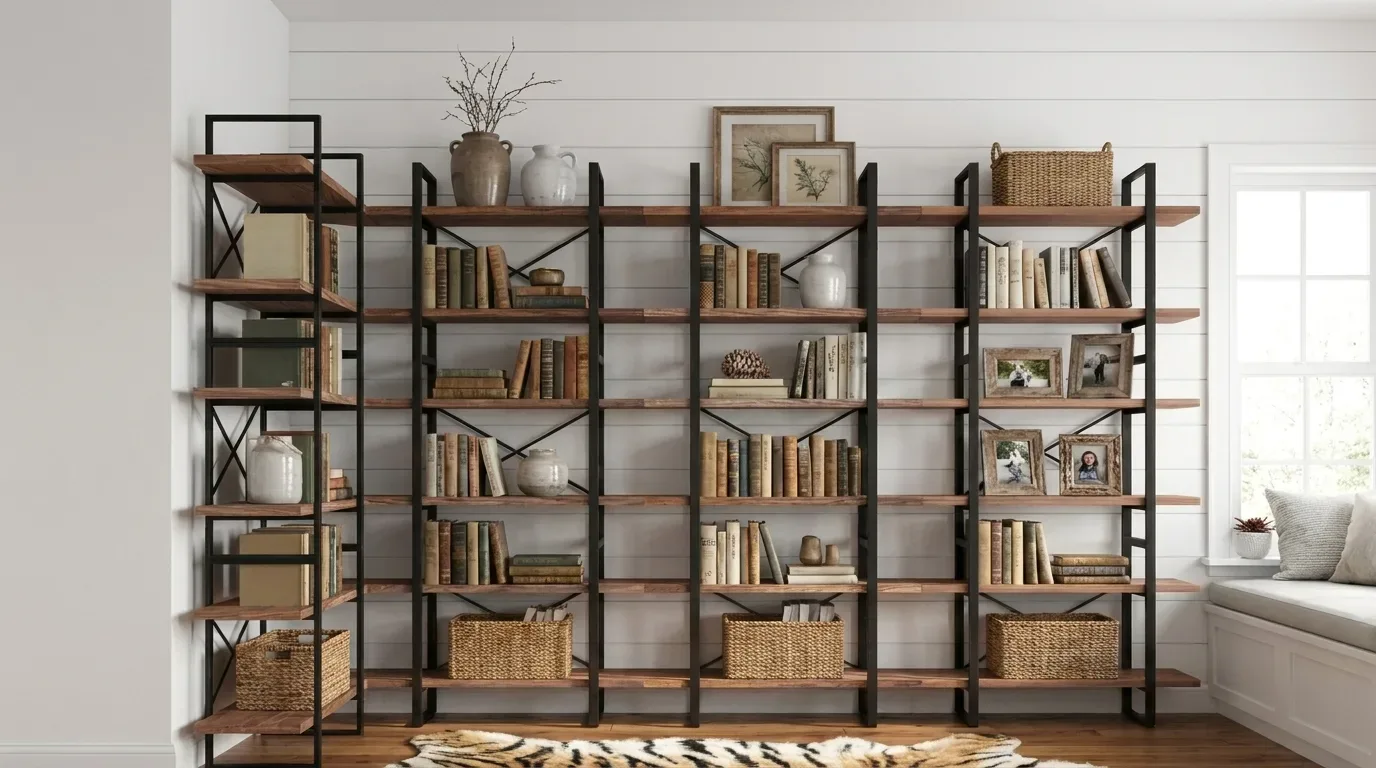
Select your wood species (oak, beech, or ash), your surface stain from the 50-plus options available, and your RAL colour for the steel frame. A useful starting point: if you have existing steel-framed pieces in the room, match the RAL exactly. If the shelf is the first piece, consider whether you want the frame to be a feature (a dark RAL 9005 against a light wall reads boldly) or to recede (RAL 9010 white against a white wall almost disappears). Key decisions at this stage:
- Wood species matched to intended load - oak for heavy use, beech or ash for lighter or more decorative purposes
- Surface finish chosen with cleaning practicality in mind as well as appearance
- RAL colour coordinated with existing joinery, doors, or other furniture
- Whether lower sections should incorporate enclosed cabinet sections for additional storage
Step 4 - Configure in the 3D Configurator
Open the Large Shelf configurator and enter your dimensions. Every change to size, wood species, stain, or frame colour updates the price in real time - there are no hidden variables that appear at checkout. You can review the configuration from multiple angles, check shelf spacing visually, and compare colour combinations before committing. Delivery costs and the production lead time are shown transparently in the basket.
Step 5 - Review Before You Order
Cross-reference every field in the configurator against your measurements and sketch. Check the delivery address carefully. Factor the production and delivery timeline into your overall project schedule - the Large Shelf is manufactured to order with a production time of 5 to 6 weeks, plus transit to the UK. All customs duties and import costs are handled by Manufaktur X, so the price you see is the price you pay.
Step 6 - Installation
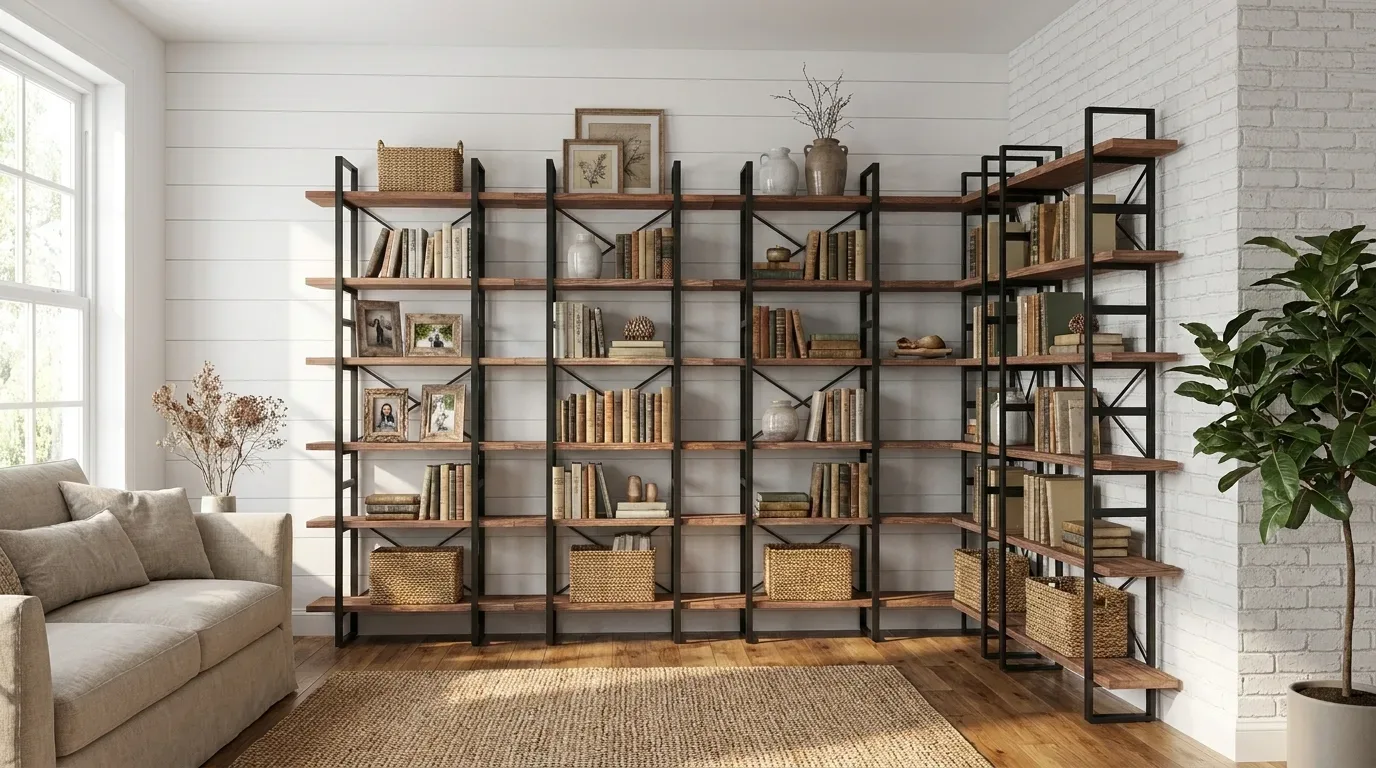
You will need a drill, spirit level, pencil, tape measure, and appropriate wall fixings for your wall type - cavity fixings for stud walls, masonry anchors for brick or blockwork (common in Victorian and Edwardian properties). On delivery, check all components against the delivery note before beginning assembly. Practical installation steps:
- Check all parts against the packing list before starting
- Use a spirit level at every stage - do not rely on the wall or floor being true
- Confirm wall fixings are rated for the intended load before tightening
- Test stability before loading any weight onto the shelves
Once assembled and fixed, check alignment, test stability, and only then begin loading the shelves. Load heavier items towards the bottom to keep the centre of gravity low.
Five Planning Mistakes Worth Avoiding
Measuring Only Once, at One Point
A single measurement taken at one point on a wall gives you one data point from a surface that is almost certainly not perfectly flat or square. In older properties particularly, walls can vary by several centimetres across their width or height. Measure multiple times, at multiple positions, and use the smallest figure as your input. A unit that arrives 20 mm too wide for the recess is a costly problem - and in the vast majority of cases, it is a measurement error rather than a production fault.
Underestimating the Load
A shelf carrying decorative objects is very different from one carrying several hundred hardback books or a collection of vinyl records. Think through what the unit will realistically hold, not just what you plan to put on it initially. Consider whether the wall fixings are appropriate for the eventual weight, not just the weight of the shelf itself.
Forgetting the Full Cost Picture
Delivery, installation time, and any wall-fixing materials are separate from the unit price. The Manufaktur X configurator shows the full price of your configuration in real time, and delivery costs are displayed in the basket - no surprises at checkout. For UK orders, customs and duties are fully covered, so there is no additional import cost to factor in.
Ignoring Future Flexibility
A shelf specified too specifically for a current use can become awkward as needs change. Where possible, build in flexibility: consider whether adjustable shelf positions would serve you better than fixed ones, and whether the lower section might usefully incorporate enclosed storage that could serve different purposes over time.
Treating the Shelf as a Separate Design Decision
The most successful interiors treat furniture as a system, not a collection of individual purchases. Coordinating your RAL frame colour with existing loft doors, room dividers, or other steel-framed pieces - and matching wood species and finish across pieces - produces a result that reads as deliberate. A shelf that is beautifully made but visually disconnected from everything around it is a missed opportunity.
The 3D Configurator: Real-Time Pricing, No Surprises
Every change you make in the configurator - dimensions, wood species, stain, or frame colour - updates the price immediately. What you see at the point of configuration is what you pay; there are no options that reveal a hidden cost at checkout. Delivery costs are shown in the basket, and for UK customers, all customs and import duties are included in the price shown.
If your room presents a configuration challenge that falls outside the standard configurator options - an angled ceiling in a loft conversion, a recess with a non-rectangular profile, or a very unusually proportioned alcove - the sketch service allows you to upload a drawing or photograph of the space. Manufaktur X will review the feasibility and come back with a bespoke quotation.
Care and Longevity
Looking After Solid Hardwood
Oak, beech, and ash are robust species chosen in part for their durability in everyday use. For routine cleaning, a lightly dampened cloth is sufficient. Oiled surfaces benefit from a periodic re-oiling - once or twice a year depending on use - to keep the wood from drying out. Avoid prolonged exposure to direct sunlight through windows, which can cause uneven fading, and try to maintain reasonably consistent humidity levels: solid hardwood responds to the ambient moisture in a room, and a very dry centrally heated environment can cause minor movement over time. That natural movement is not a defect - it is a property of the material - and the patina that develops with age adds rather than detracts from the character of the piece.
Looking After the Powder-Coated Steel Frame
The powder-coated finish is resistant to scratching and to common household solvents. Routine cleaning requires nothing more than a dry or slightly damp cloth. Avoid abrasive cleaning products or scouring pads, which can abrade the coating surface. The finish is not affected by normal cleaning products used elsewhere in a room.
Frequently Asked Questions
What does the Large Shelf from Manufaktur X cost?
Pricing depends on the dimensions, wood species, stain, and configuration you choose. The 3D configurator shows a live price in pounds sterling for your exact specification - updated in real time as you make changes. Delivery costs are shown transparently in the basket, and all UK customs and import duties are included. There are no additional charges on delivery.
Is the shelving genuinely solid hardwood, or is it veneered?
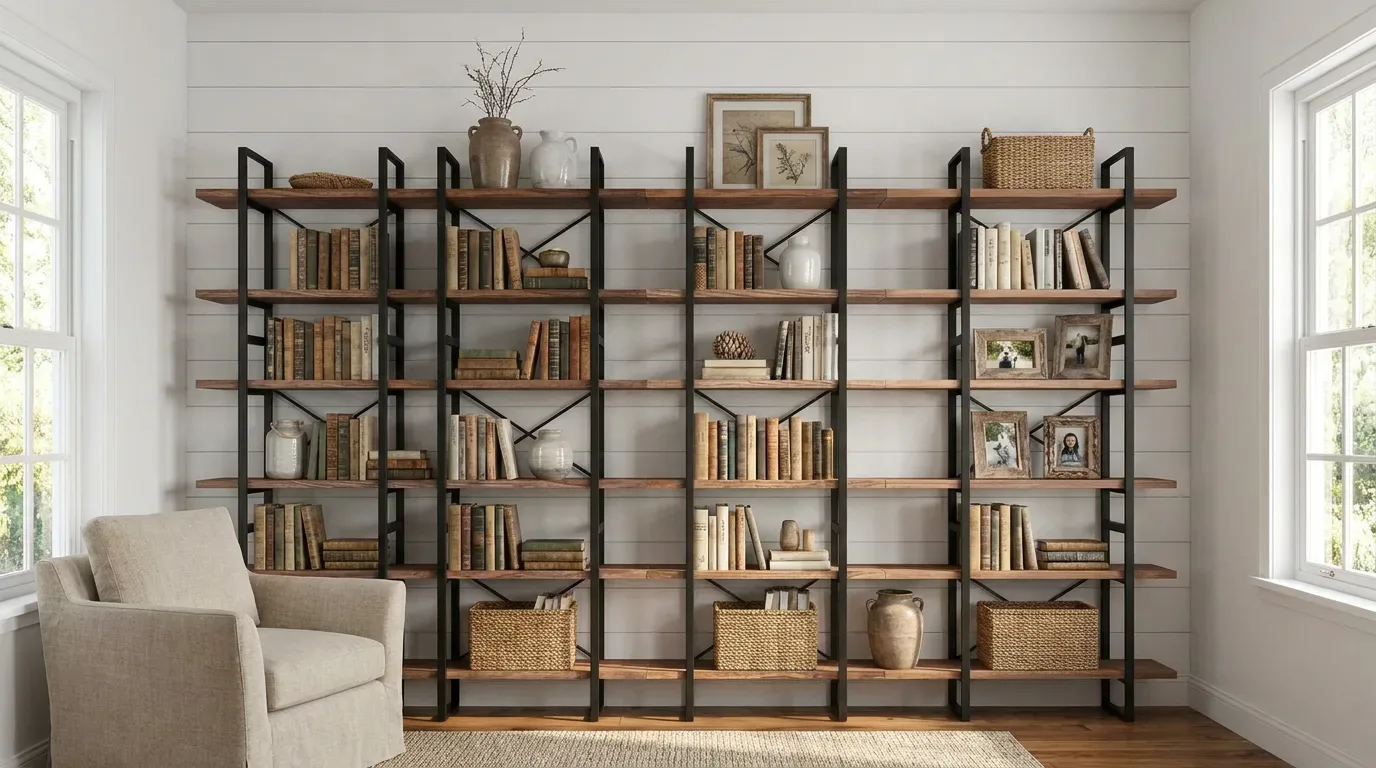
The shelves in the Large Shelf are solid hardwood throughout - oak, beech, or ash, with no veneered or particleboard core. This is what gives the shelves their load-bearing properties and their longevity. Veneer options are not available for this product.
Can the Large Shelf be used as a room divider in an open-plan space?
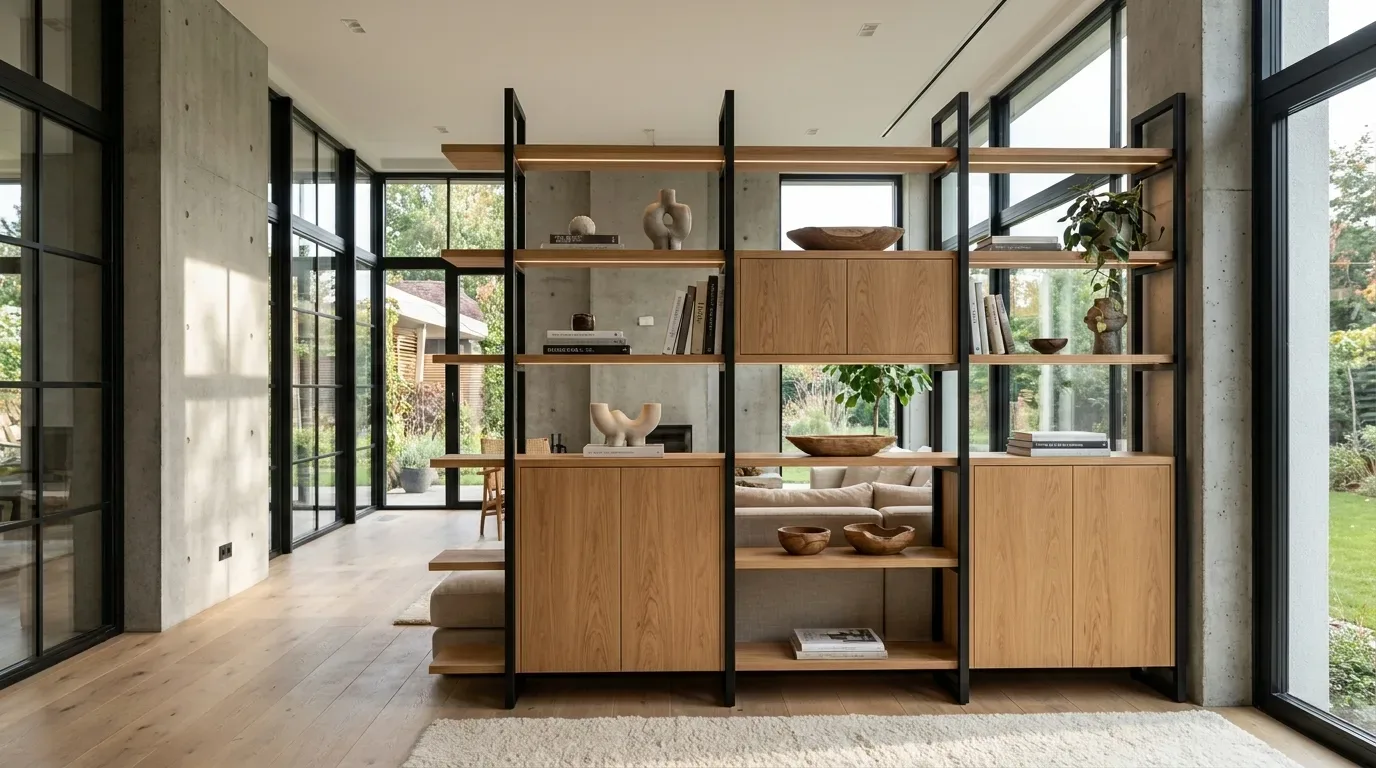
Yes. Because the Large Shelf is freestanding and available without a back panel, it can divide an open-plan room into distinct zones without completely closing off the space. This works particularly well in open-plan kitchen-dining rooms or combined living-working areas where a visual separation is useful but a solid partition wall would be impractical or intrusive.
What is the difference between the Large Shelf and the Pipe Shelf?
The Large Shelf has a welded box-section steel frame and can stand freely or sit flush against a wall - it also works as a room divider. The Pipe Shelf must be fixed to the wall and features a visible pipe-work frame aesthetic. Both are available in oak, beech, or ash, and both can be specified in any standard RAL colour. The choice usually comes down to installation preference and the visual character you want in the room.
How do I measure correctly to make sure the unit fits?
Measure width, height, and depth at multiple points - width at the top, middle, and bottom of the opening; height at a minimum of two horizontal positions. Use the smallest measurement in each direction as your input value. The unit is manufactured to precisely the dimensions you enter in the configurator. In older British properties, walls are rarely perfectly square or plumb, so this multi-point approach is particularly important.
How long does production take, and what about delivery to the UK?
Production takes 5 to 6 weeks from the point your order is confirmed. Delivery to UK addresses follows production. All customs duties and import costs are handled by Manufaktur X - the price shown at checkout is the final price, with no additional charges on arrival.
Does the Large Shelf include glass?
No. The Large Shelf is a steel frame and solid hardwood product only - there is no glass in this range. Glass is used in the loft door and room divider product lines.
What if my room has an unusual shape that does not fit the standard configurator?
The sketch service on manufakturx.co.uk allows you to upload a drawing, sketch, or photograph of your space. Manufaktur X will assess the feasibility and provide a bespoke quotation for configurations that fall outside the standard options - angled ceilings in loft conversions, non-rectangular alcoves, and similar situations are all handled on a case-by-case basis.