Standard furniture sizes were designed for new-builds with perfectly square rooms, plumb walls, and uniform ceiling heights. If you live in a Victorian terrace, an Edwardian semi, a period conversion, or a 1930s semi-detached, you already know those assumptions rarely hold. Alcoves run at odd angles. Chimney breasts eat into usable wall space. Doorways in older properties can measure anything from 680 mm to well over 1,300 mm wide. Custom-made furniture solves these problems because it adapts to your home - not the other way around.
Why Custom Furniture Is a Practical Decision, Not Just a Luxury One
A significant proportion of the UK's housing stock dates from before the 1970s. Victorian and Edwardian properties alone account for millions of homes, and period conversions - former warehouses, factories, and commercial buildings turned into flats - add further variety to the mix. These buildings were not built to any modern furniture standard. Ceilings vary in height between floors, and sometimes within a single room. Walls are rarely perfectly vertical. Alcoves beside chimney breasts are almost never symmetrical.
Off-the-shelf furniture from retailers like IKEA or John Lewis is designed around a set of assumed dimensions that suit new-build layouts. That works well in a 2010s flat with 2.4 m ceilings, straight walls, and no period features. It works considerably less well when your sitting room ceiling runs to 3.1 m, your hallway doorway is 1,350 mm wide, or your loft conversion has a sloped ceiling that starts at 1.6 m on one side. In those situations, custom-made furniture is not an indulgence - it is the only approach that actually fits.
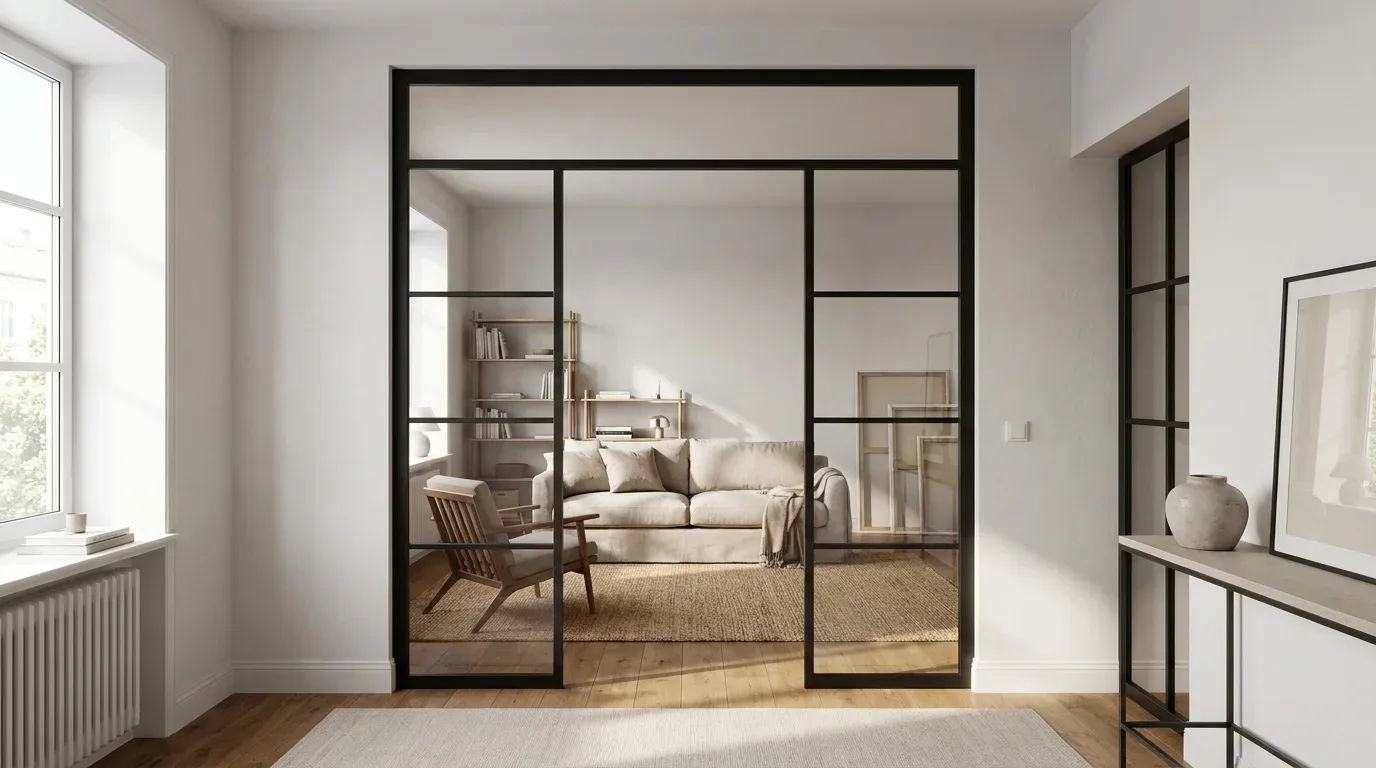
„Maßgefertigte Einbauten sind kein Luxus, sondern in vielen Altbauten die einzig funktionale Lösung. Standardmaße wurden für Neubauten mit rechten Winkeln entwickelt - nicht für gewachsene Gebäudestrukturen."
Bauwelt, Ausgabe 12/2022
Many brands market their products as "customisable" or "made to order" - but what they usually mean is a choice from a fixed grid of sizes, with perhaps a handful of finish options. If the grid stops at 2,200 mm wide and your alcove measures 2,370 mm, you are back to square one. Genuine made-to-measure production, as practised by Manufaktur X, means every dimension - width, depth, height - is set to the millimetre based on your actual space.
What Sets Custom Furniture Apart from Standard Retail
Handcrafted furniture is built around your architecture, not a catalogue photograph. A shelf closes flush with your wall. A dining table is the exact height that works with your chairs. A bench is the precise length that fits the bay window recess without a gap. Nothing is trimmed, shimmed, or left floating in space because the nearest standard size was 40 mm short.
Material control matters just as much as dimensional accuracy. With custom furniture you choose the timber species, the stain, the surface finish, the steel colour, and the handle style. Solid wood, powder-coated steel, and safety glass are not marketing language - they are the reason a well-made piece lasts twenty years rather than eight. At Manufaktur X, loft doors come with three handle options: Elongated, Subtle, and Half-Moon.
| Criterion | Standard retail furniture | Custom-made furniture |
|---|---|---|
| Fit | Approximate - compromises often needed | Exact match to your space |
| Design freedom | Limited to manufacturer's options | Every detail chosen by you |
| Materials | Often MDF, chipboard, or mixed wood | Solid hardwood, steel, safety glass |
| Expected lifespan | Typically 5-10 years | 20 years or more |
| Long-term value | Low - difficult to restore | High - can be refinished and repaired |
| Suitable spaces | Square rooms with standard dimensions | Period properties, conversions, any geometry |
The Manufaktur X Product Range: Steel, Glass and Solid Wood
Manufaktur X produces custom furniture in steel, glass, and solid wood - with different material combinations depending on the product. The range divides clearly into two groups:
Steel and glass products (where glass is a key design element):
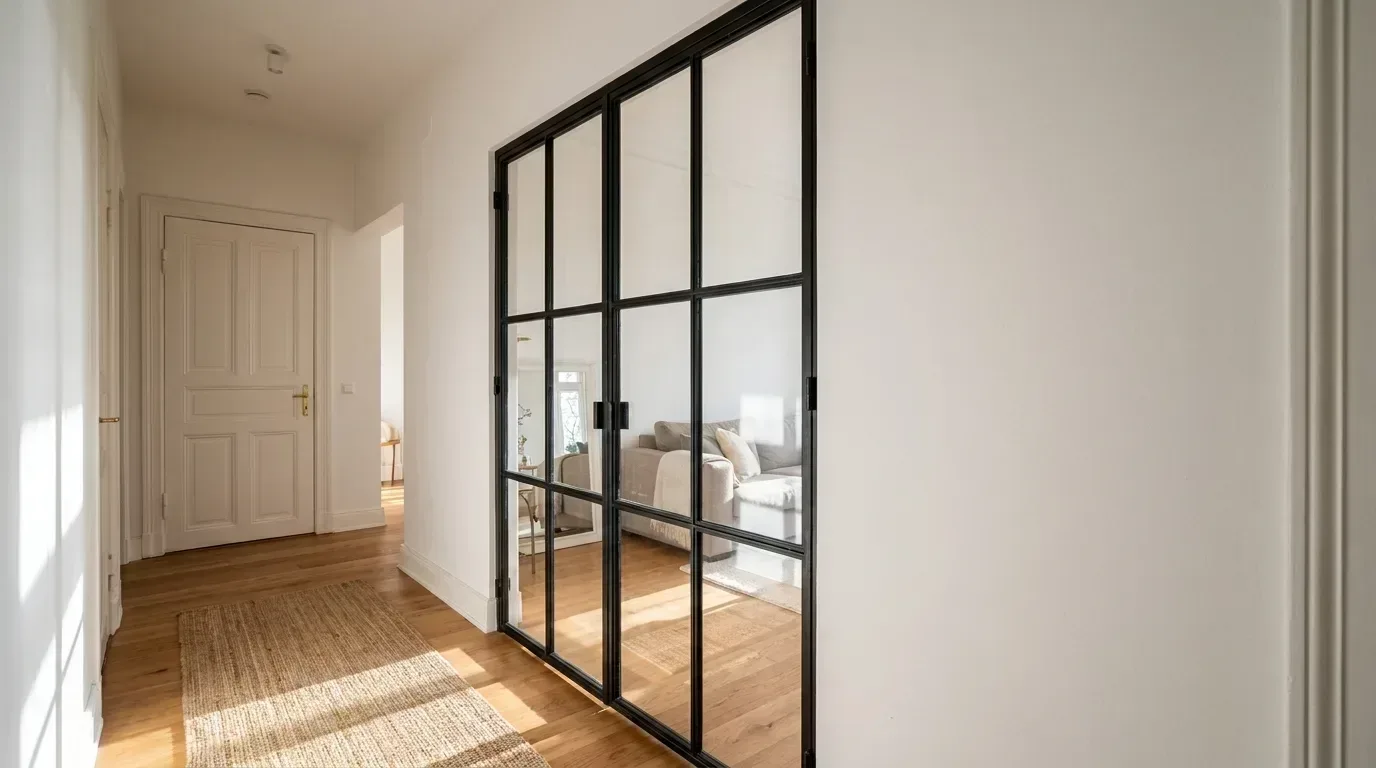
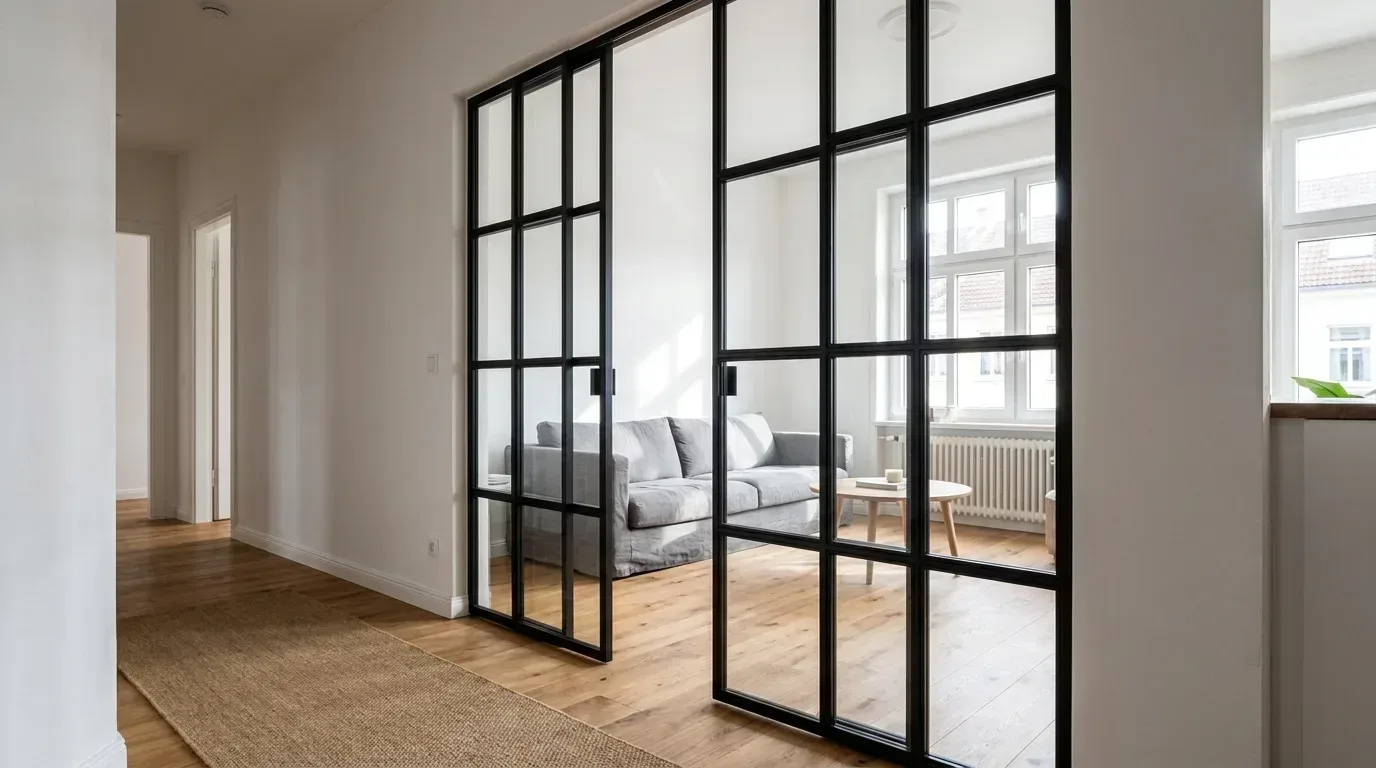
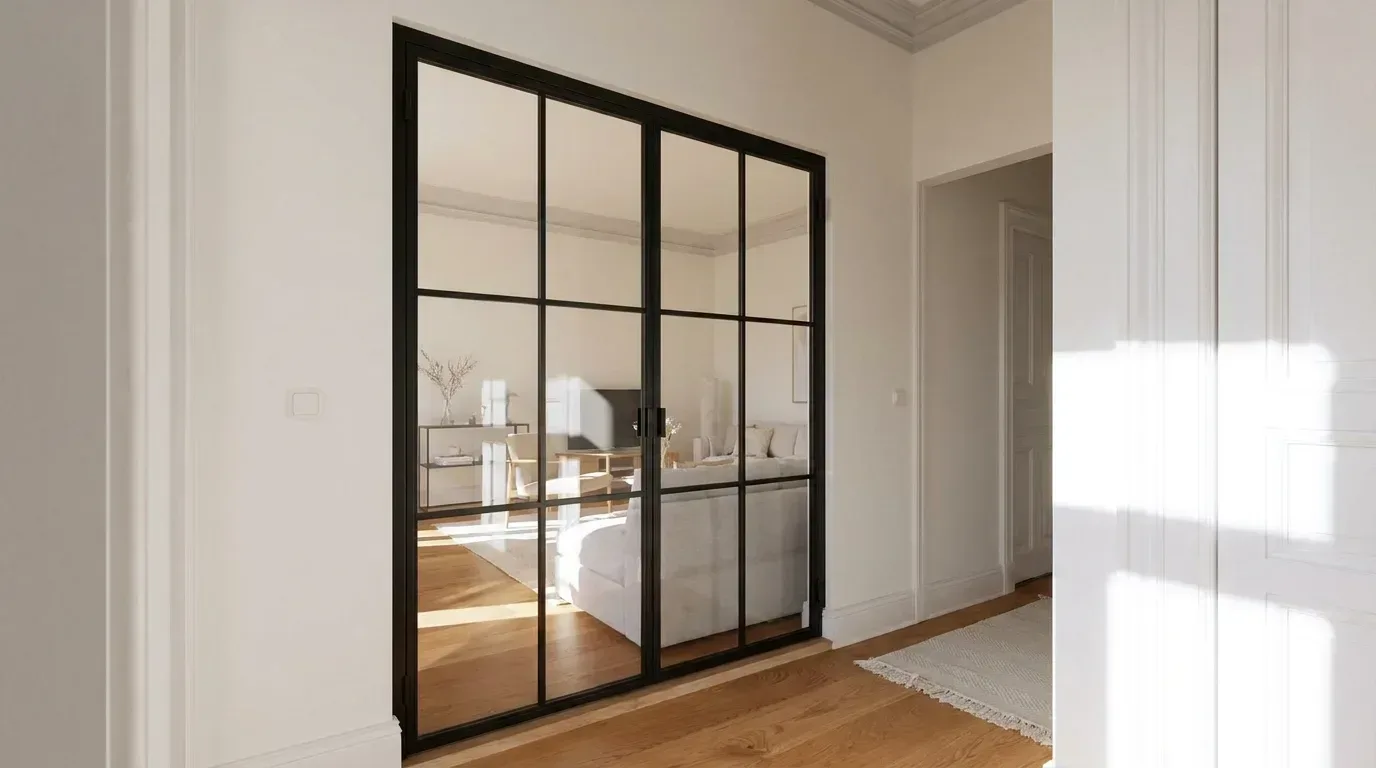
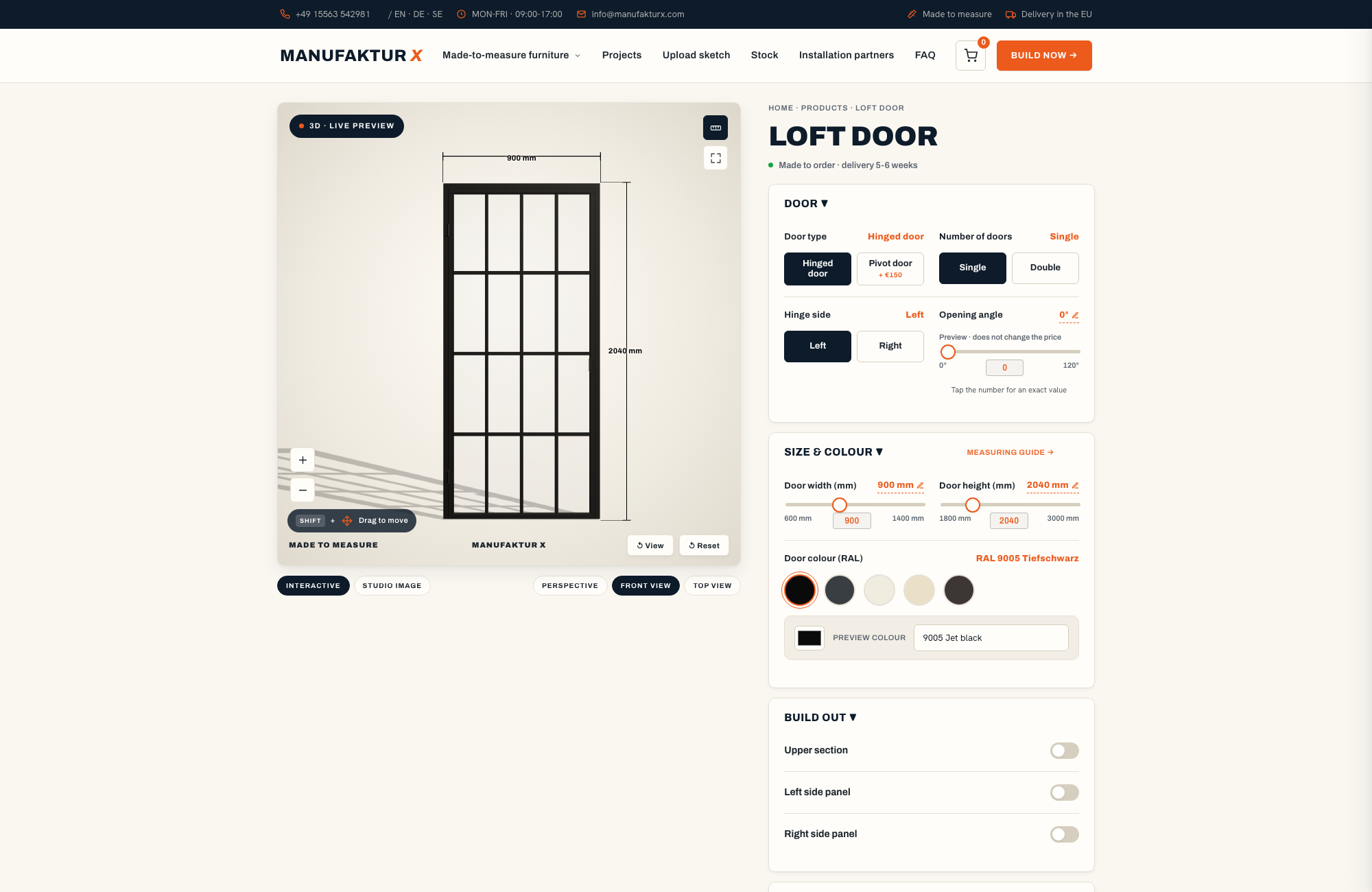
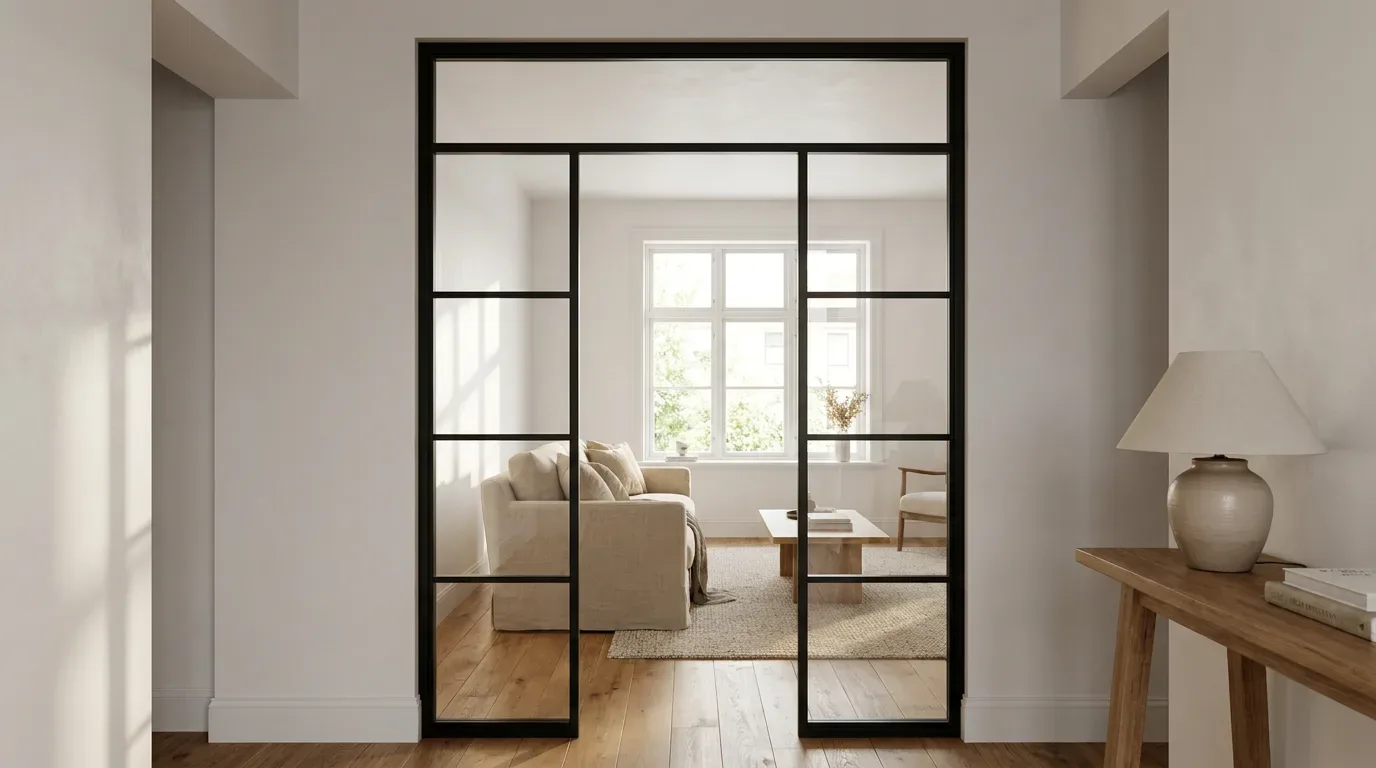
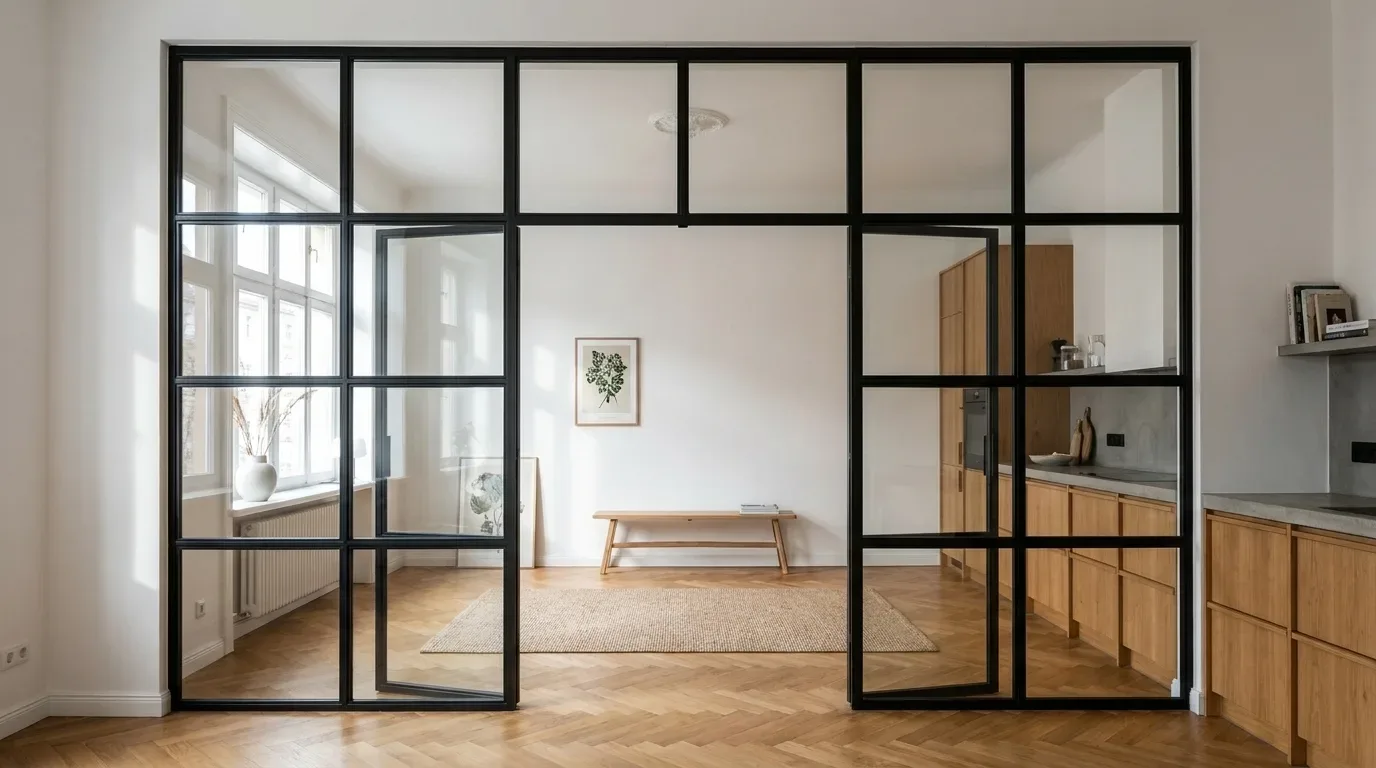
- Loft door: A fully functioning door with a frame, hinge side (left or right), opening direction, opening angle, handle, and hinges. It connects two spaces without completely blocking light or sightlines between them.
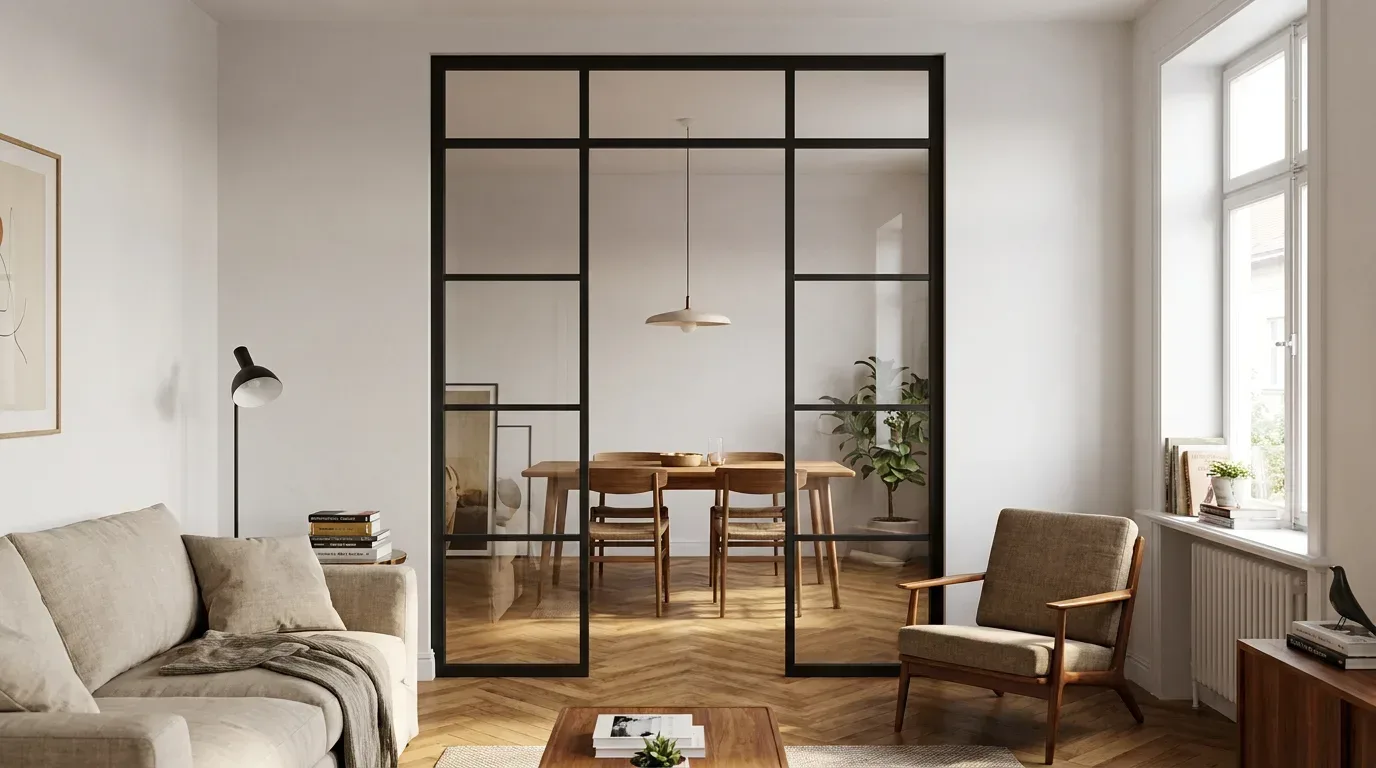
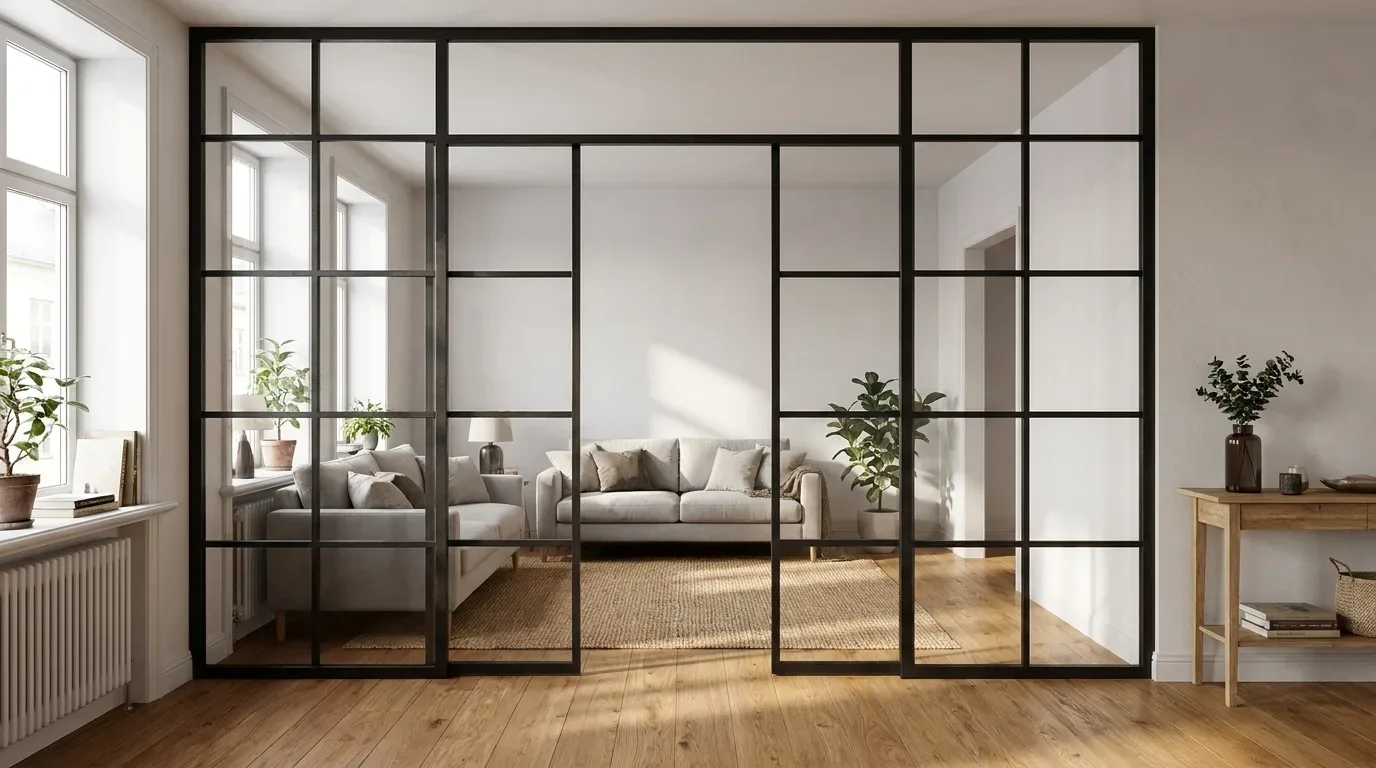
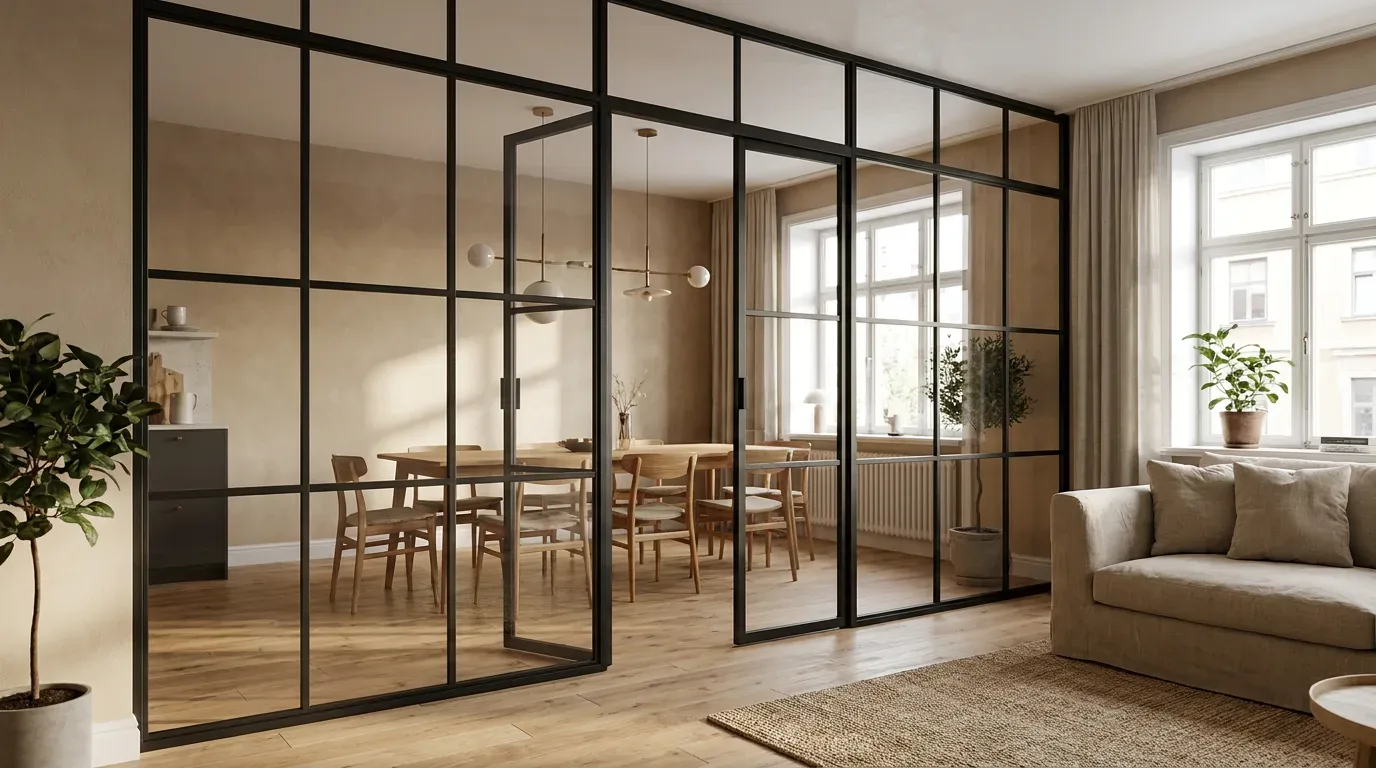
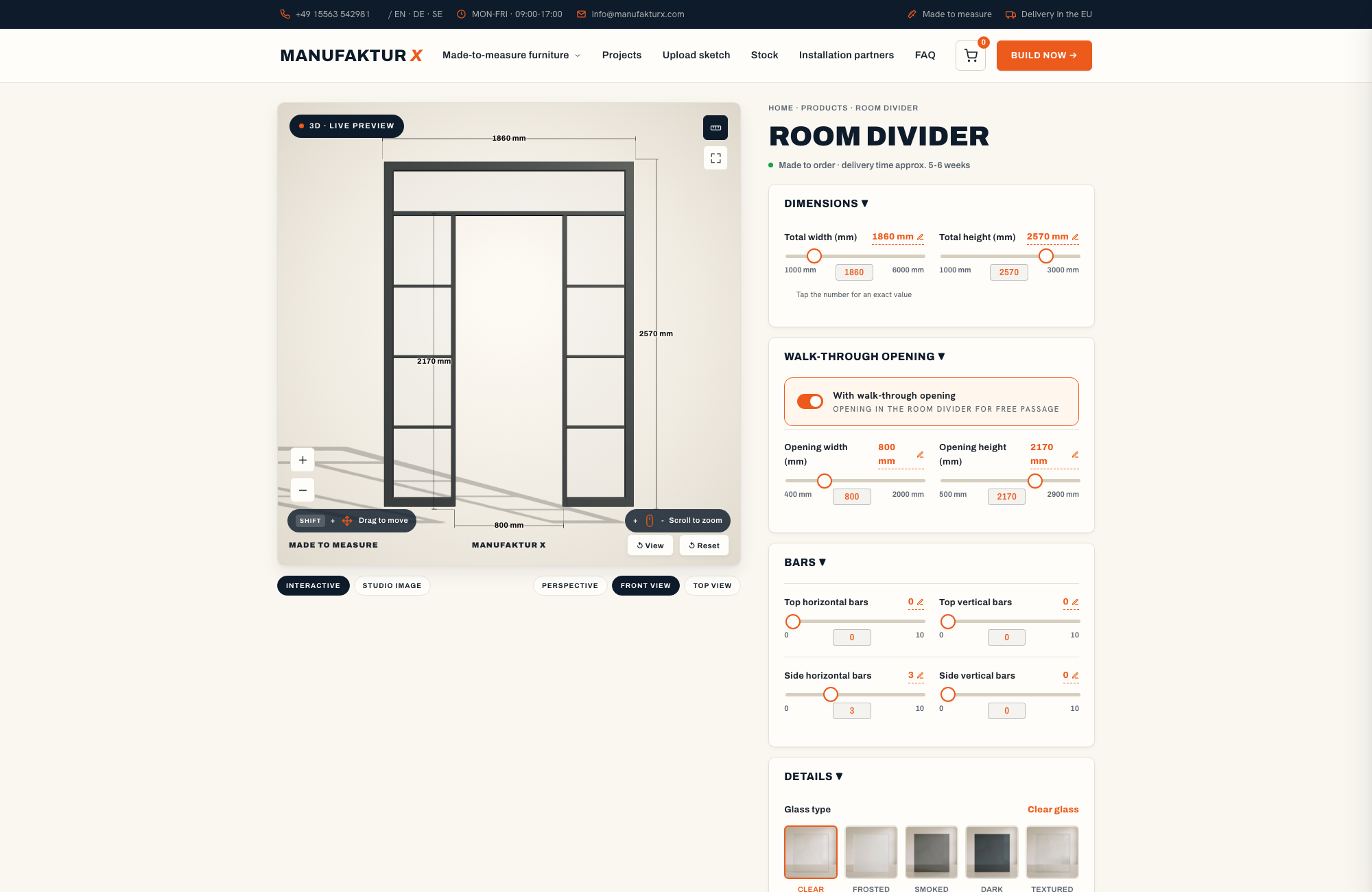
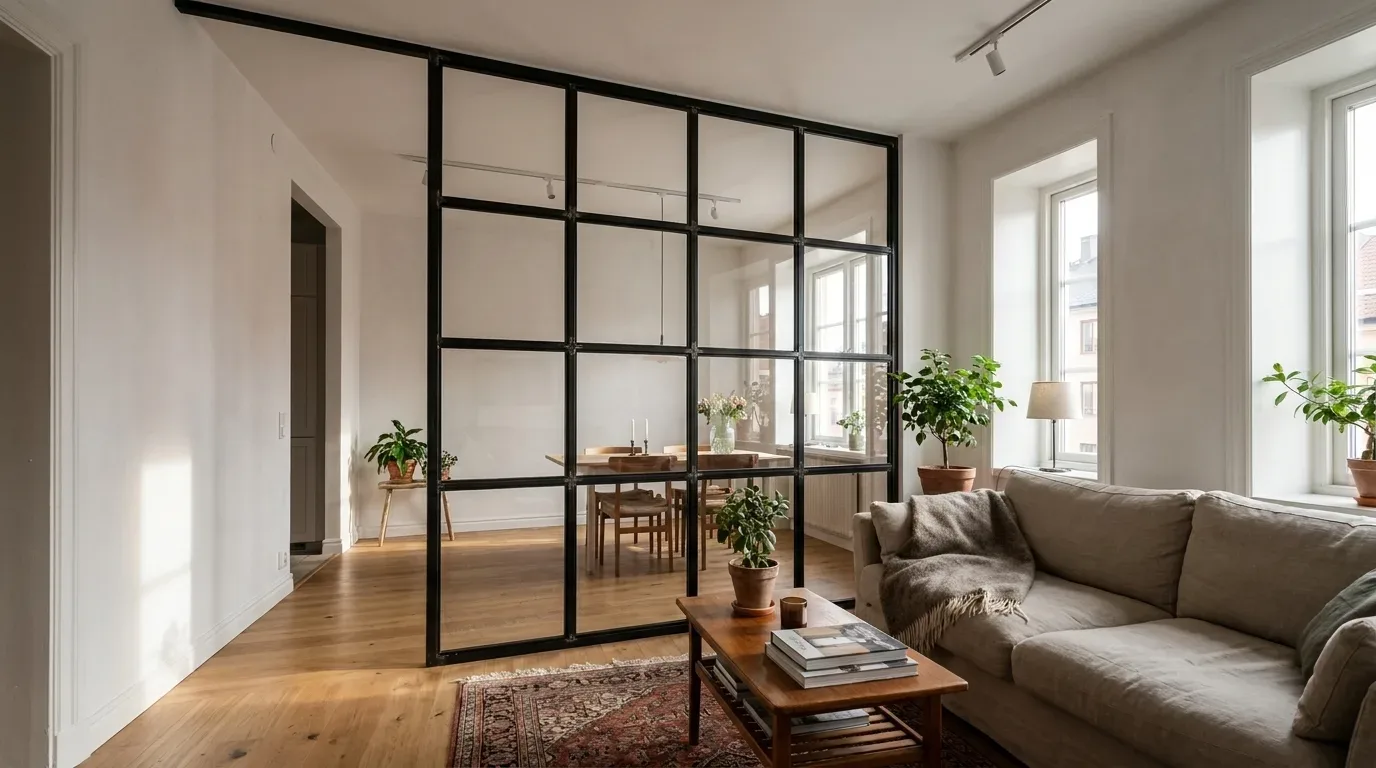
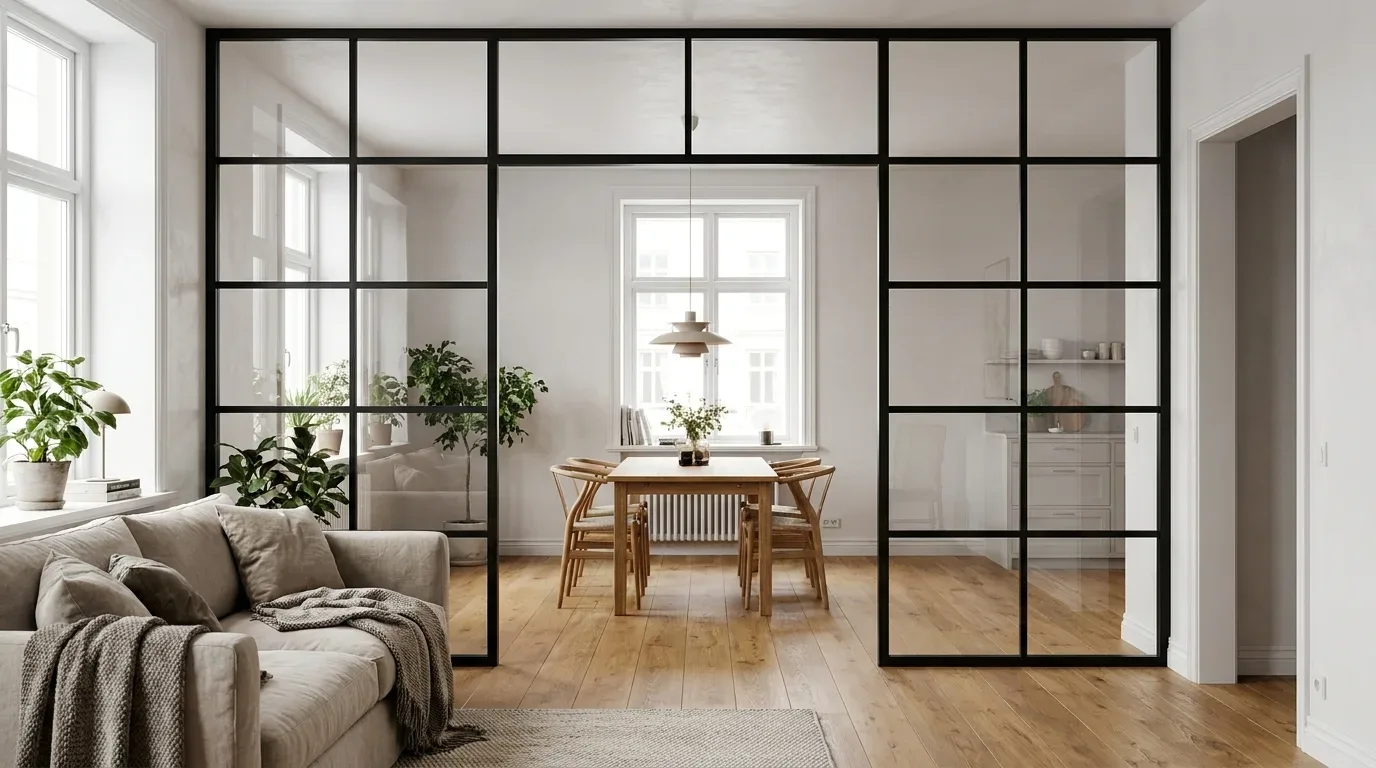
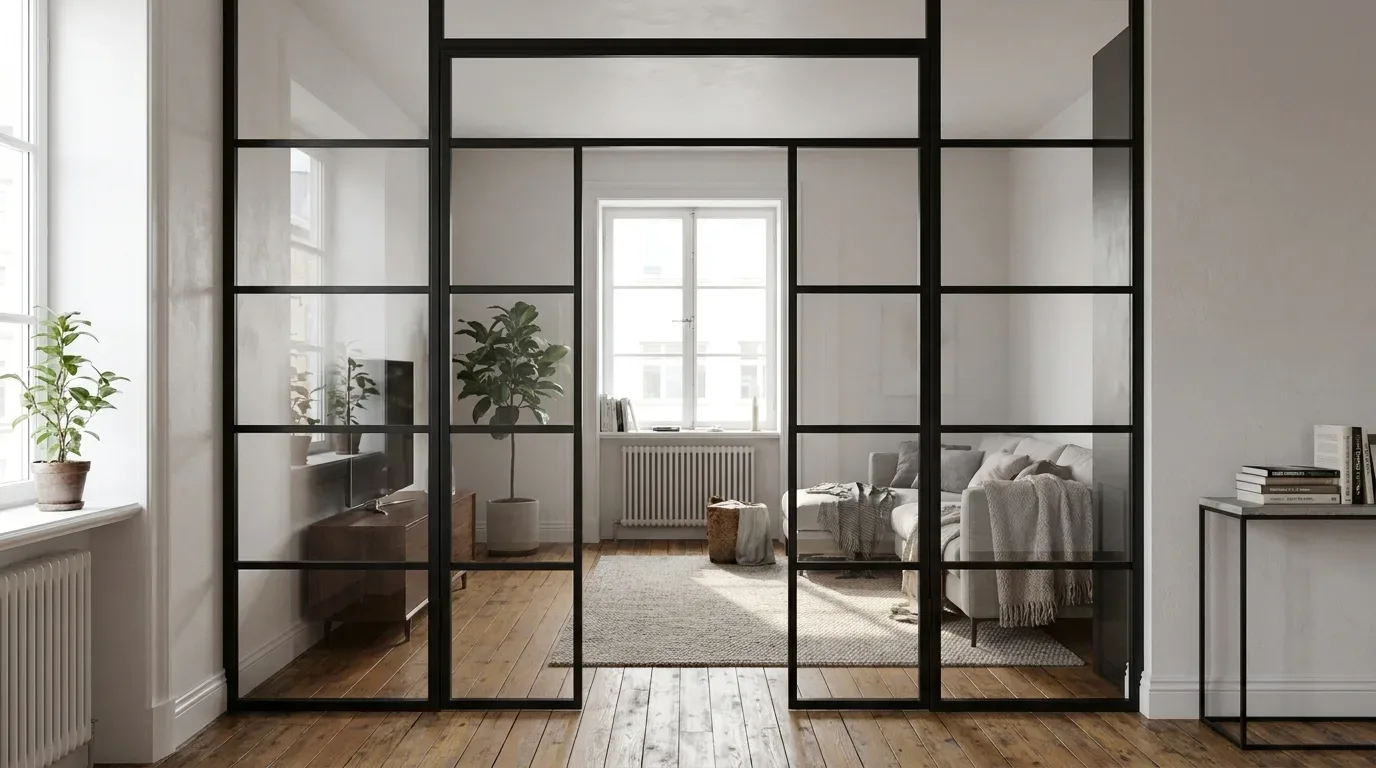
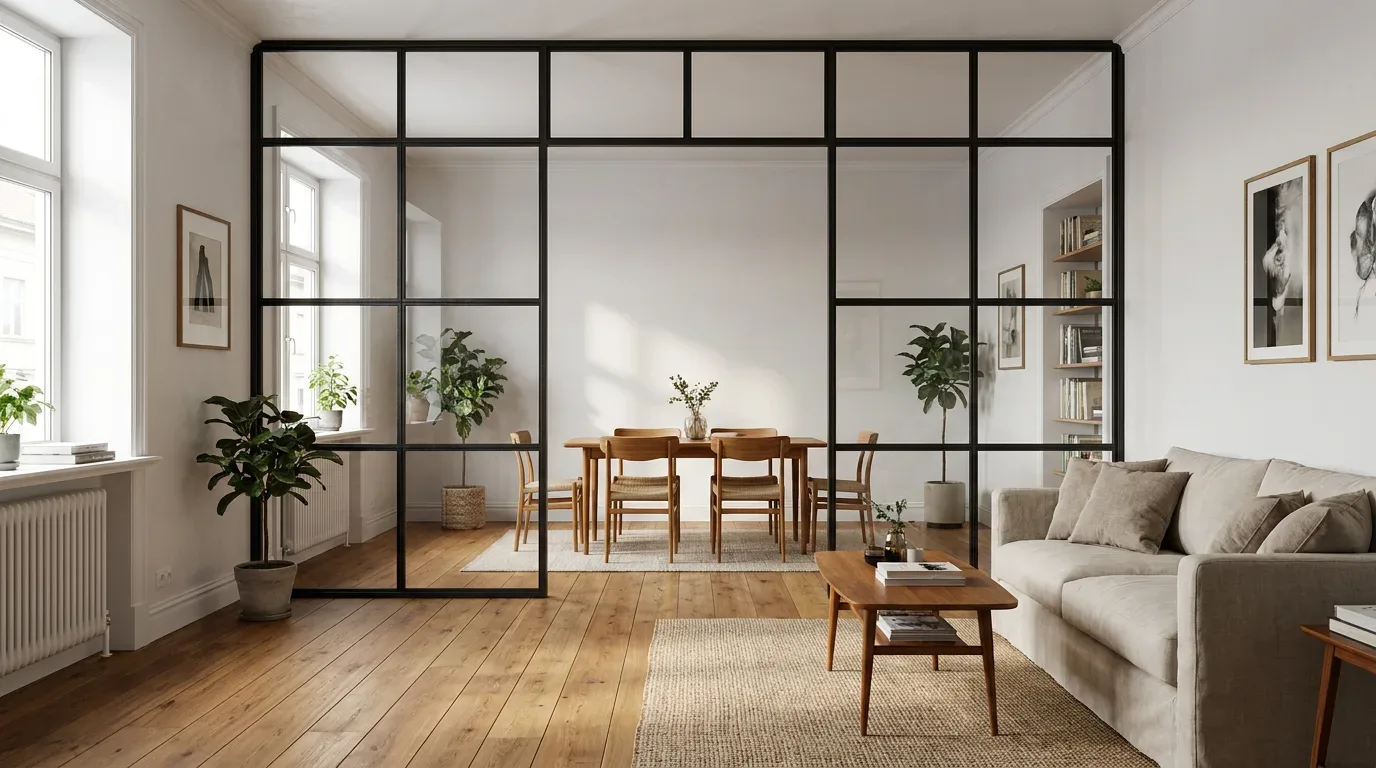
- Room divider: A fixed steel and glass partition wall - no door, no handle, no hinges, no frame rebate. Can optionally include a walk-through opening (a gap without a door). Suited to open-plan spaces that benefit from some structure without a full wall.
Solid wood and steel products (no glass):
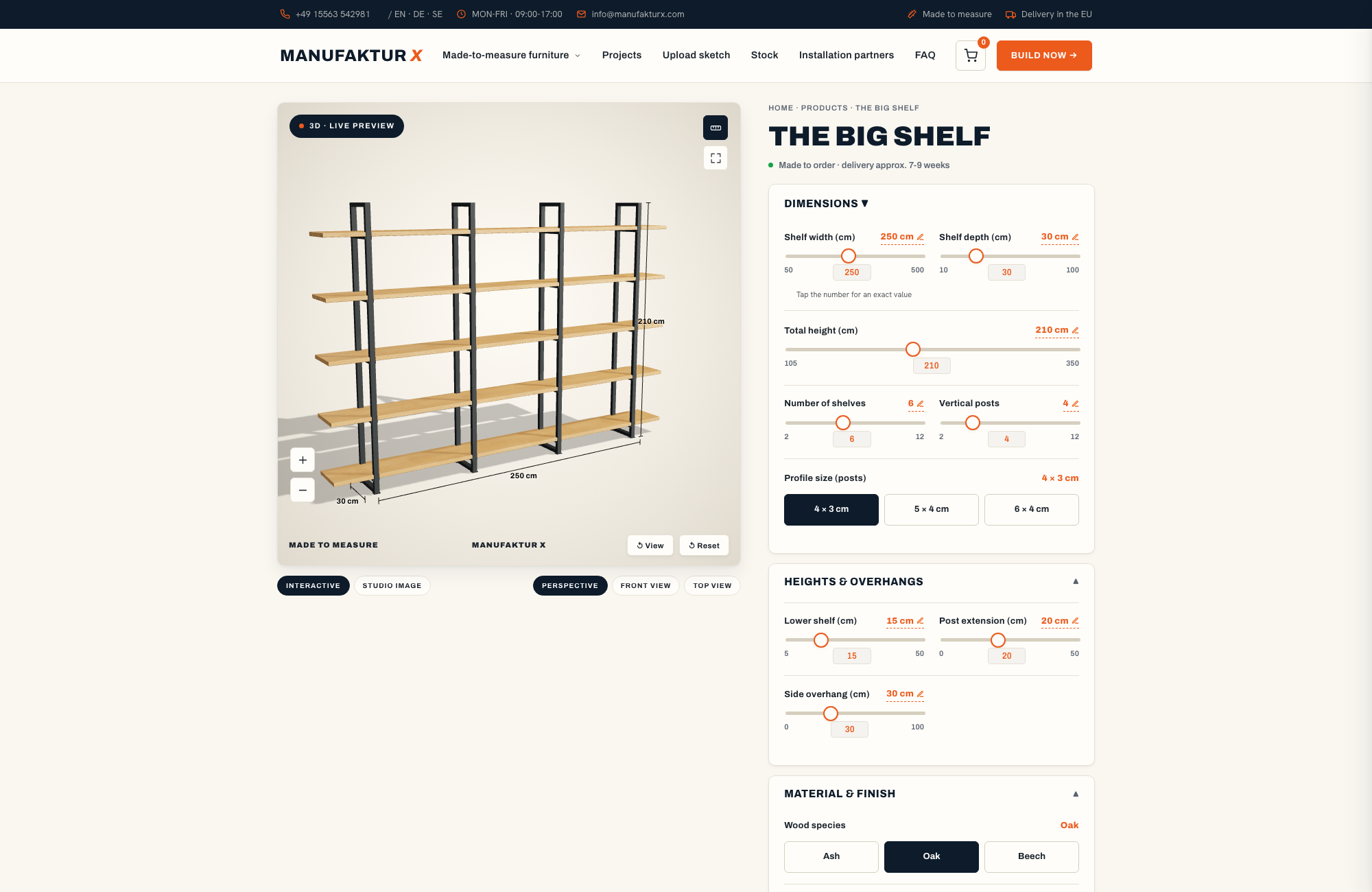
- Large shelf unit: Steel frame with solid wood shelves, optionally with integrated wooden cupboards in the lower section.
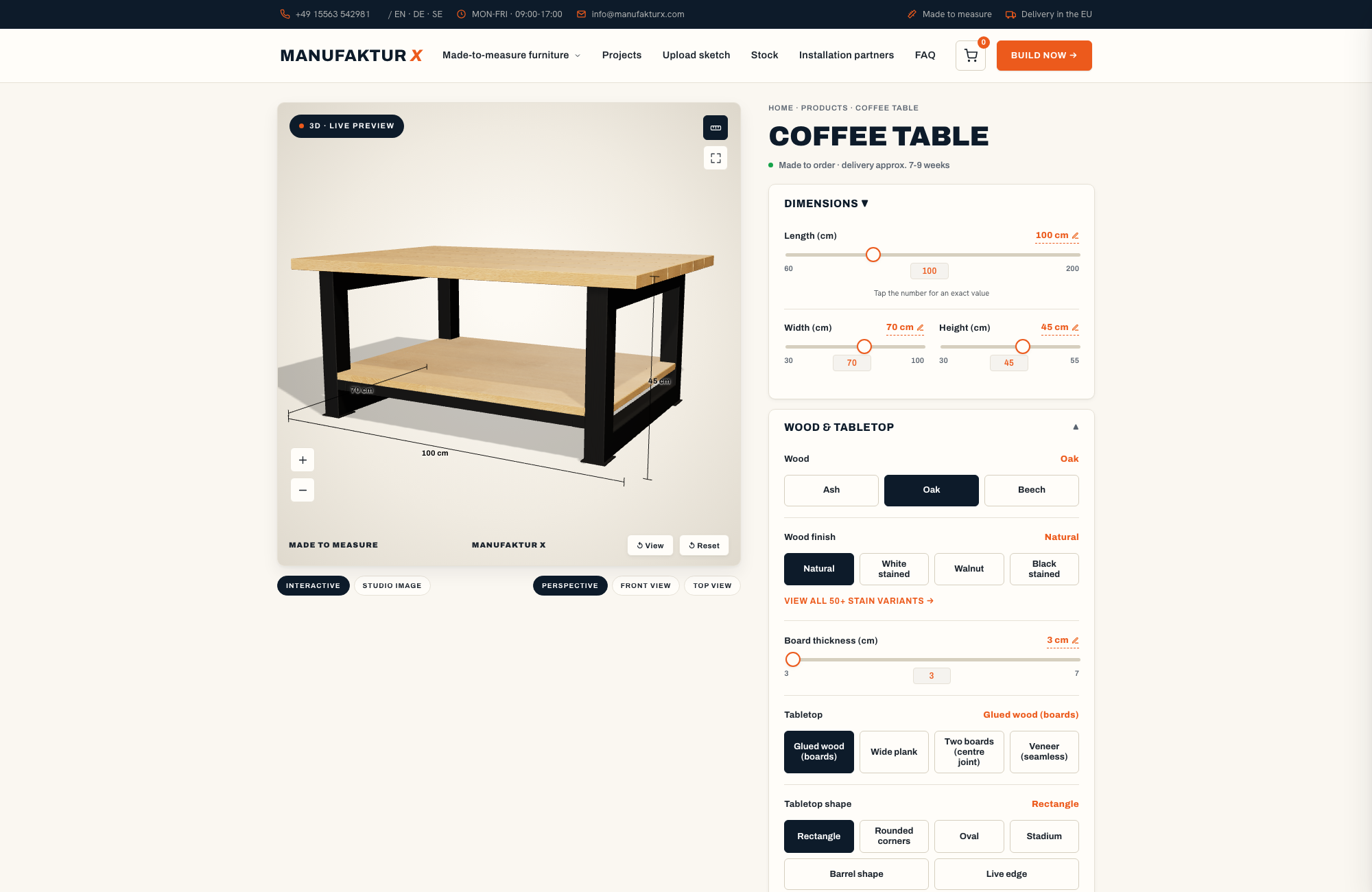
- Dining table and coffee table: Wood top on a steel base, available as solid glued boards or veneer top.
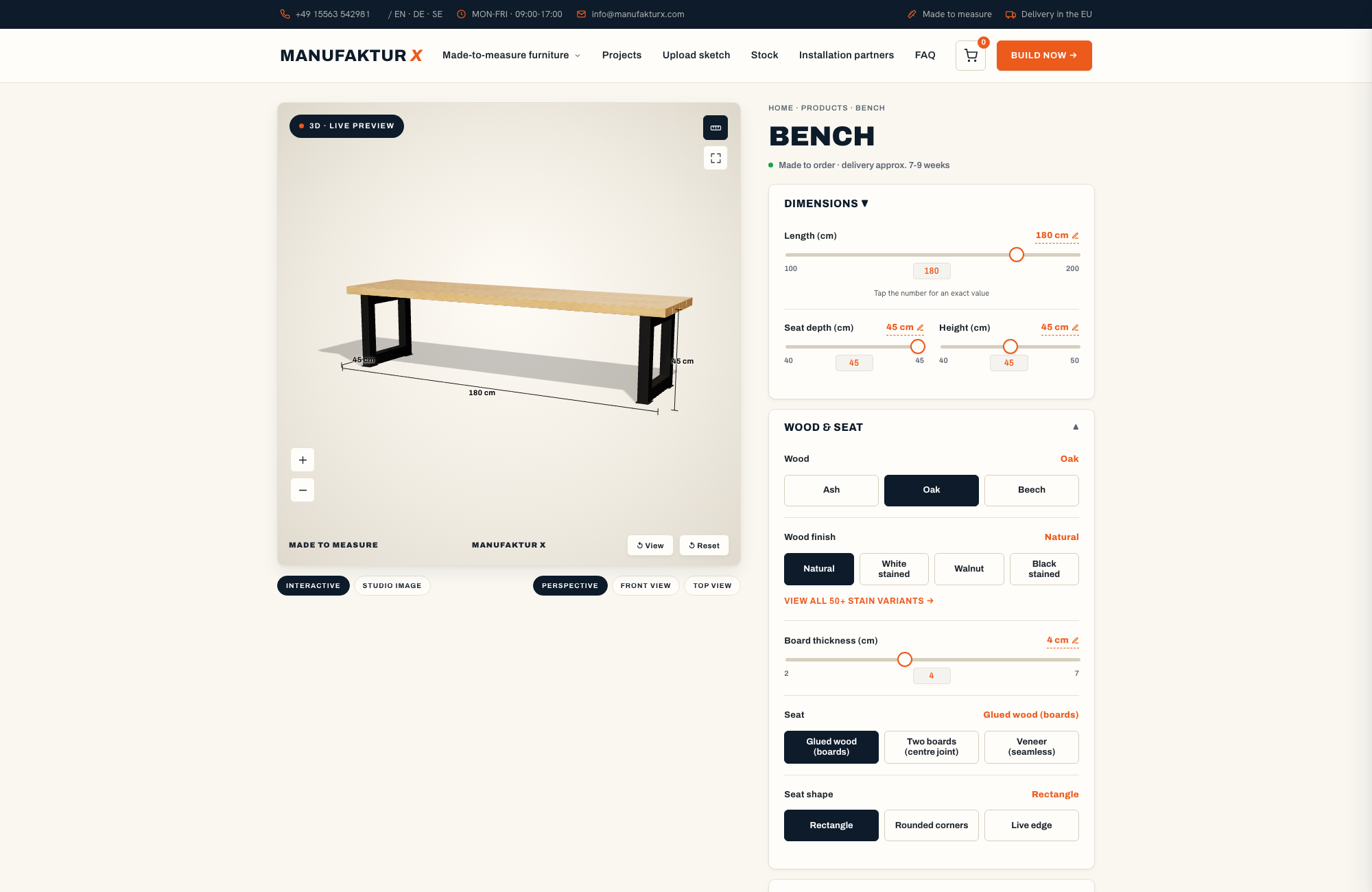
- Bench: Solid wood or veneer top with a steel base - space-efficient and built to last.
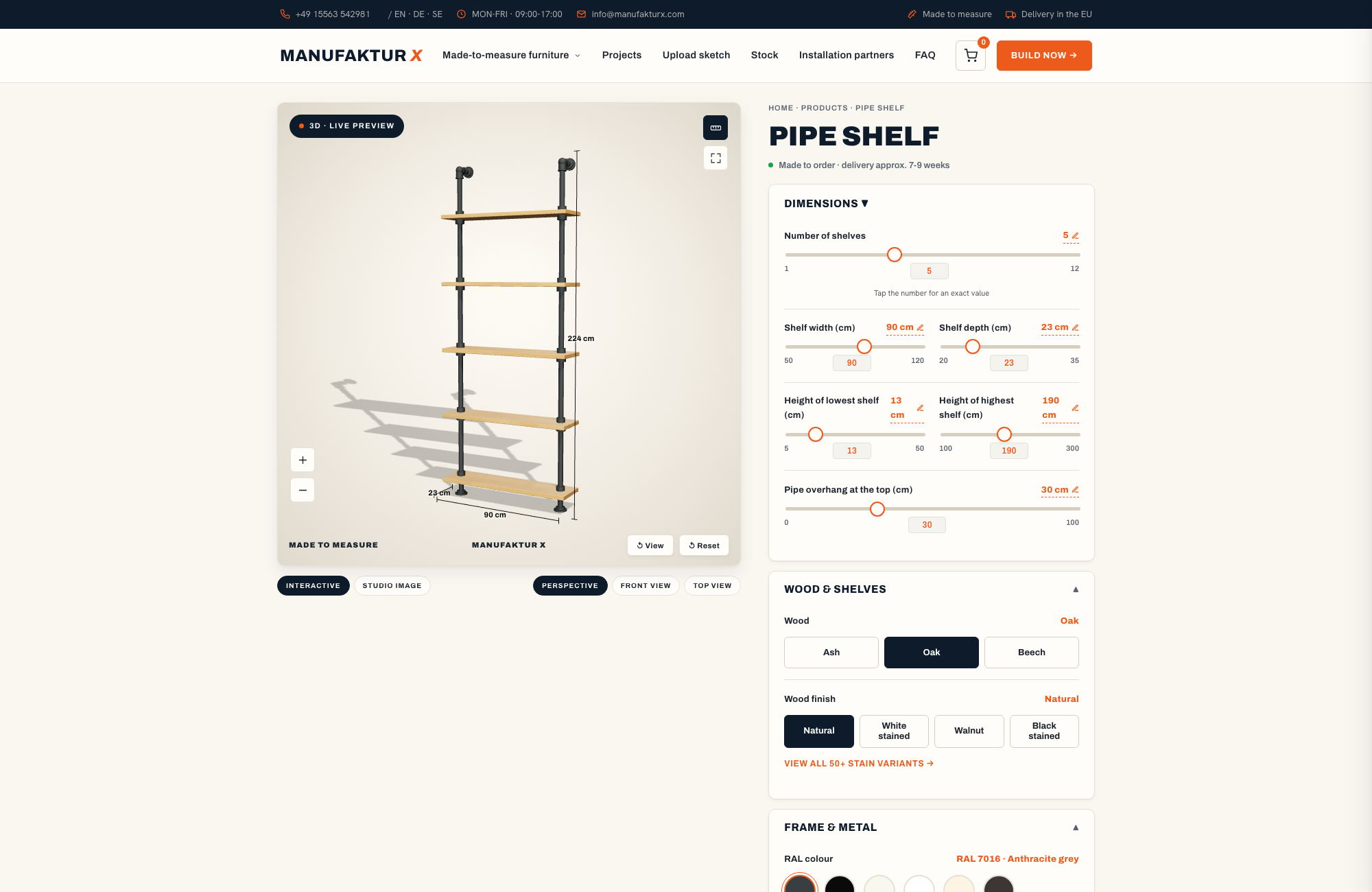
- Pipe shelf: Steel pipe construction with solid wood shelves - an industrial aesthetic that works particularly well in period conversions and loft spaces.
Loft doors start from a price shown live in the configurator - that is the entry price for the most straightforward configuration. For a full current overview of pricing across all products:
| Product | Default configuration price | Note |
|---|---|---|
| Loft Door | £1,413 | Steel and glass, default configuration 900 × 2,040 mm |
| Room Divider | £1,902 | Steel + laminated glass, custom width |
| Large Shelf | £2,752 | Solid wood, steel frame, floor-to-ceiling |
| Dining Table | £2,038 | Solid wood, steel frame |
| Coffee Table | £1,548 | Solid wood, steel frame |
| Bench | £946 | Solid wood, steel frame |
| TV Stand | £1,324 | Solid wood, steel frame |
| Bedside Table | £856 | Solid wood, steel frame |
| Hallway Wardrobe | £1,608 | Solid wood, steel frame |
| Display Cabinet | £2,533 | Solid wood, steel frame |
| Pipe Shelf | £916 | Modular pipe shelf |
| Desk | £1,561 | Solid wood, steel frame |
| Chest of Drawers | £4,334 | Solid wood, steel frame |
Timber and Materials: Which Works Best Where?
Manufaktur X works exclusively with three hardwood species: oak, beech, and ash. The selection is deliberately narrow - all three are among the hardest and most durable timbers available, which means no compromise on load-bearing capacity or longevity. Softwoods like pine are not used.
Oak, Beech and Ash - a Practical Comparison
For surfaces that take daily wear, wood hardness is the most meaningful measurable factor. Each species has its own character:
- Oak: Janka hardness approximately 5.9 kN, Brinell hardness 3.8. The open grain gives it a warm, characterful appearance that ages particularly well in period interiors. Excellent for dining tables, benches, and coffee tables. Surface dents can be disguised with re-oiling rather than requiring replacement.
- Ash: Janka hardness approximately 6.1 kN, Brinell hardness around 4.0. Slightly harder than oak, visually lighter in tone, and generally more affordable at raw material stage. A strong choice for large shelf units where load-bearing matters and a lighter visual weight suits the space.
- Beech: Janka hardness approximately 6.3 kN, Brinell hardness 3.2. Pale and even-grained. Under heavy daily use it shows wear a little sooner than oak, so it is less suited to work surfaces with sustained abrasion - but it is excellent for pieces where a clean, consistent appearance is the priority.
All three species can be compared directly in the 3D configurator, with the price updating in real time as you switch between them. Over 50 stains are available, giving you precise control over the final colour.
A word on solid wood movement. In our experience, the most common reason a custom piece does not fit as expected after delivery is not a production fault - it is either a measurement error or a failure to account for natural wood movement. Solid wood responds to seasonal humidity changes: central heating in winter reduces moisture in the air, summer brings it back. Across the grain, a table top wider than 1,000 mm should be planned with a dimensional tolerance of ±3 mm. This is not a defect - it is the behaviour of genuine solid timber. A well-made oak table will develop a patina over the years that chipboard never can, because chipboard deteriorates before that process begins.
Steel Frames: Powder Coating in Any RAL Colour
Every steel frame and structure from Manufaktur X receives a RAL powder coating applied at a layer thickness of 60-80 µm. Powder coating outperforms wet paint in scratch resistance and chemical resistance - both important for surfaces in daily contact with hands, crockery, and cleaning products. After 15-20 years, frames can be recoated rather than replaced, which is both economical and environmentally sensible. The even, consistent colour coverage is another advantage over conventional painting - there are no brush marks, no runs, and no variation across large flat surfaces.
Glass Options: Five Designs, Two Safety Types
Glass is used exclusively in loft doors and room dividers. It is not a feature of the shelf, table, or bench range. Manufaktur X offers exactly five glass options:
- Clear glass
- Frosted glass
- Smoked glass
- Dark smoked glass
- Textured glass
On top of the visual choice, you select the safety glass type: ESG (toughened single-pane safety glass) or VSG (laminated safety glass). When ESG breaks, it shatters into small blunt fragments without sharp edges. VSG consists of two glass layers bonded by a plastic interlayer; if it breaks, the interlayer holds the fragments together. For a fixed room divider in a straightforward setting, ESG is entirely appropriate. For loft doors in households with children, or for larger panel dimensions, VSG is the technically sound choice.
Note that glass type (toughened or laminated) and glass design (clear, frosted, smoked, and so on) are two separate decisions in the configurator - do not confuse them.
Five Steps to Planning Custom Furniture That Actually Fits
The planning process for made-to-measure furniture rewards care up front. Errors in measurement cannot be corrected after production - the piece is built to exactly what you enter in the configurator. These five steps walk you through the process.
Step 1 - Understand Your Space Before Choosing a Product
Start by measuring the actual dimensions of the space, not the dimensions you think it has. Period properties regularly surprise even experienced tradespeople. Note ceiling heights (in metres), the position of skirting boards, any cornicing that projects into the space, socket and switch positions, radiators, and window reveals. In a room with a sloped ceiling - a common feature in loft conversions and attic bedrooms - record both the height at the highest and lowest points.
Document:
- Exact room dimensions, including ceiling height at multiple points
- For loft doors and room dividers: the opening width and height at three points each
- Functional requirements - storage, room separation, display, seating
- Colour palette and material preferences
- Budget
A mood board of colours, materials, and room references makes the configuration step faster and reduces the chance of a finish choice you later regret.
Step 2 - Choose Materials and Design
Wood brings warmth and a connection to natural materials. Steel adds an architectural, industrial quality that suits period conversions and loft spaces particularly well. Glass lets light travel between zones while still providing a sense of enclosure. Ask yourself for each material decision:
- Does this material complement what is already in the room?
- Is it practical for how the piece will actually be used?
- Does it suit the architectural character of the property?
- Am I happy with how it will feel and look in ten years?
For loft doors, the three handle styles - Elongated, Subtle, and Half-Moon - vary considerably in visual weight. Bar patterns on the glass panels and surface treatments are also set at this stage.
Step 3 - Measure Precisely, Then Measure Again
Custom furniture is produced to ±1 mm accuracy. That precision is only meaningful if the measurements you provide are equally accurate. Measure width, height, and depth at a minimum of three points - top, middle, and bottom for vertical measurements; left, centre, and right for horizontal. In Victorian and Edwardian properties, these three readings commonly differ by 10-25 mm from each other. Always enter the smallest of the three measurements into the configurator.
For loft doors, there is an additional step: subtract the installation gap from the smallest measured dimension. Allow approximately 5 mm clearance per side - left, right, and top. Factor in any radiators, electrical fittings, or window openings that fall within the door's swing radius.
Practical tip: use a laser distance measure rather than a tape for ceiling heights and long spans. Take photographs of the space as it currently stands - they are invaluable when you are choosing colours and finishes on a screen rather than standing in the room.
Step 4 - Configure Online or Submit a Sketch
After measuring, you have two routes forward:
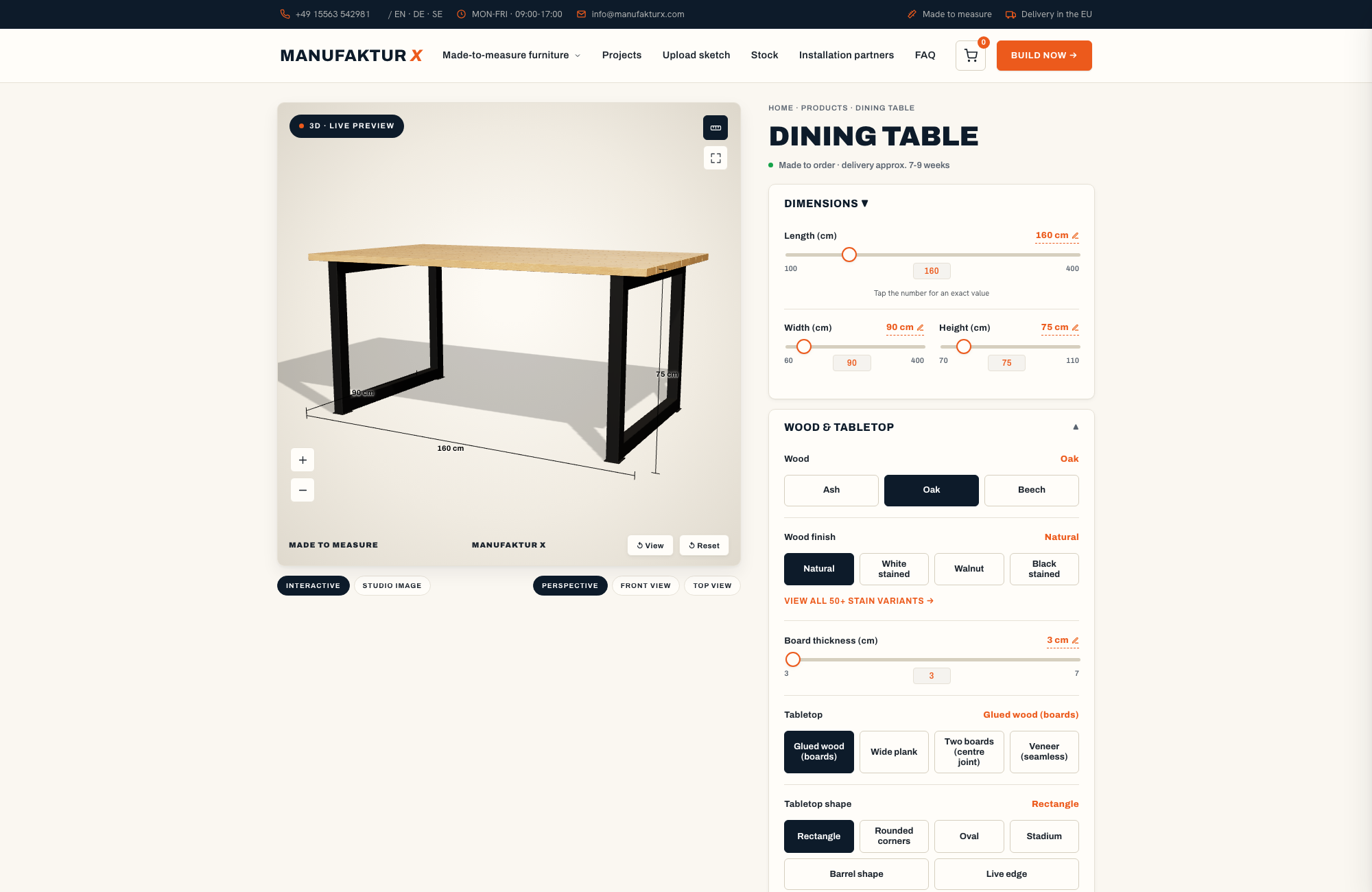
Option A - the 3D configurator: The Manufaktur X online configurator takes you through every decision in sequence. As you adjust dimensions, select a timber species, choose a stain, pick a steel colour, and set your glass type and design, a 3D preview updates in real time alongside the price. There are no hidden charges added at checkout - delivery costs and lead times are displayed transparently in your basket. You can configure, compare, and reconfigure before committing to anything.
Option B - submit a sketch: If your project has requirements that go beyond what the configurator handles, you can upload your own drawings or sketches at manufakturx.co.uk. The team will assess feasibility and come back with a quote. This is the route for unusually complex geometries or multi-piece commissions.
Step 5 - Installation and Final Check
Begin with a full inventory of all components before anything goes up. Standard tools needed: a cordless drill driver, a spirit level, a tape measure, a hammer, and screwdrivers. Once installed, test every function methodically - drawers should run smoothly, doors should close flush with no binding, shelves should carry the expected load without flex.
Post-installation checklist:
- Are all components present and undamaged?
- Do the installed dimensions match your original measurements?
- Do all moving parts operate without resistance?
- Is the structure level and stable?
- Are there any marks or damage from installation that need addressing?
How the Manufaktur X 3D Configurator Works
The configurator removes the need for a showroom visit or a tradesperson consultation for the design stage. Every decision is made in sequence, with immediate visual and financial feedback:
- Select product type - loft door, room divider, shelf, table, or bench
- Enter your dimensions - width, depth, and height based on your measurements (always use the smallest reading)
- Choose your timber - oak, beech, or ash
- Select a stain - over 50 options to match your interior
- Pick a steel colour - the full RAL range, powder coated
- Configure glass (loft door and room divider only) - clear, frosted, smoked, dark smoked, or textured; toughened (ESG) or laminated (VSG)
- Choose a handle (loft door only) - Elongated, Subtle, or Half-Moon
- Review the 3D preview - make any adjustments before proceeding
- Check price and lead time - shown transparently in the basket with no surprises at checkout
The price recalculates with every change. What you see is what you pay.
Custom Furniture in Practice: How It Works in Real British Homes
Loft Doors in Period Properties and Open-Plan Conversions
A made-to-measure loft door is one of the most effective ways to separate two zones in an open-plan layout without sacrificing light. In a Victorian terrace where the kitchen and sitting room have been knocked through, a steel and glass loft door restores a degree of separation while keeping the visual connection and allowing natural light to travel through both spaces. Because the door is produced to your exact opening dimensions, it does not matter whether that opening is a standard 762 mm or an awkward 1,380 mm wide.
Loft doors are particularly well suited to:
- Separating a kitchen from a living area in a knocked-through ground floor
- Creating a home office partition from a bedroom or sitting room
- Openings with non-standard widths - common in period properties after alterations
- Any space where light and a visual connection between rooms should be preserved
Room Dividers: Structure Without Building Work
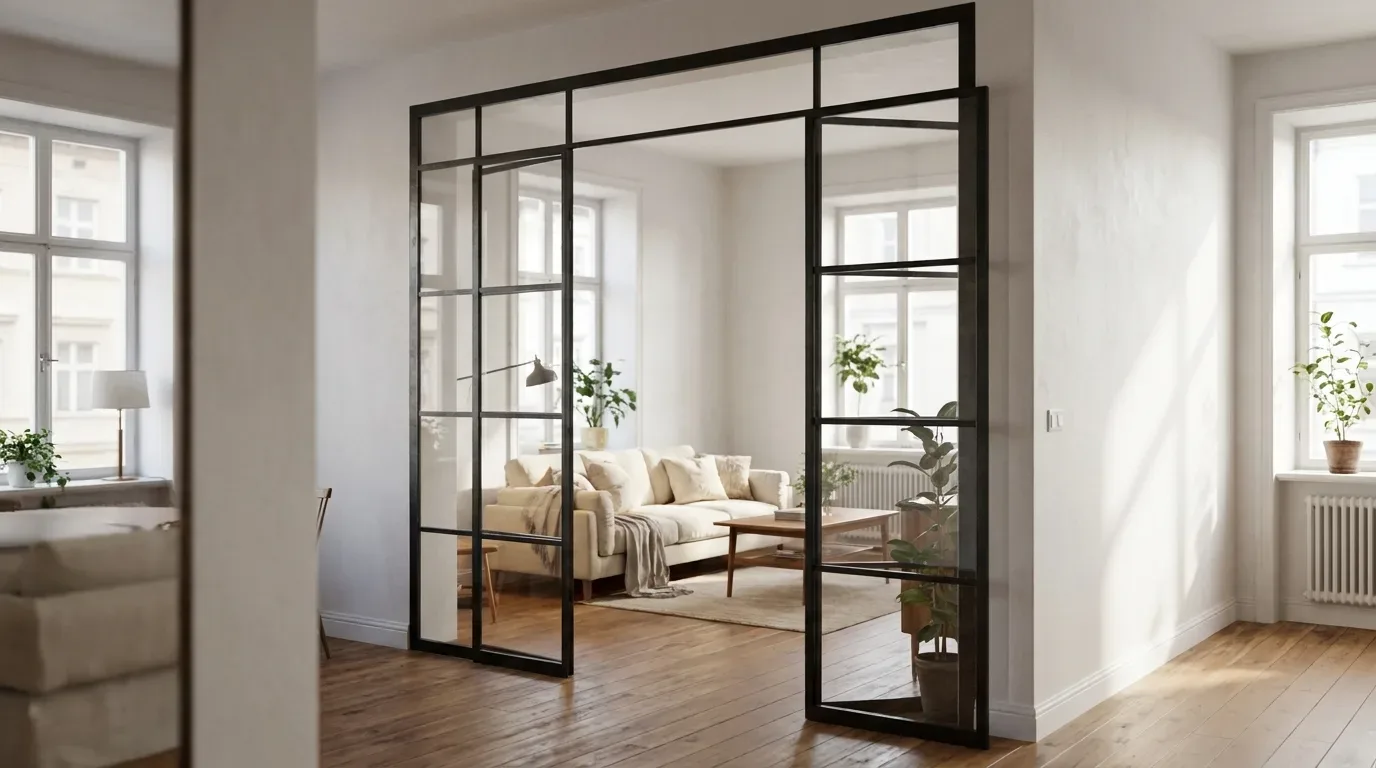
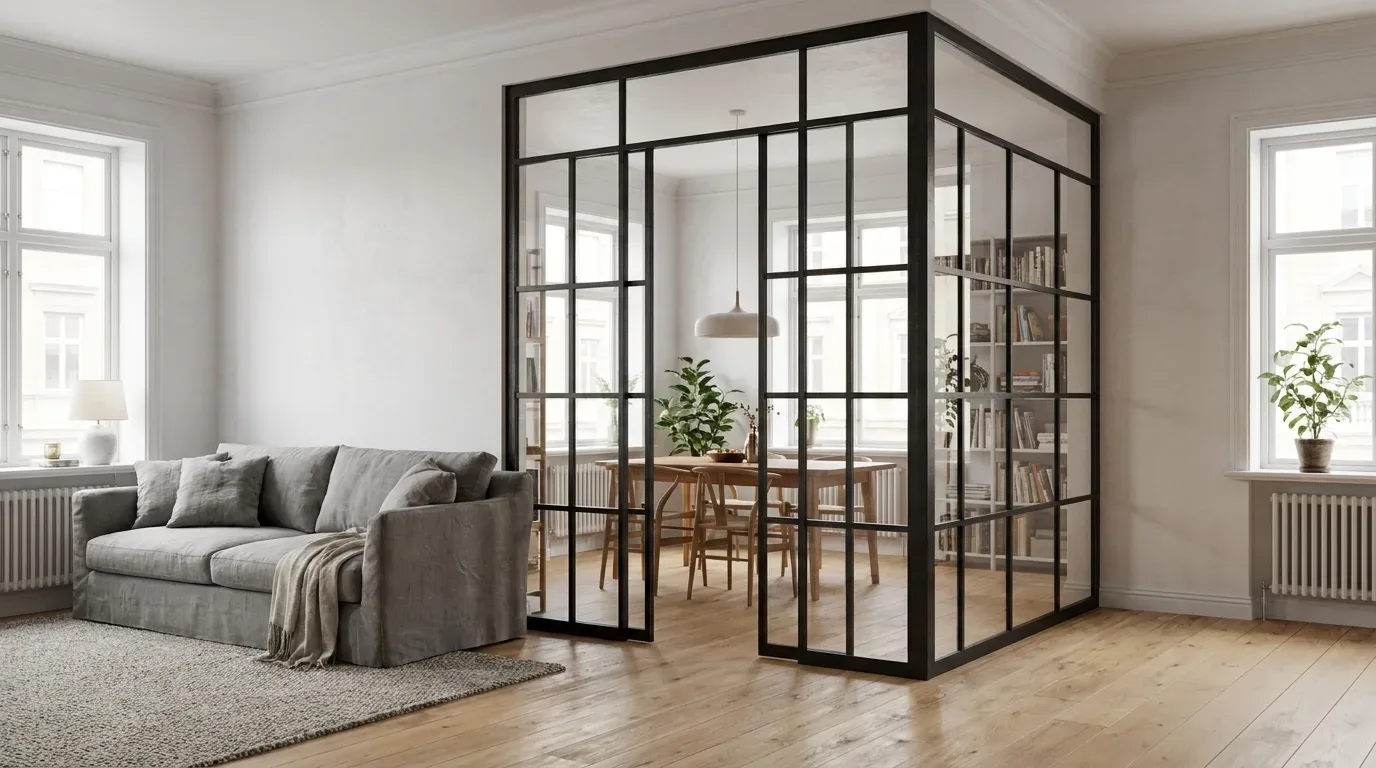
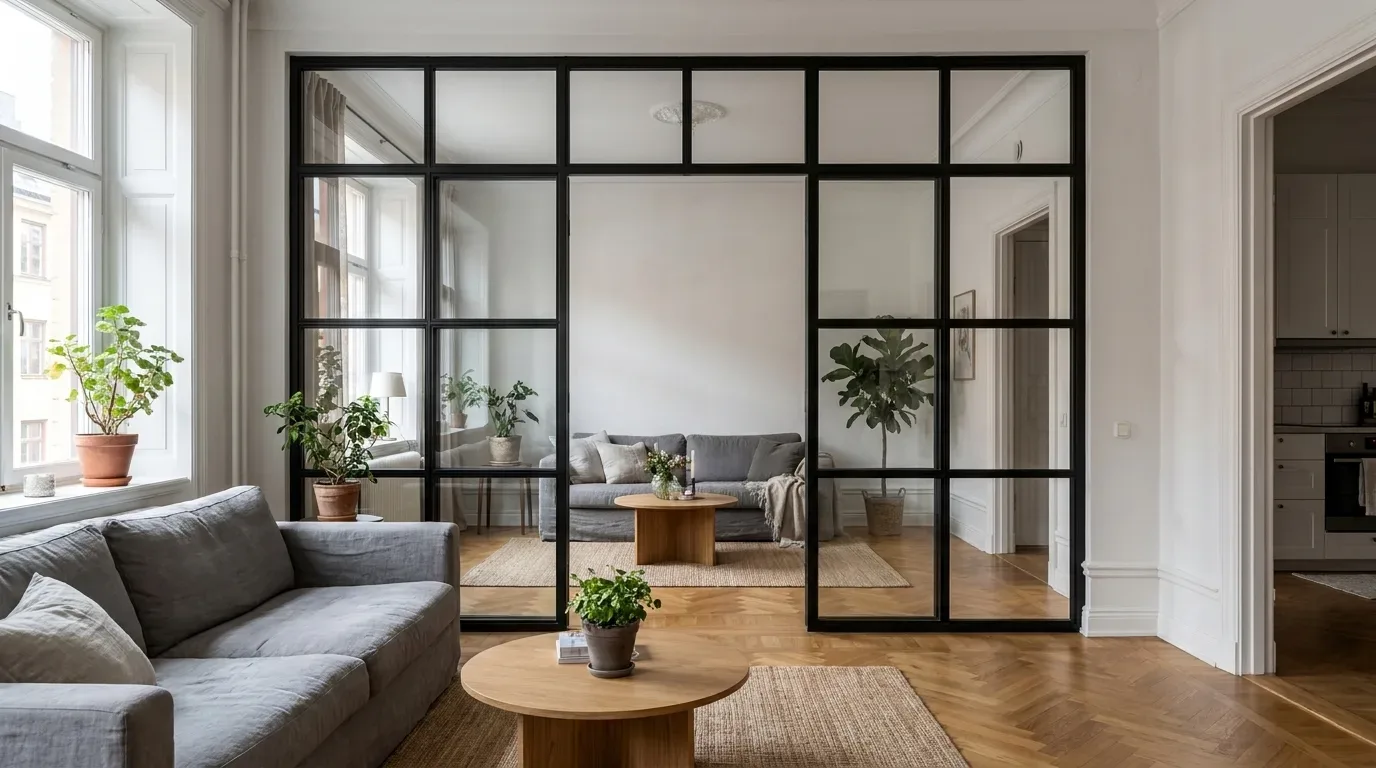
In open-plan spaces - particularly former industrial buildings converted to residential use, or large Victorian reception rooms that have been merged - there is often a desire to reintroduce structure without undertaking plastering, drying time, or significant construction work. A custom steel and glass room divider achieves this without touching the building's fabric.
Steel and glass structures read as architectural elements in their own right - comparable in visual weight to exposed brickwork or a cast-iron column. They do not read as neutral partitions but as deliberate design features. The room divider is a fixed wall; if you need to pass through, an open walkthrough gap is designed into the panel from the outset - there is no door, just a clear opening.
Shelves, Tables, and Benches: Where Solid Wood Meets Steel
The timber and steel products in the Manufaktur X range contain no glass:
- Large shelf unit: Steel frame with solid wood shelves, fitted precisely to a wall recess or run along a full wall. Optional integrated wooden cupboards in the lower section keep clutter out of sight.
- Dining table: Wood top - available in solid glued boards or veneer - on a powder-coated steel base, configured to the exact length, width, and height that suits your chairs and dining space.
- Coffee table: Built to the precise height of your sofa for a considered, intentional look.
- Bench: Solid wood or veneer top with a steel base - works in hallways, dining rooms, or at the foot of a bed.
- Pipe shelf: Steel pipe framework with solid wood shelves - an industrial aesthetic that sits naturally in converted properties and urban flats.
Costs, Lead Times, and Honest Expectations
Understanding the True Cost of Custom Furniture
Custom furniture costs more to buy than mass-produced furniture. But the purchase price alone says little: what also matters is how long a piece stays in use and whether it can be refinished instead of replaced.
Solid wood and powder-coated steel can be sanded, re-oiled, or recoated after 15-20 years. Veneered chipboard cannot. That difference is not aesthetic - it is structural. Current loft door pricing is shown live in the configurator.
All products are manufactured in the EU and delivered to the UK as a tax-free export - no German VAT is charged on the invoice, and Manufaktur X arranges and pays customs clearance and handling fees. UK import VAT is due on import.
Production and Delivery Lead Times
The production period begins from order confirmation, not from initial enquiry. Build these timelines into your project schedule:
- All products: 5-6 weeks production time
Seasonal demand can affect lead times. The confirmed delivery date is shown in your basket before you place an order.
When Does Custom Furniture Make Sense?
| Factor | Custom furniture recommended | Standard retail sufficient |
|---|---|---|
| Property type | Period home, conversion, unusual geometry | New-build with standard dimensions |
| How long you plan to stay | Long-term home, permanent setup | Short-term, frequent moves |
| Budget approach | Higher upfront, lower lifetime cost | Lower upfront, more frequent replacement |
| Design priorities | Specific aesthetic, nothing off the shelf works | Standard designs are acceptable |
| Sustainability | Long lifespan, repairability a priority | Less emphasis on longevity |
Craftsmanship, Sustainability, and Why It Matters
Solid wood is a living material - it responds to the humidity cycle of the seasons, shrinking slightly in winter when central heating dries the air, and expanding slightly in summer. This is not a flaw to be engineered away; it is evidence of authentic material. In our production process, each board is individually selected and the grain direction considered relative to how the piece will be used. Drawer runners are fitted and adjusted to run fluidly. Surface finishes are applied in multiple stages.
Every Manufaktur X product is manufactured in the European Union and goes through quality control before despatch. A solid hardwood shelf unit re-oiled after twenty years looks close to how it looked on the day it arrived. That is not just a pleasing thought - it is the economic and environmental case for buying well once rather than replacing repeatedly.
The environmental argument for custom furniture is straightforward:
- Longer lifespan means fewer manufacturing cycles per household
- Repairability means fewer complete disposals
- EU production means shorter supply chains than furniture sourced from outside Europe
- Emotional investment in a piece that was made specifically for your home means fewer impulse replacements
Caring for Custom Furniture Over the Long Term
Solid wood furniture is durable, but it is not maintenance-free. With the right care it remains in excellent condition for decades:
- Oiled surfaces: Re-oil once or twice a year to keep the wood fibres supple and protect against moisture. Minor surface scratches can be disguised by re-oiling rather than refinishing the whole piece.
- Waxed surfaces: Similar care to oiled surfaces, with slightly more water resistance. Re-wax when the surface begins to look dull.
- Powder-coated steel: Wipe with a damp cloth. Avoid abrasive cleaners, which will scratch the surface coating.
- Glass panels: Clean with a standard glass cleaner or a damp cloth - no specialist products needed.
- Restoration after years of use: Solid hardwood can be sanded back and refinished - this is the single greatest practical advantage it holds over any chipboard or MDF product, which cannot be meaningfully restored.
Where possible, choose oiled or waxed finishes over lacquered ones. They are more forgiving of everyday marks, and they improve with age in a way that sealed lacquer finishes cannot match.
Start Configuring Your Custom Furniture
With the Manufaktur X 3D configurator you can design loft doors, room dividers, shelving, tables, and benches to your exact dimensions, material preferences, and colour choices - and see exactly how each decision affects the appearance and the price, in real time, before you commit.
Browse the full product range at manufakturx.co.uk. For complex or multi-piece projects, the sketch upload service lets the team assess your requirements and provide a bespoke quote.
Frequently Asked Questions About Custom Furniture
What is custom-made furniture and who does it suit?
Custom-made furniture is produced to your exact dimensions, functional requirements, and design preferences. It is particularly well suited to period properties, conversions, and any space with unusual geometry - sloped ceilings in loft rooms, deep alcoves beside chimney breasts, doorways that fall outside standard widths. It also makes sense for anyone buying furniture they intend to keep for twenty or more years, or who wants a coherent interior where nothing looks approximate or off-the-shelf.
Which timber species does Manufaktur X use?
Manufaktur X works exclusively with three hardwood species: oak, beech, and ash. All three are among the hardest and most durable timbers available. Over 50 stain options allow you to precisely match the finish to your interior. Softwoods such as pine are not used.
What is the difference between a loft door and a room divider?
A loft door is a fully functioning door - it has a frame, a hinge side (left or right), an opening direction, an opening angle, a handle (Elongated, Subtle, or Half-Moon), and hinges. A room divider is a fixed steel and glass partition wall with none of those components - no door, no handle, no hinges. A room divider can optionally include a walk-through gap (an open passage without a door) if you need to move between the two zones.
How do I measure correctly for a loft door or room divider?
Measure the width and height of the opening at three points each - left, centre, and right for width; top, middle, and bottom for height. Always enter the smallest of those three readings into the configurator. In Victorian and Edwardian properties, these readings often differ by 10-25 mm - this is normal. For loft doors, subtract the installation gap from your smallest measurement: allow approximately 5 mm clearance per side (left, right, and top). The piece is produced to exactly the dimensions you enter.
What glass options are available for loft doors and room dividers?
There are five glass designs to choose from: clear, frosted, smoked, dark smoked, and textured. Separately, you choose the safety glass type: ESG (toughened single-pane safety glass) or VSG (laminated safety glass). For households with young children, or for larger panel dimensions, VSG is the recommended choice. Glass design and glass type are two separate decisions in the configurator.
How long does production take, and what does a loft door cost?
All products have a production lead time of 5-6 weeks from order confirmation. The entry price for loft doors in the most basic configuration is shown live in the configurator. The exact price for your specification is shown live in the configurator as you build it. Delivery to the UK is a flat price per order, shown in the basket. Goods are exported tax-free - no German VAT is charged on the invoice - and Manufaktur X arranges and pays customs clearance and handling fees. UK import VAT is due on import.
Can I submit my own drawings for an unusual project?
Yes. If your project has requirements that go beyond what the online configurator covers, you can upload your own sketches or drawings. The Manufaktur X team will review the feasibility and come back with a bespoke quote. This is the recommended route for complex geometries or commissions involving multiple pieces.
How do I care for solid wood furniture over time?
Oiled surfaces should be re-oiled once or twice a year. Minor surface scratches can be addressed by re-oiling the affected area rather than refinishing the whole piece. Waxed surfaces should be re-waxed when they start to look dull. After many years of use, solid hardwood can be sanded back and re-treated - a restoration option that is simply not available with chipboard or MDF furniture, which must be replaced when it deteriorates.