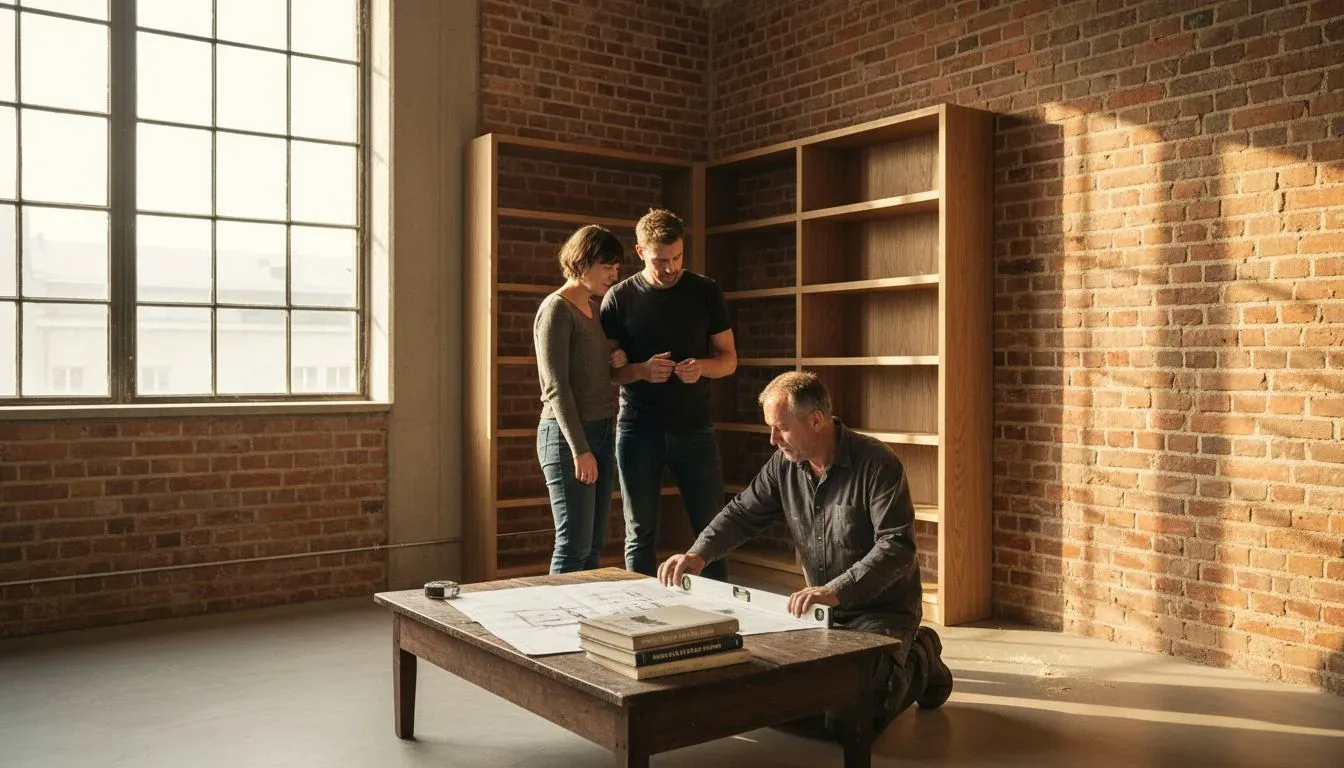
Victorian terraces, Edwardian semis, 1930s conversions, loft flats - British homes are wonderfully varied, and almost none of them conform to the neat rectangular layouts that flat-pack furniture was designed for. A chimney breast that juts 300 mm into the living room. A doorway opening that measures 1,380 mm rather than the standard 762 mm. A sloped ceiling in a converted attic that makes every off-the-shelf unit too tall by just enough to matter. Bespoke furniture built from steel, solid wood and safety glass solves these problems at the source - because it adapts to your home, not the other way around.
Why Bespoke Furniture Is a Practical Choice, Not Just a Luxury One
A significant proportion of British housing stock pre-dates the post-war building boom. Period properties - whether a Victorian terrace in Leeds, an Edwardian semi in Bristol, or a Georgian conversion in Edinburgh - were built before standardised room dimensions existed. Walls are rarely truly plumb. Room heights can vary by 20 mm or more between one corner and another. Alcoves beside fireplaces rarely match each other. And in converted properties, the constraints can be even more pronounced: sloped ceilings, exposed beams, irregular floor plans.
Off-the-shelf furniture from the high street - whether from IKEA, John Lewis or anywhere else - is engineered for new-build proportions: straight walls, right-angle corners, standard ceiling heights. That is not a criticism; it is simply what mass production requires. But it does mean that in a period property or a converted space, you are almost always buying a compromise. A shelf that is 40 mm too short for the alcove. A dining table that is 200 mm too long for the room once chairs are in. A room divider that simply does not exist in the right size.
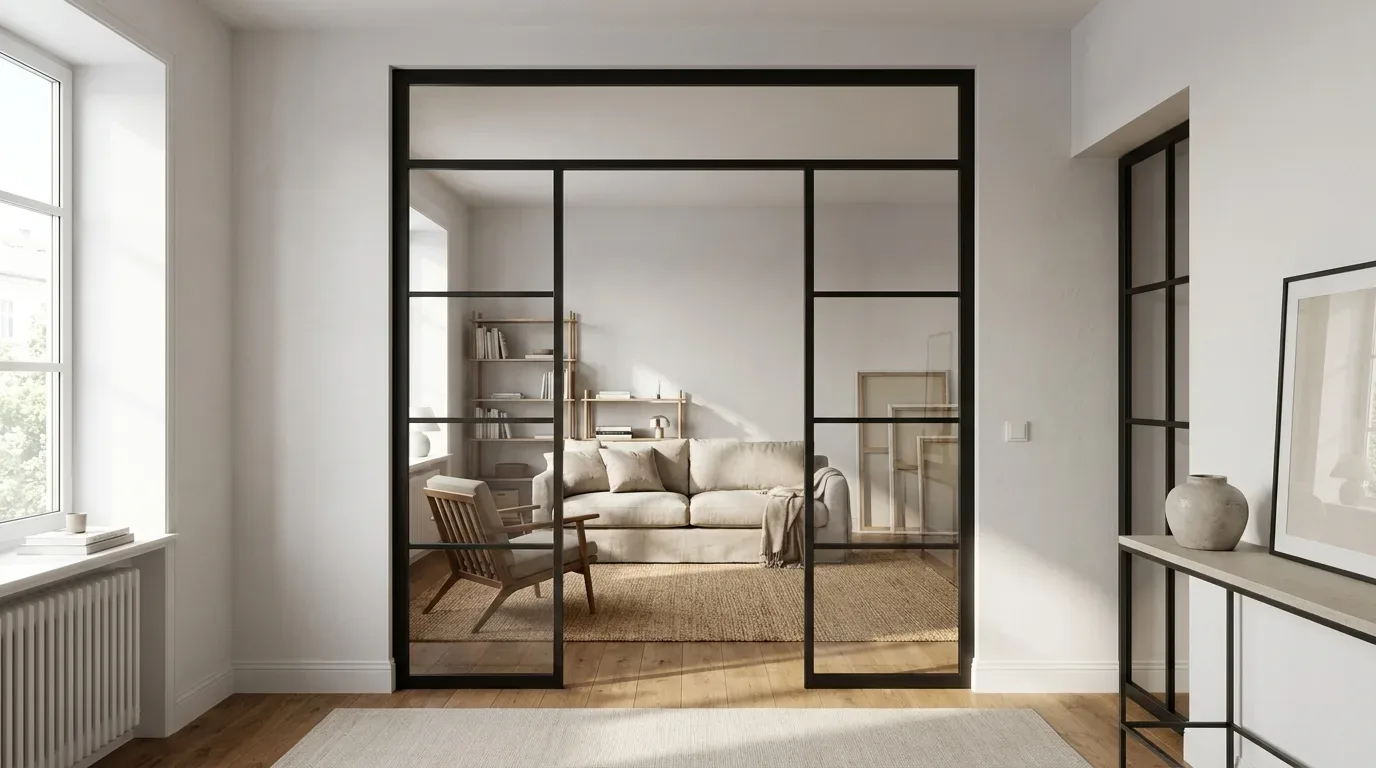
Genuine bespoke manufacture - the kind that Manufaktur X specialises in - begins where standard size ranges end. Width, depth, height: every dimension is set to the millimetre, based on the actual measurements of your room.
"Maßgefertigte Einbauten sind kein Luxus, sondern in vielen Altbauten die einzig funktionale Lösung. Standardmaße wurden für Neubauten mit rechten Winkeln entwickelt - nicht für gewachsene Gebäudestrukturen."
Bauwelt, Ausgabe 12/2022
Many retailers use the word "customisable" to mean you can choose from a grid of preset sizes and a handful of finishes. That is not bespoke. If the largest shelf in a product range is 2,200 mm wide and your alcove needs 2,370 mm, you are still left with a gap - or an overhang. Bespoke manufacture fills that gap entirely.
What Sets Bespoke Furniture Apart From Standard Retail
The fundamental difference is architectural fit. A bespoke shelf sits flush with the wall on both sides, because it was made to those exact measurements. A bespoke dining table is the right height for your particular chairs - not a height that works adequately for a generic seating arrangement. A bench does not have to be pushed awkwardly against a wall because it is 80 mm too long; it was made to fit.
Beyond dimensions, bespoke manufacture gives you direct control over every material decision: the species of wood, the finish, the steel colour, the glass type, the handle style. Solid wood, powder-coated steel and safety glass are not marketing language - they are the reason these pieces last 20 years rather than 8.
| Criterion | High-street / flat-pack furniture | Bespoke furniture |
|---|---|---|
| Fit to room | Limited - compromises are standard | Exact fit to your measurements |
| Design control | Fixed by manufacturer | Every detail chosen by you |
| Materials | Often MDF, chipboard, mixed wood | Solid wood, steel, safety glass |
| Expected lifespan | Typically 5-10 years | 20 years or more |
| Resale and refurbishment value | Low - not refinishable | High - solid wood can be re-oiled and restored |
| Room types it suits | Standard new-build proportions | Period properties, conversions, any geometry |
The Manufaktur X Range: Bespoke Furniture in Steel, Glass and Solid Wood
Manufaktur X produces bespoke furniture in steel, glass and solid wood - with materials varying by product type. There are two clear product families:
Steel and glass products (where glass is a structural and visual element):
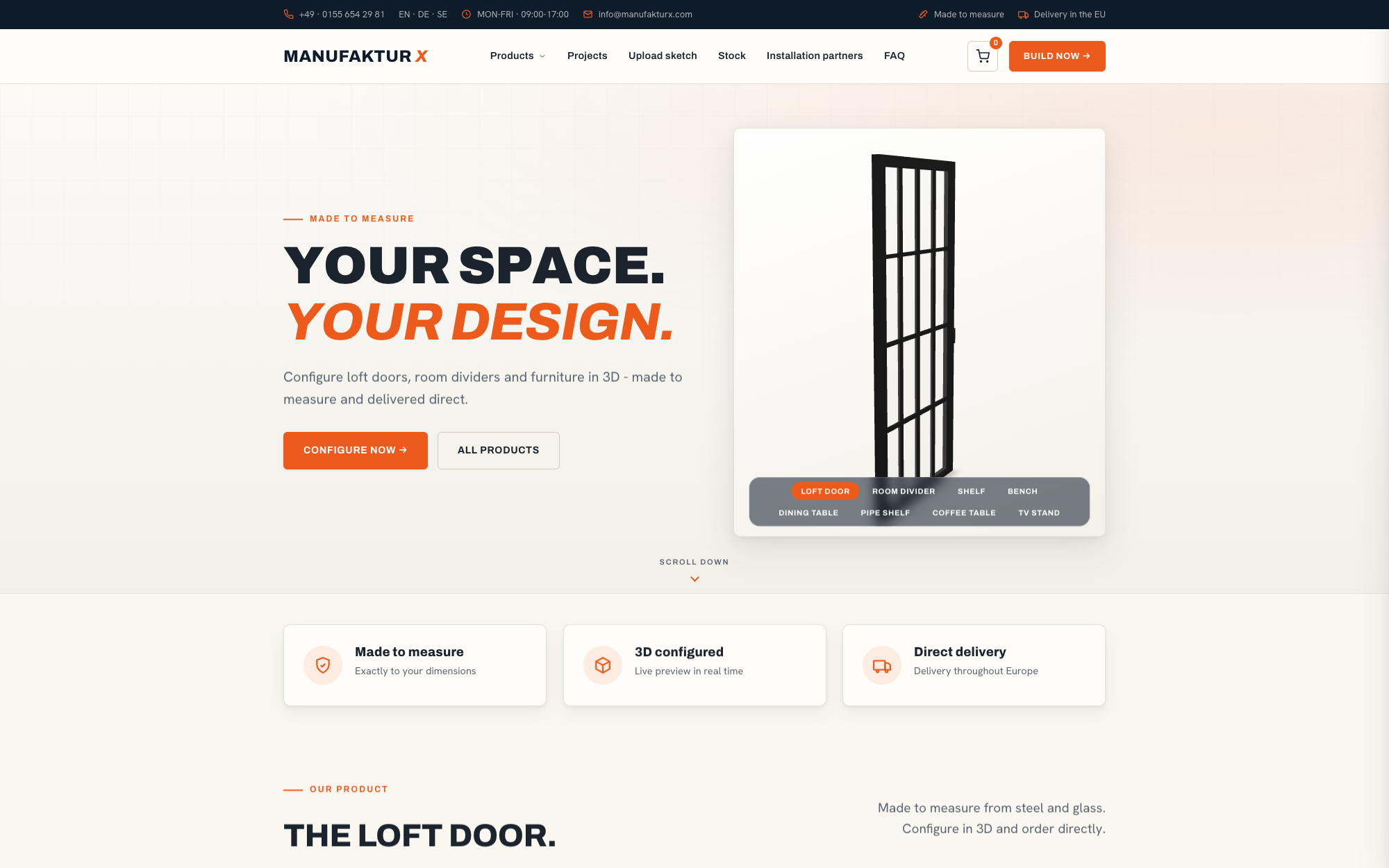
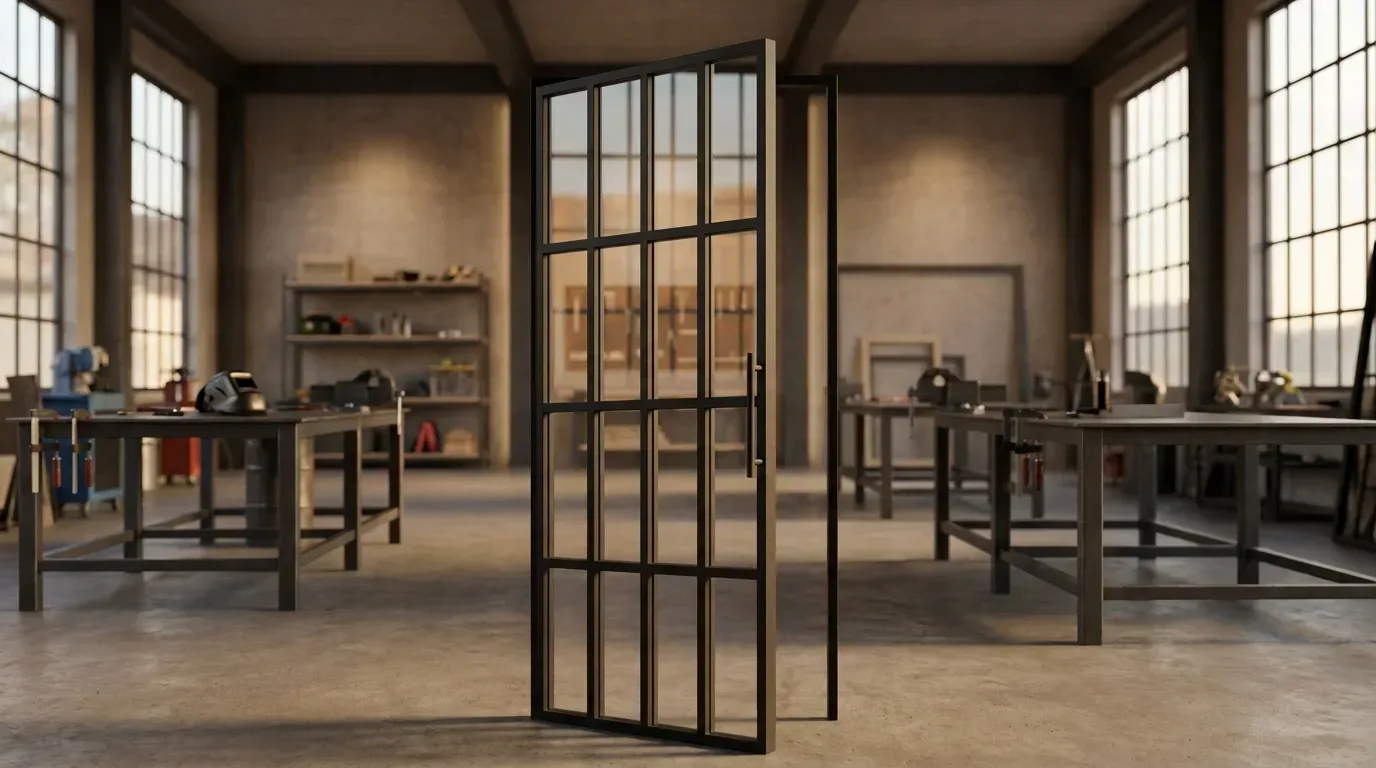
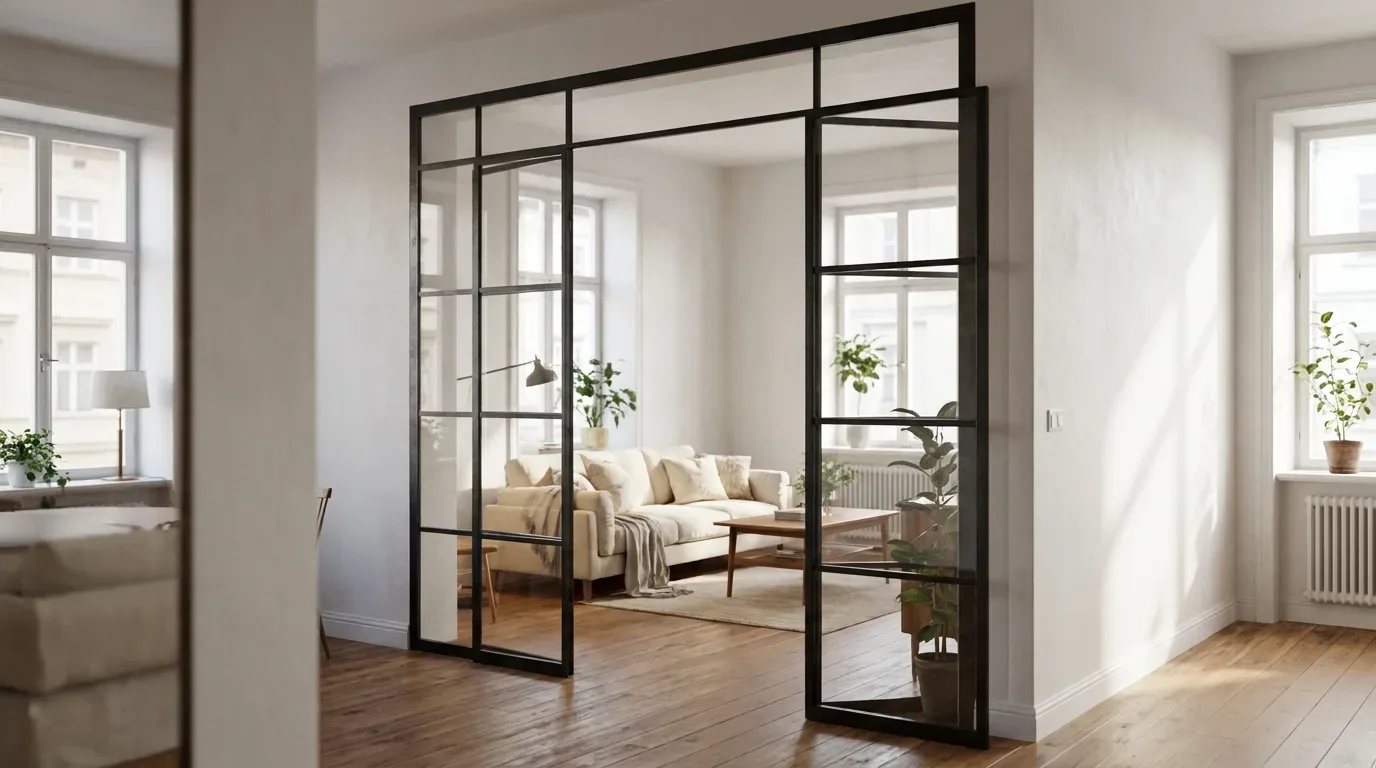
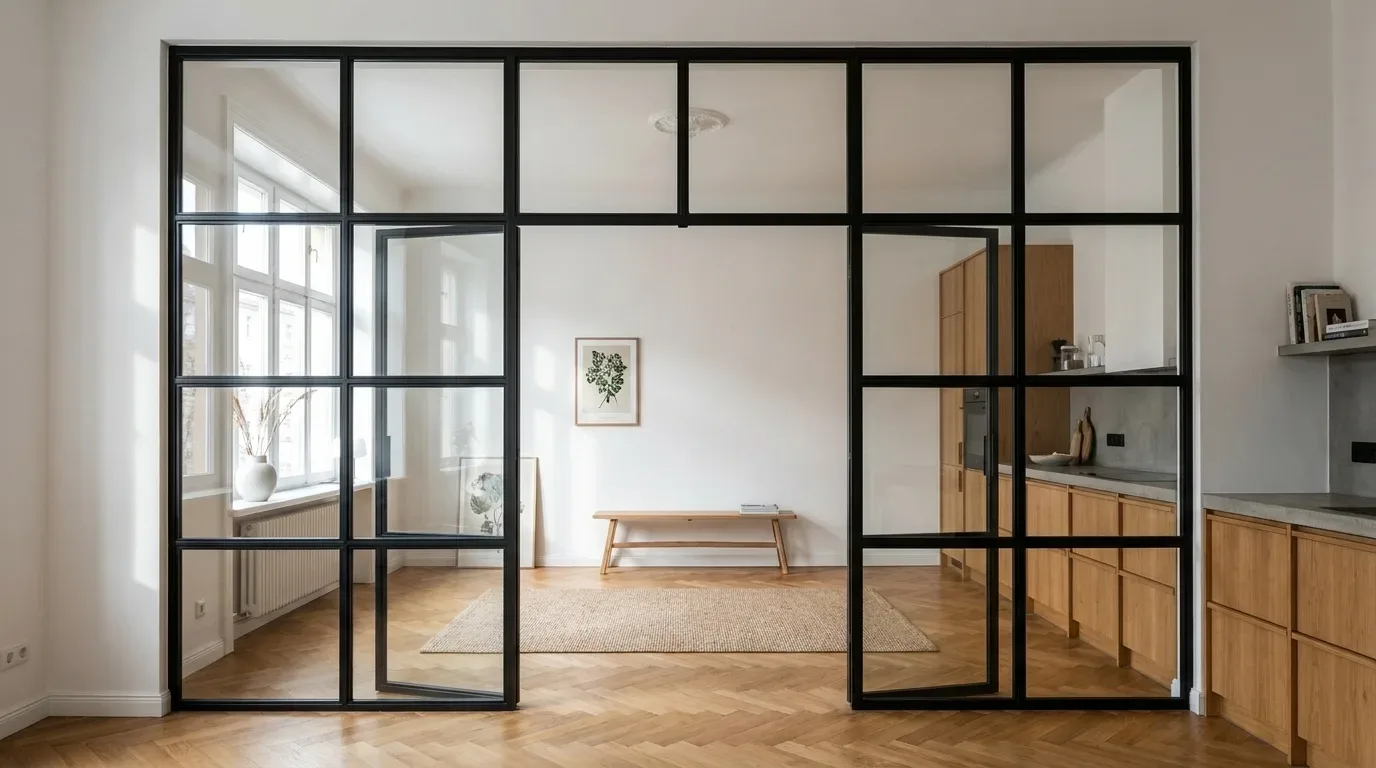
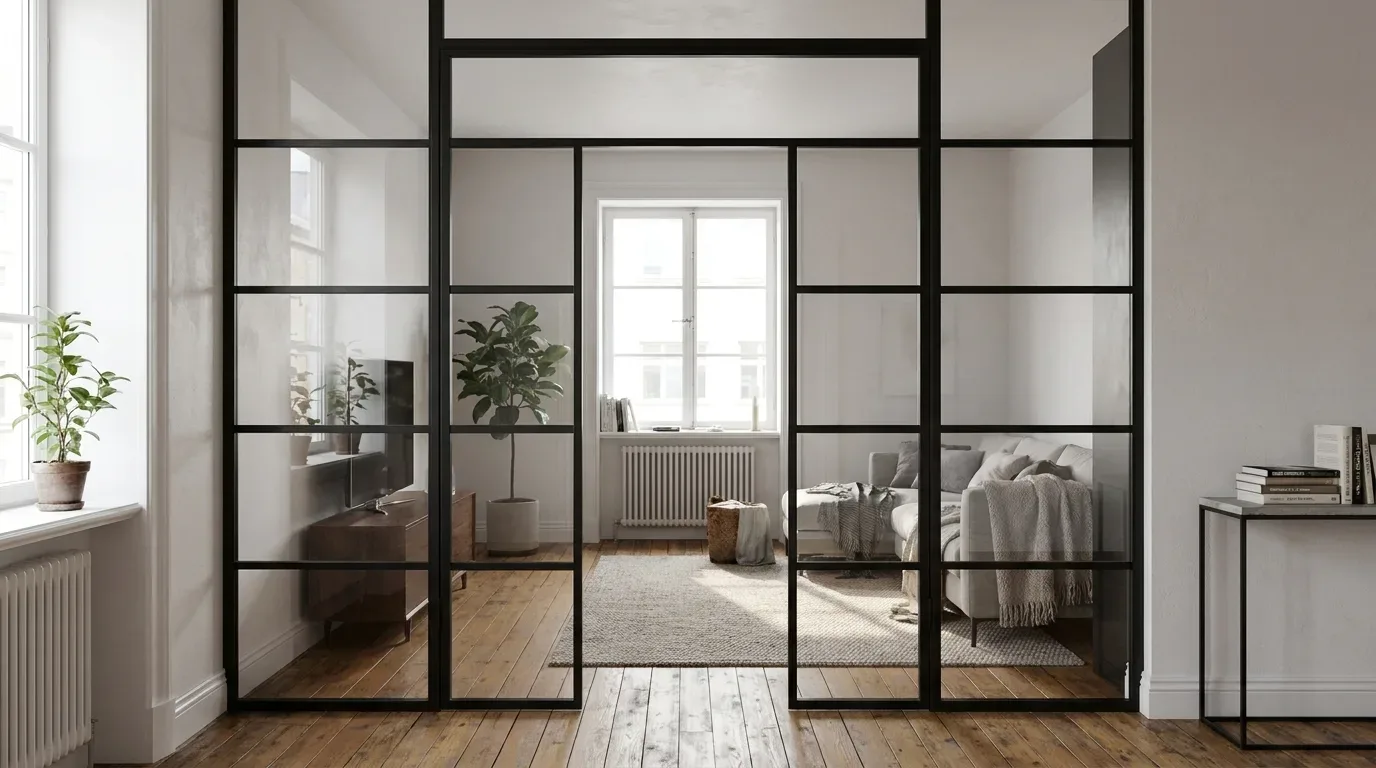
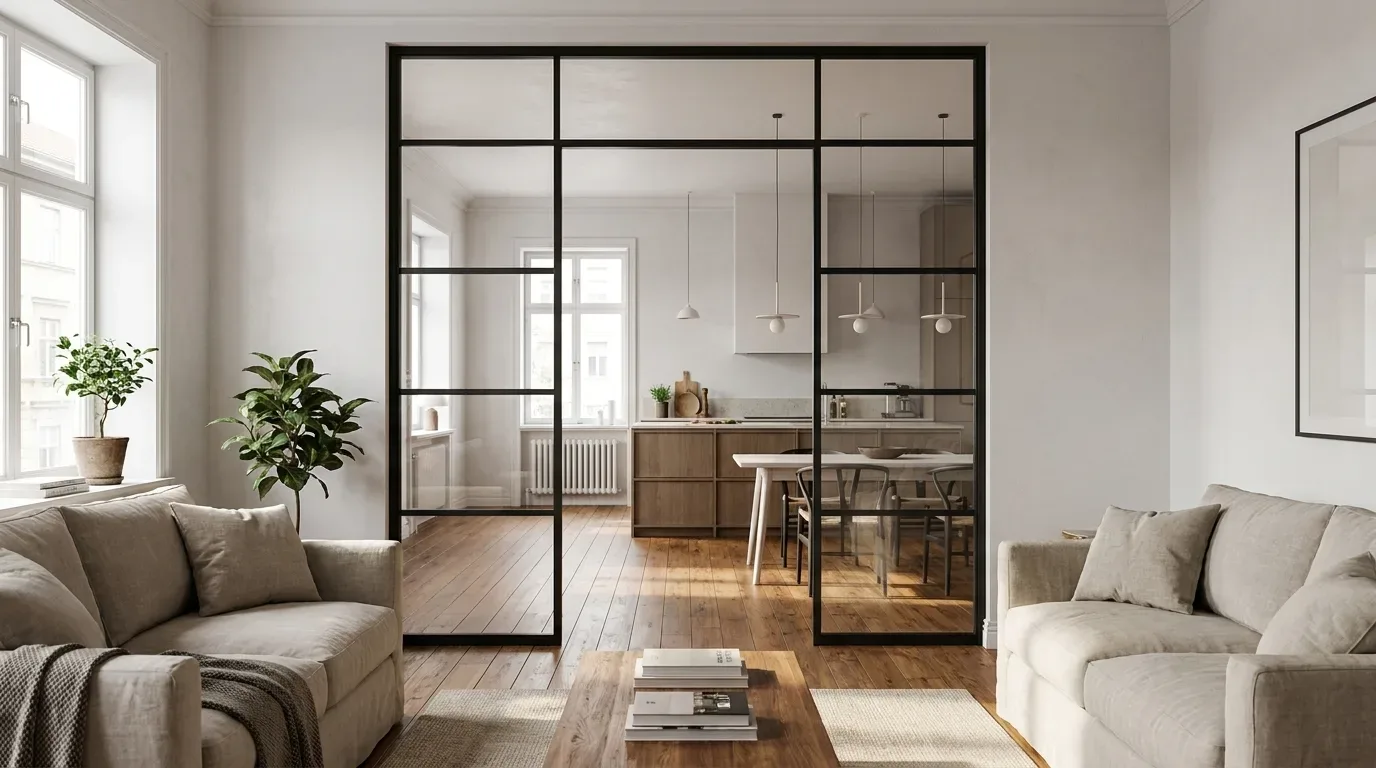
- Loft door: A functioning door with a frame, hinge side (left or right), opening direction, opening angle, handle and hinges. A loft door connects two rooms without sealing them off - light passes through, visual connection is maintained. See the full range on the loft door product page.
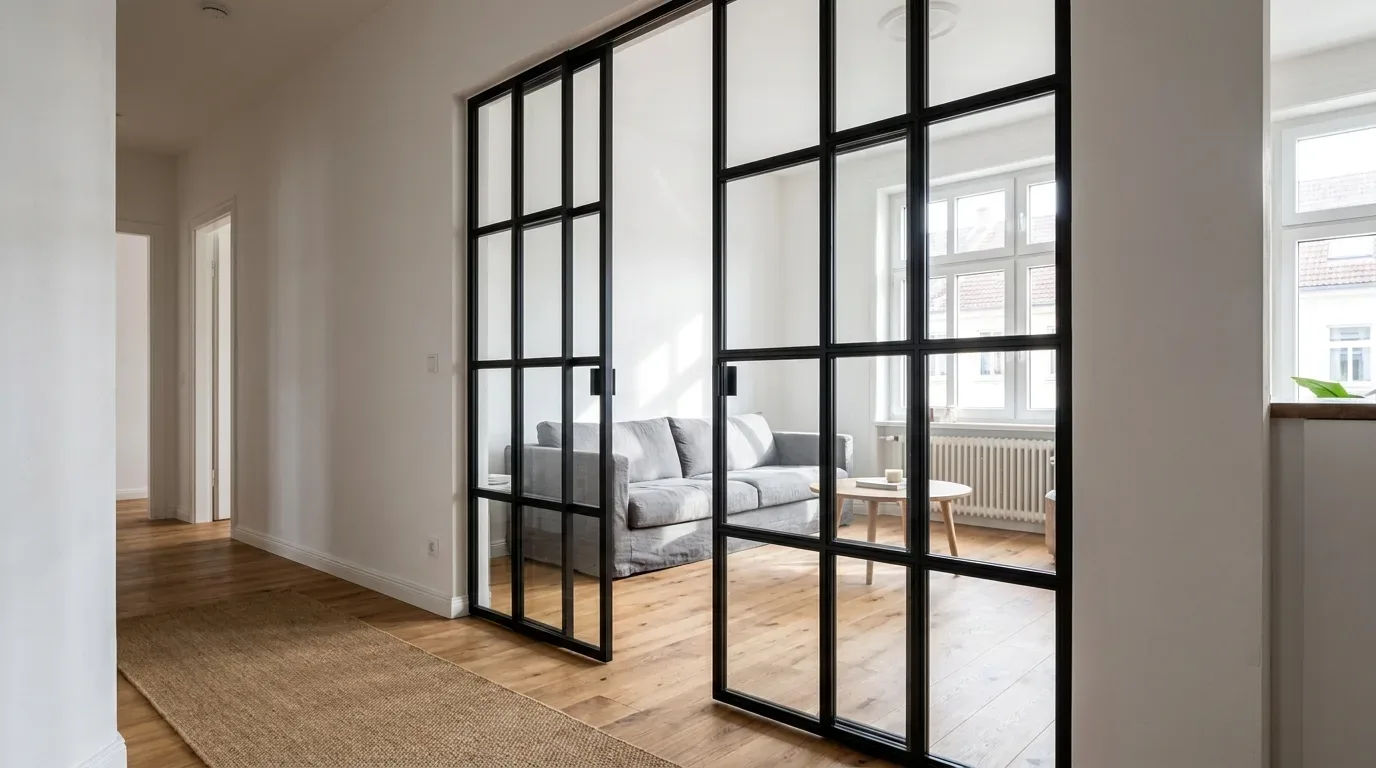
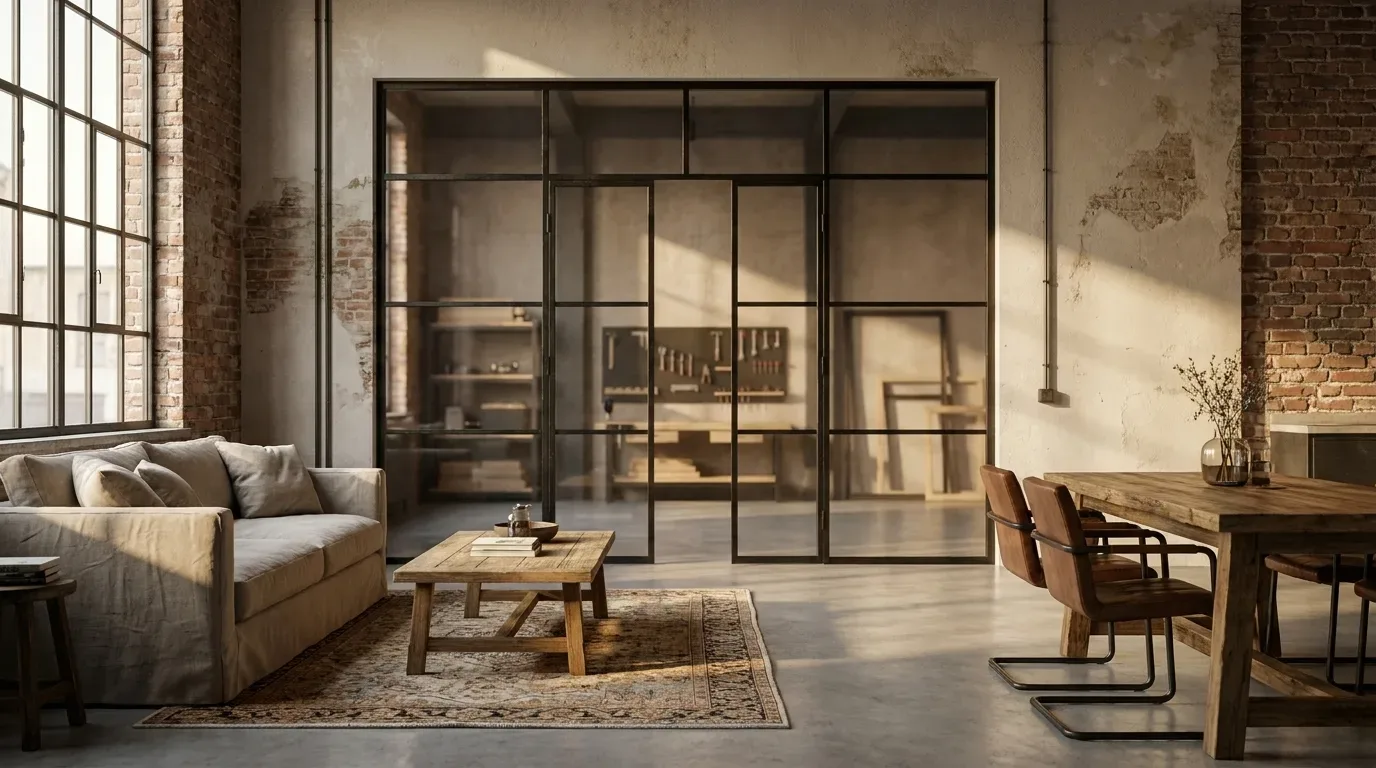
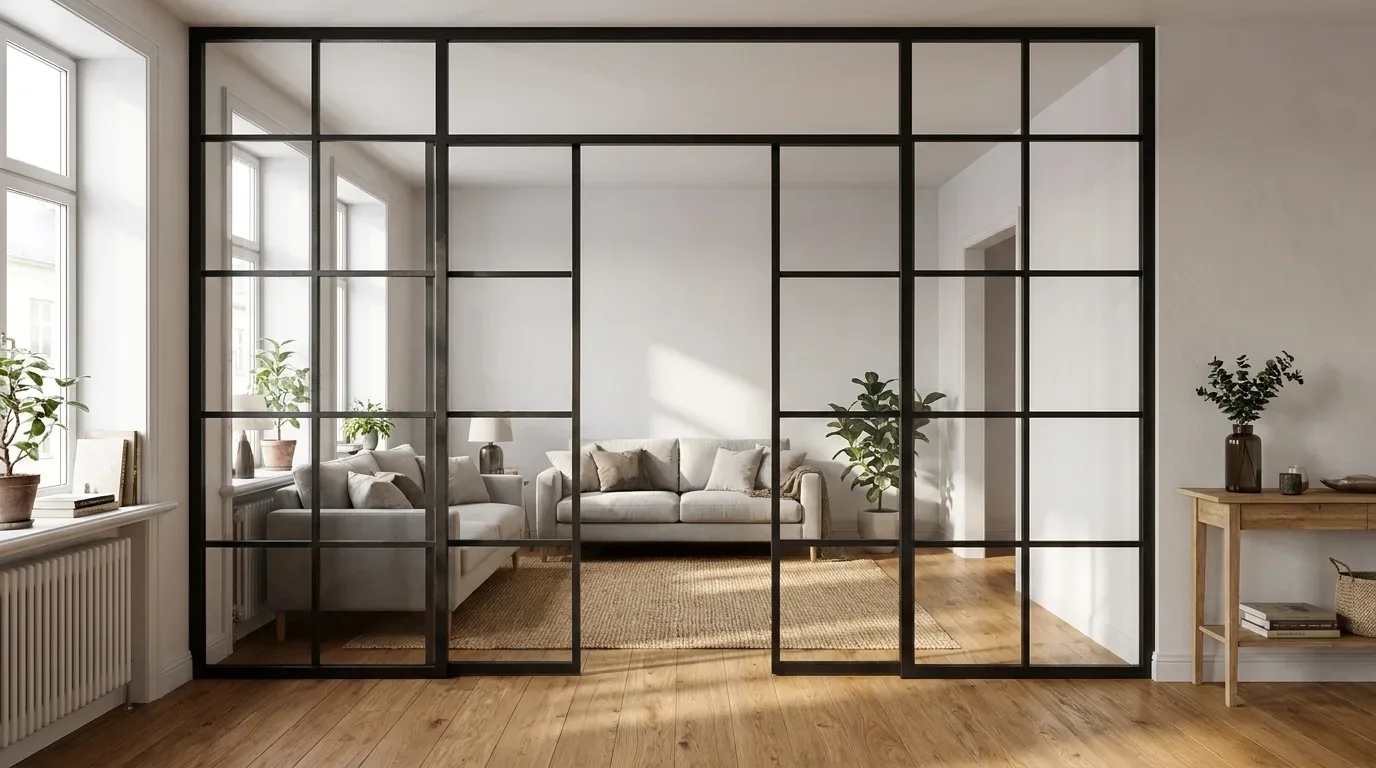
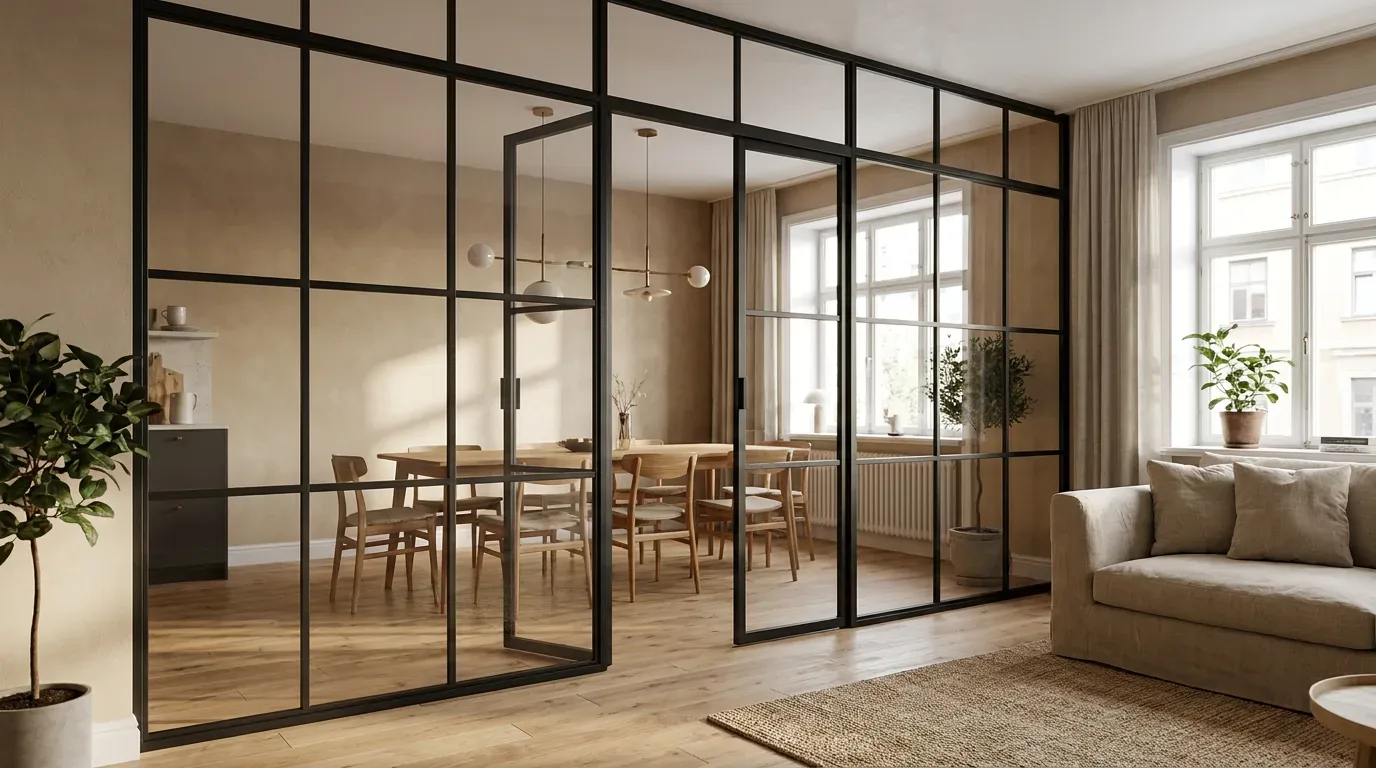
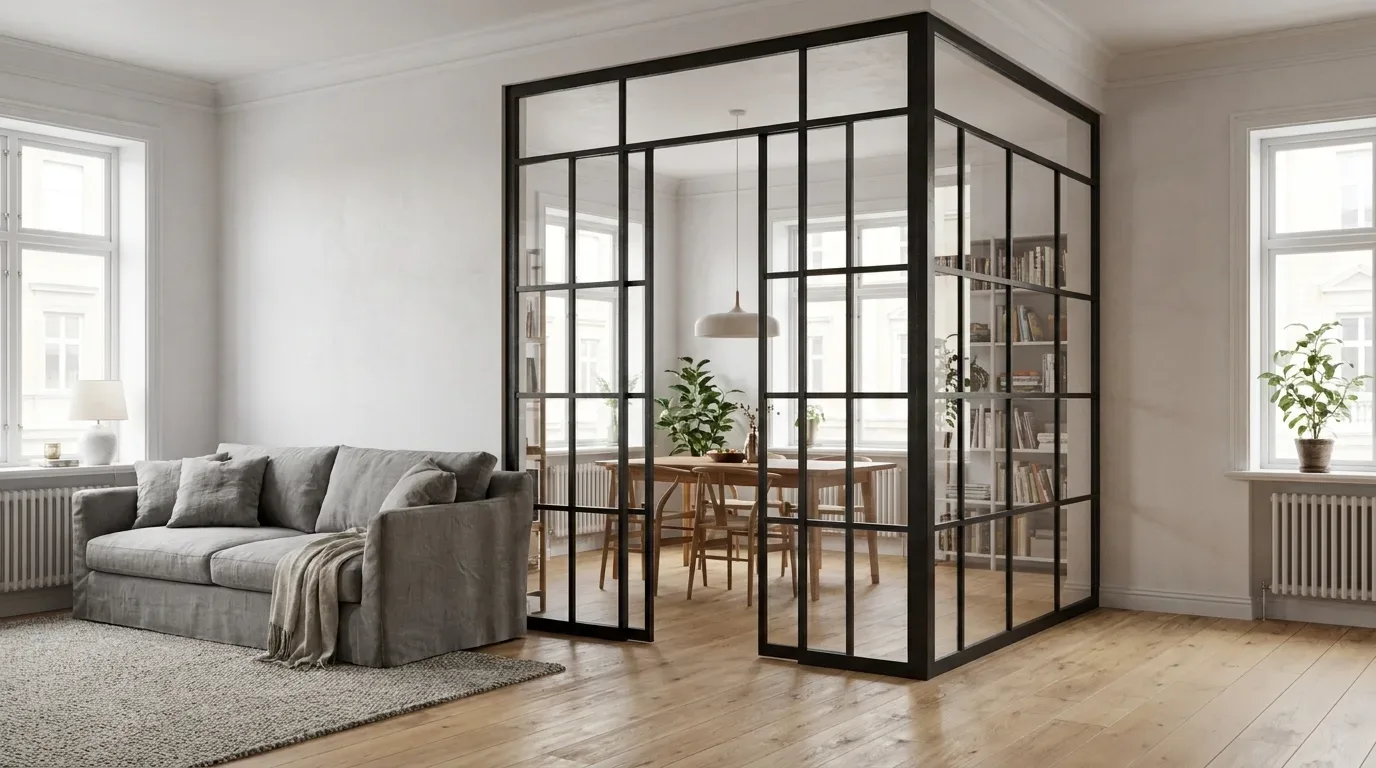
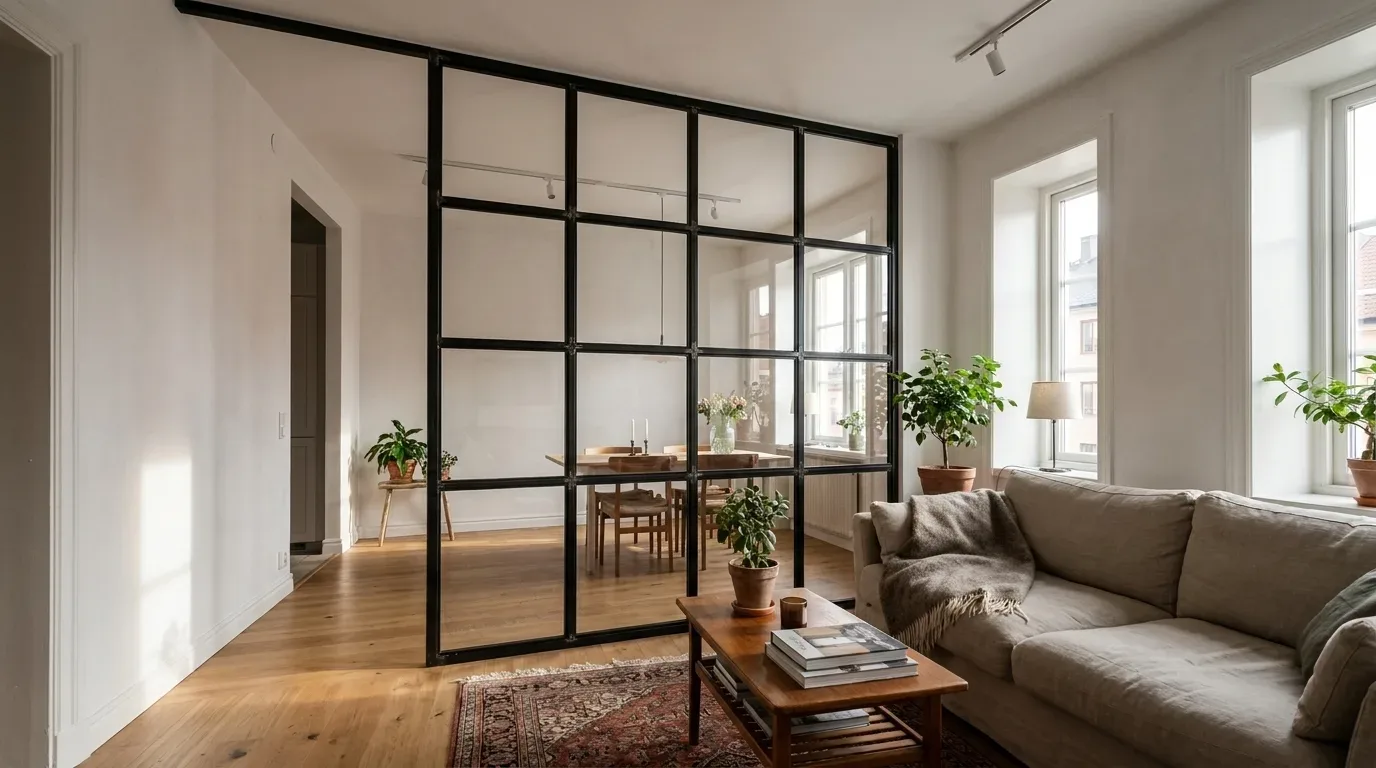
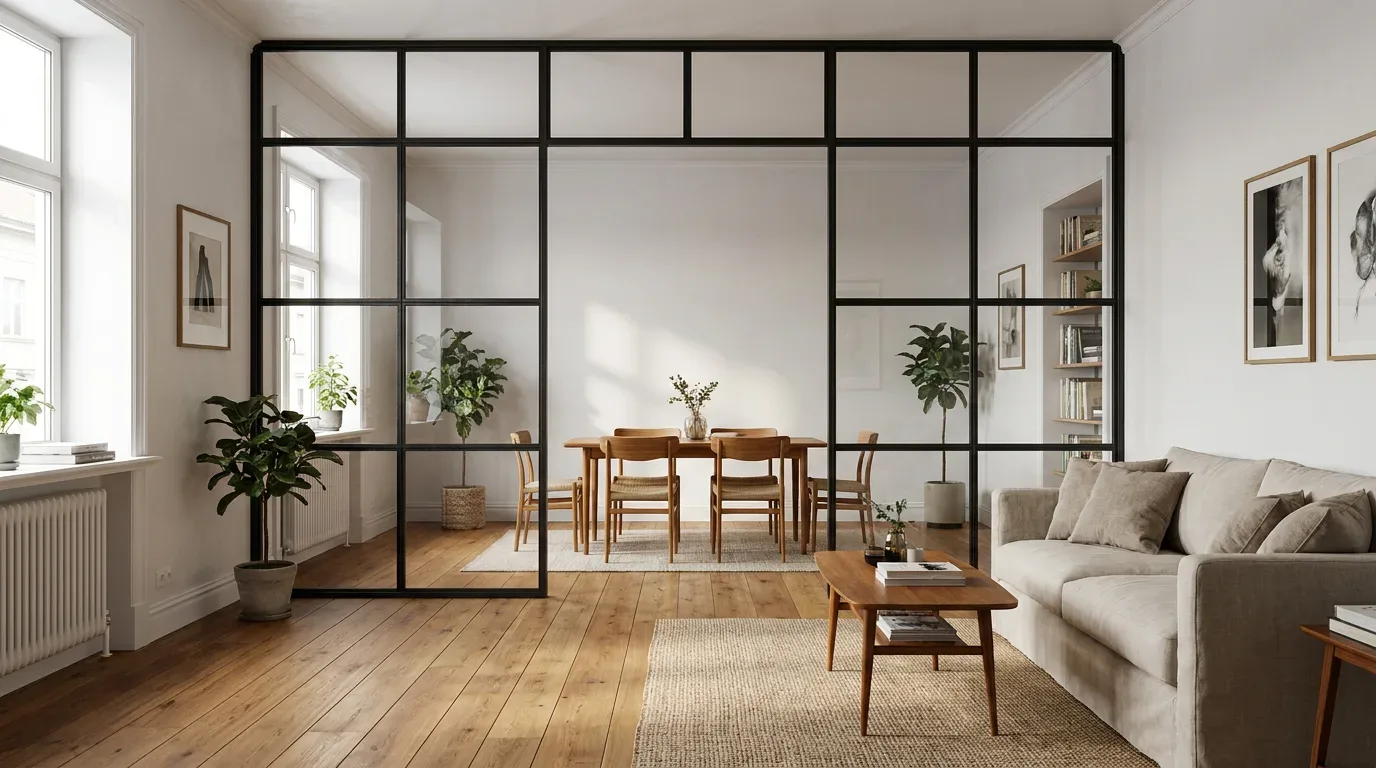
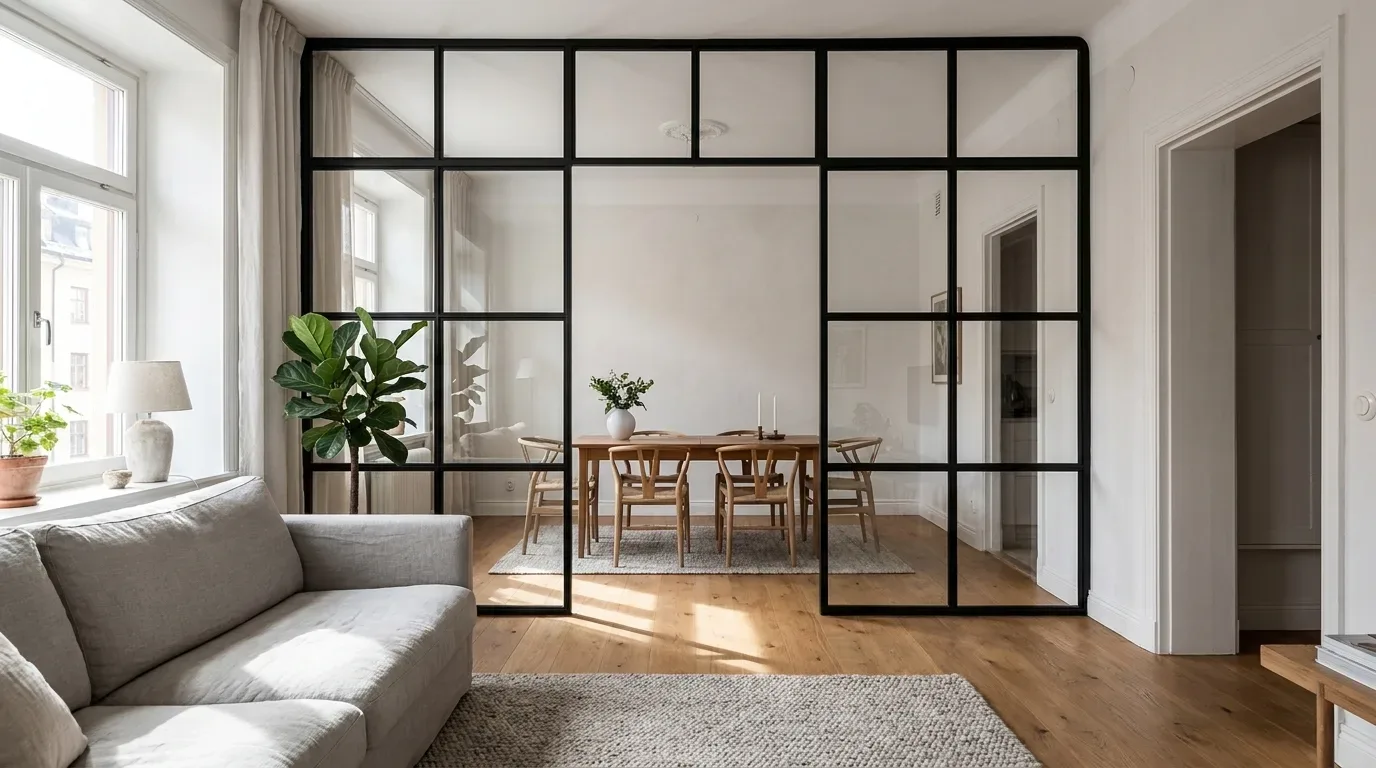
- Room divider: A fixed steel and glass partition wall with no door. No hinge side, no opening direction, no handle, no hinges. Optionally includes a walk-through opening - an unglazed aperture with no door. Explore the options on the room divider product page.
Solid wood and steel products (no glass):
- Large shelf: Steel frame with solid wood shelves, made to fit a specific wall or alcove. Optionally includes integrated wooden cupboards in the lower section. View the large shelf configurator.
- Dining table: A solid wood or veneer top on a steel frame, sized to length, width and height. Configure yours on the dining table page.
- Coffee table: Made to the exact height of your sofa. See the coffee table options.
- Bench: Solid wood or veneer top with a steel frame. Explore the bench configurator.
- Pipe shelf: Steel tube construction with solid wood shelves - a natural fit for industrial-influenced interiors. See the pipe shelf page.
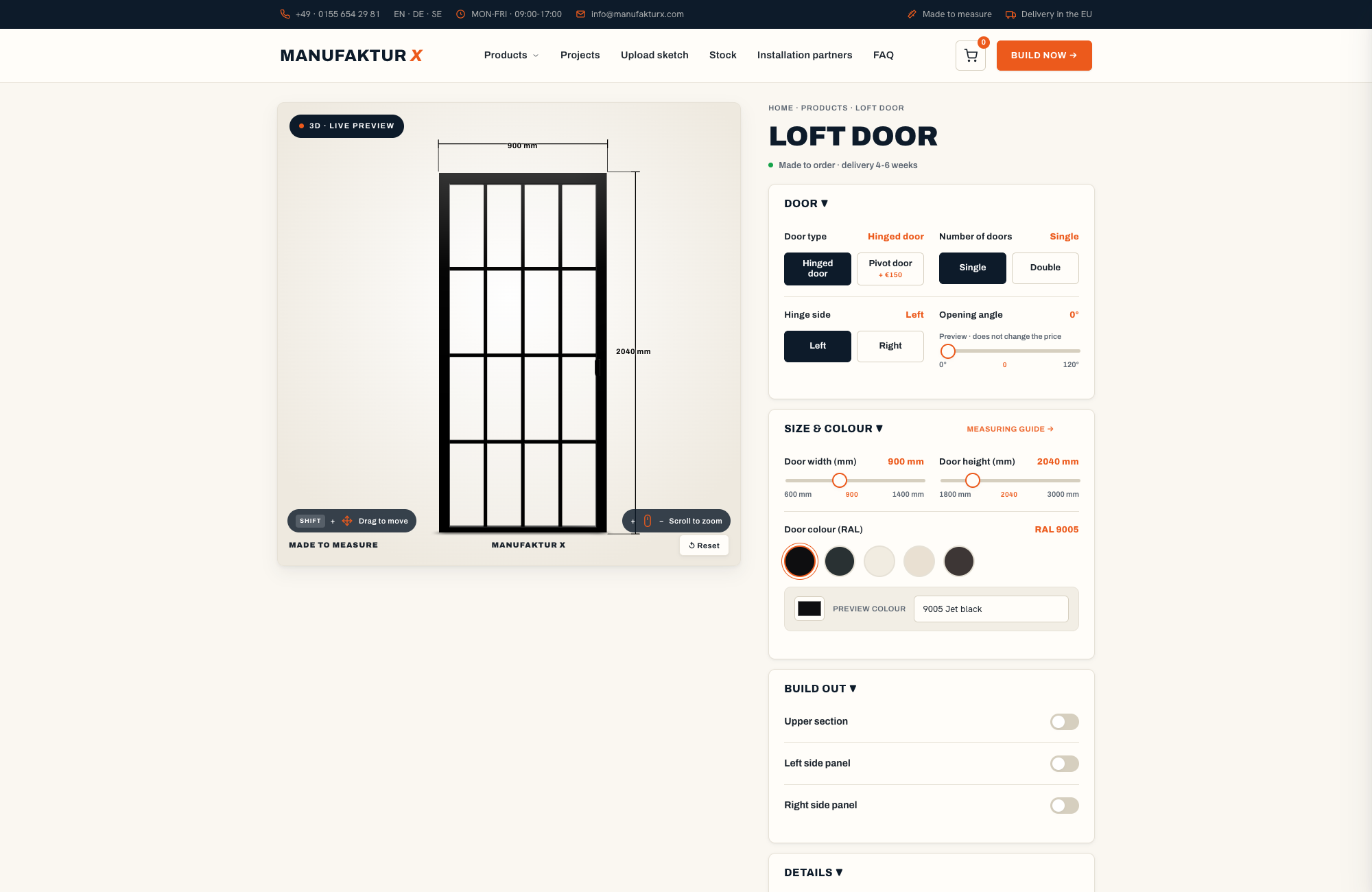
Loft doors start from £1,157 - that is the entry price for the most basic configuration. Current pricing across all products is shown in real time in the configurator:
| Product | From | Note |
|---|---|---|
| Lofttür | £995 | Lowest possible option |
| Raumteiler | £1.900 | Steel + laminated glass, custom width |
| Großes Regal | £2.750 | Solid wood, steel frame, floor-to-ceiling |
| Esstisch | £1.360 | Solid wood, steel frame |
| Couchtisch | £995 | Solid wood, steel frame |
| Sitzbank | £945 | Solid wood, steel frame |
| TV-Board | £1.325 | Solid wood, steel frame |
| Rohrregal | £915 | Modular pipe shelf |
Wood Species and Materials: Making the Right Choice for Your Home
Manufaktur X works exclusively with three hardwoods: oak, beech and ash. The range is deliberately focused - all three are among the hardest and most durable timbers available, which means no compromises on load-bearing capacity or longevity.
Oak, Beech and Ash - How They Compare
For furniture that takes daily use, wood hardness is the most meaningful technical measure. Here is how the three species compare:
- Oak: Janka hardness approximately 5.9 kN, Brinell hardness 3.8. The open grain gives it a warm, characterful appearance that works especially well in period interiors - alongside exposed brick, original floorboards or Victorian tiling. Well suited to dining tables, benches and coffee tables that see heavy daily use. Minor surface marks can be disguised with a re-oil rather than a full refinish.
- Ash: Janka hardness approximately 6.1 kN, Brinell hardness approximately 4.0. Slightly harder than oak, with a lighter, more linear grain. A good choice for large shelving where load capacity matters but you do not want the piece to visually dominate. Also slightly lower in raw material cost than oak.
- Beech: Janka hardness approximately 6.3 kN, Brinell hardness 3.2. Pale and even-grained, with a clean Scandinavian quality that suits contemporary interiors. Slightly less resistant to surface wear than oak under heavy daily contact, so better suited to shelves and benches than to high-traffic table tops.
You can compare all three species directly in the 3D configurator - the price updates in real time with each switch. Over 50 stains are available to adjust the tone further, from light natural finishes to deep, almost ebonised shades.
A note on solid wood movement. Solid wood is a living material - it expands and contracts with changes in humidity. In a British home with central heating running through winter, and then summer humidity, this is worth understanding. For table tops wider than 1,000 mm, a dimensional tolerance of ±3 mm across the grain is normal and expected. This is not a manufacturing fault; it is the nature of genuine solid wood. A table that has been properly made and finished develops a patina over years that chipboard and MDF simply cannot replicate - because they deteriorate before that stage is reached.
It is also worth noting: for dining tables, coffee tables and benches, you can choose between a solid glued wood top (Leimholz - genuine solid wood throughout) and a veneer option. Shelves - both the large shelf and the pipe shelf - are always solid wood with no veneer option. If longevity and refinishability matter to you, solid tops are the stronger long-term choice.
Steel Frames: Powder Coating in Any RAL Colour
All steel frames and structural elements at Manufaktur X are finished with a RAL powder coating applied at 60-80 µm thickness. Powder coating is chemically bonded to the steel surface during curing - this makes it significantly more scratch-resistant and chemically resistant than wet paint, and it delivers a consistently even colour across the entire frame with no brush marks or drips. In a household context, that matters: the frame of a dining table gets knocked with chair legs, the shelf gets wiped down with cleaning products. Powder coating handles both. After 15-20 years, frames can be stripped and recoated rather than replaced - an important sustainability advantage. The full RAL colour range is available, so your steel can match an existing interior palette precisely.
Glass: Five Visual Options and Two Safety Types
Glass is used exclusively in loft doors and room dividers. Manufaktur X offers exactly five glass options:
- Clear glass
- Frosted glass
- Smoked glass
- Dark smoked glass
- Textured glass
These are visual choices - the appearance and privacy level of the panel. Separately, you choose your safety glass type: ESG (toughened single-pane safety glass) or VSG (laminated safety glass). The distinction matters practically. ESG shatters into small, blunt fragments rather than sharp shards - a significant safety improvement over standard float glass. VSG consists of two glass layers bonded by a plastic interlayer; if it breaks, the interlayer holds the fragments in place. For a fixed room divider in an adult household, ESG is generally sufficient. For a loft door in a home with young children, or for larger panel dimensions, VSG is the technically well-founded choice.
It is worth being clear about the difference between glass design and glass type. The bar pattern (sometimes called a glazing bar or Sprossen pattern) on a loft door is a design feature - it affects appearance only. The choice of ESG versus VSG is a material and safety decision. They are configured separately in the Manufaktur X system.
Five Steps to Planning Your Bespoke Furniture
Bespoke furniture is made to the exact measurements you submit. This is the source of its precision - and also the reason that accurate measuring is the single most important step in the process. In our experience, the most common reason a bespoke piece does not fit is a measurement error, not a production fault. The five steps below walk you through the process from start to finish.
Step 1: Understand Your Space and What You Actually Need
Before you open a configurator, spend time in the room. Note not just the obvious dimensions but the details that will affect installation: skirting board depth, window positions relative to the wall, the position of sockets and radiators, any ceiling slopes or beams. In a Victorian terrace, the alcoves beside a chimney breast are almost never the same width as each other - measure both.
Document the following before you start configuring:
- Exact room dimensions - width, height and depth of the relevant space or opening
- Any architectural constraints: slopes, skirting boards, beams, radiators, sockets
- The function you need: storage, room separation, dining, a seating surface
- Your preferred materials, colours and finish style
- Your budget and timeline
A quick mood board - screenshots, magazine tears, colour swatches - makes the material and finish decisions noticeably faster when you get to the configurator.
Step 2: Choose Your Materials and Design Direction
Wood brings warmth; steel brings structure and an industrial edge; glass keeps spaces visually open while creating separation. British interiors currently tend in one of two directions: the warm, layered look of period renovation (oak, dark steel, exposed brick) or the cleaner, lighter aesthetic of contemporary new-build styling (beech or ash, lighter steel tones, frosted glass). Neither is wrong - the point is coherence with what you already have.
When evaluating each material choice, ask:
- Does this work with the existing floor, walls and other furniture in the room?
- Will this surface hold up to the way this room is actually used?
- Does the overall look suit the architecture of the property?
- Am I comfortable with the maintenance requirements?
For loft doors, Manufaktur X offers three handle styles: Long, Discreet and Half-Moon. Bar pattern designs and surface treatments are also configurable.
Step 3: Measure Carefully - Then Measure Again
Manufaktur X manufactures to ±1 mm accuracy. That level of precision is only useful if the measurements you submit are equally precise. Measure width, height and depth at a minimum of three points each - top, middle and bottom for vertical measurements; left, centre and right for horizontal ones. In a period property, variations of 10-25 mm across a single opening are common. Always enter the smallest measurement you record.
For loft doors, there is an additional step: deduct the installation gap from your smallest measurement before entering it in the configurator. Allow approximately 5 mm clearance per side - left, right and top. This gap is necessary for the door to open freely and to allow for seasonal movement in the frame.
Practical tip: use a laser distance measure rather than a fabric tape for long spans. Measure at least twice, and photograph the opening with a tape in shot - this gives you a permanent reference if a question arises later.
Step 4: Configure Online or Submit a Sketch
Once your measurements are confirmed, you have two routes:
Option A - The 3D configurator: The Manufaktur X configurator takes you through every decision in sequence - dimensions, wood species, stain, steel colour, glass type and handle. Every change you make updates the 3D preview and the price instantly. There are no hidden costs; what you see in the configurator is what appears in the checkout, including delivery to the UK with all customs duties handled.
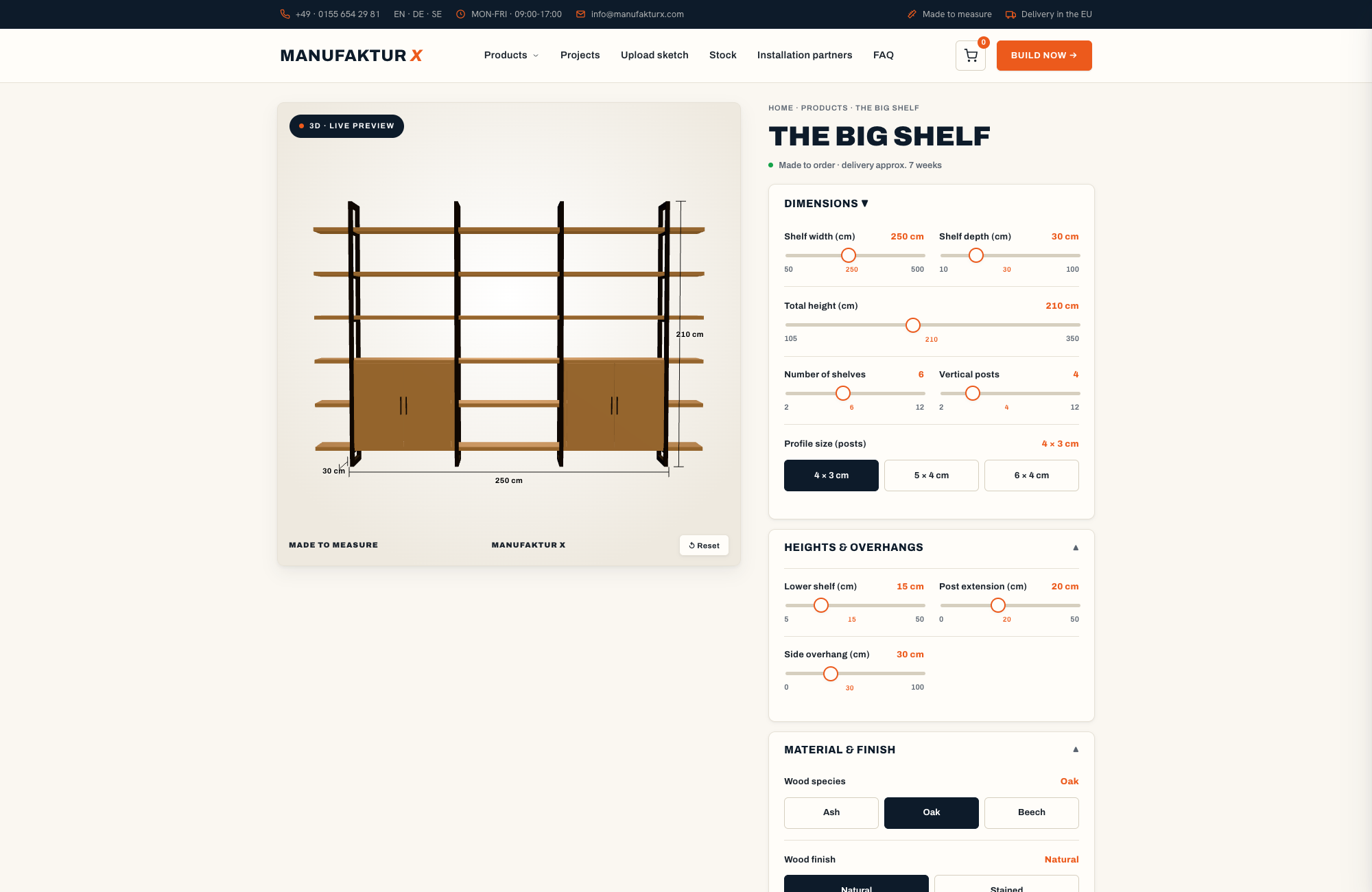
Option B - Upload a sketch: If your project has requirements that go beyond the standard configurator options, you can upload your own sketch or drawing to manufakturx.co.uk. The team will assess feasibility and come back with a tailored quote.
Step 5: Installation and Final Check
Begin by checking all components against the delivery note before you start. Standard tools for installation: a cordless drill, a spirit level, a tape measure, a hammer and a set of screwdrivers. Once everything is in place, test every function methodically - doors open and close cleanly, shelves are level and carry the expected load, all fixings are secure.
Post-installation checklist:
- All parts present and undamaged?
- Dimensions match what was ordered?
- All moving parts functioning correctly?
- Structure is level and stable?
- No transit damage to surfaces or finishes?
How the Manufaktur X 3D Configurator Works
The configurator is designed to replace the need for a showroom visit or a lengthy consultation. You work through every decision at your own pace, see the result in three dimensions, and know the price at every step. The sequence runs as follows:
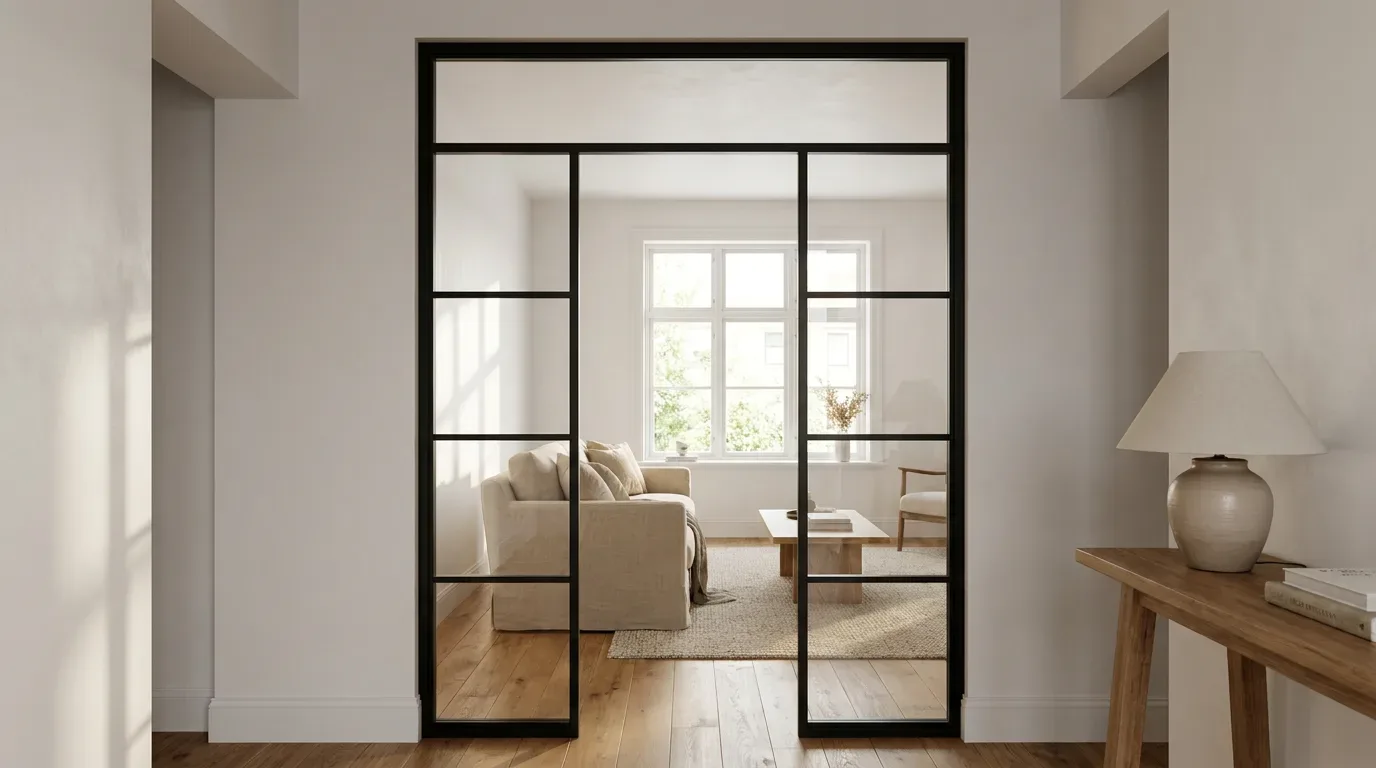
- Choose your product type: Loft door, room divider, dining table, coffee table, bench, large shelf or pipe shelf
- Set your dimensions: Enter your exact required measurements - width, depth and height
- Select your wood species: Oak, beech or ash
- Choose your stain: Over 50 options, from natural to deep tones
- Choose your steel colour: Full RAL powder-coating range
- Configure your glass (loft doors and room dividers only): Clear, frosted, smoked, dark smoked or textured; ESG or VSG
- Select your handle style (loft doors only): Long, Discreet or Half-Moon
- Review the 3D preview: Check the result and adjust anything before ordering
- Review pricing and delivery: Full cost including UK delivery shown transparently in the basket
The price recalculates in real time with every change. No surprise charges at checkout. Delivery to the UK includes all customs and import duties - nothing to sort out on your end.
Bespoke Furniture in Practice: What Works Where
Loft Doors: Light Without Noise
A made-to-measure loft door separates two rooms without blocking natural light or creating the visual weight of a solid wall. This is particularly valuable in older British homes where rooms can feel dark - a steel and glass door between a kitchen and a dining area, for instance, keeps the flow of light while containing cooking smells and noise. Because the door is made to the exact width and height of the opening, there is no need for a liner or an awkward filler strip. The opening can be 900 mm or 1,380 mm - it makes no difference.
Loft doors work especially well for:
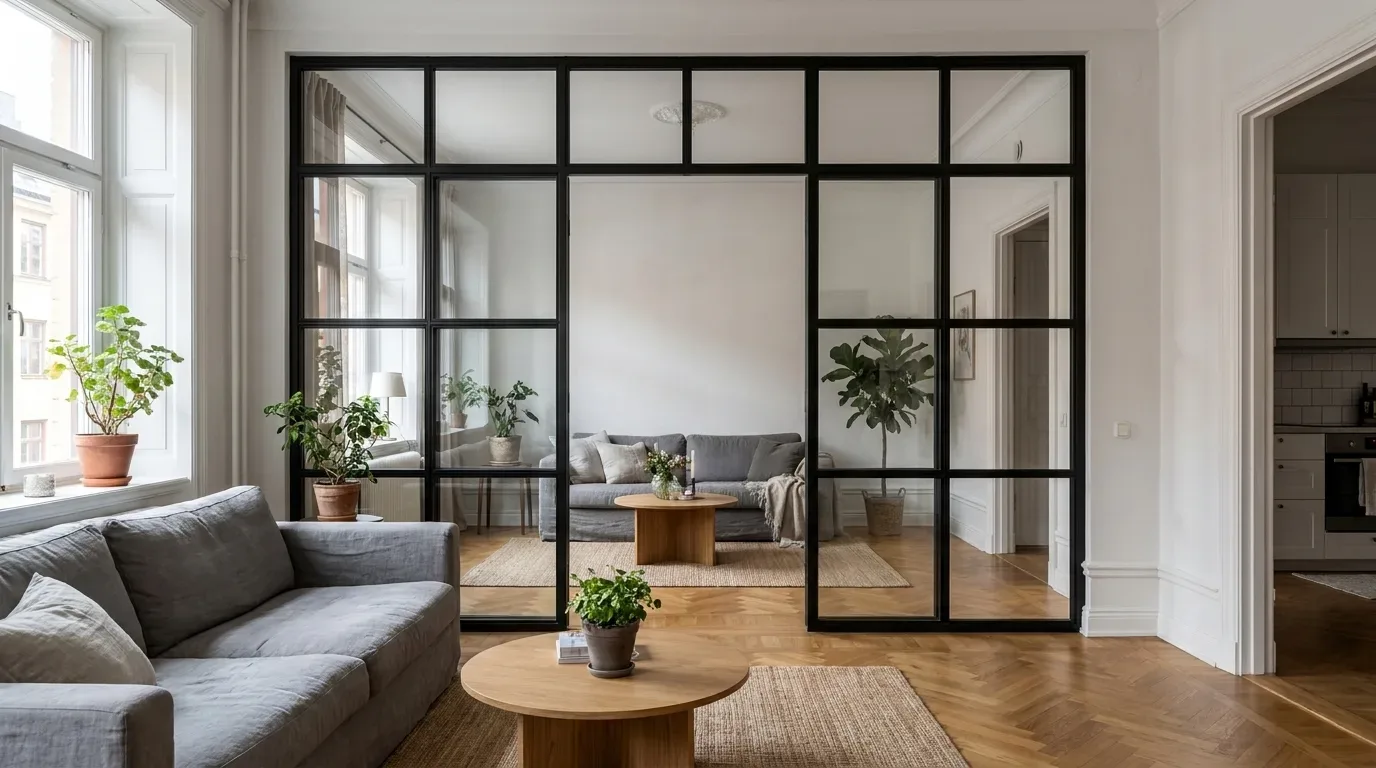
- Separating a kitchen from a living or dining area in an open-plan ground floor
- Creating a dedicated home office space without closing off a room entirely
- Non-standard door openings in period properties or extensions
- Any space where you want separation without sacrificing borrowed light
Room Dividers: Defining Space Without Building Work
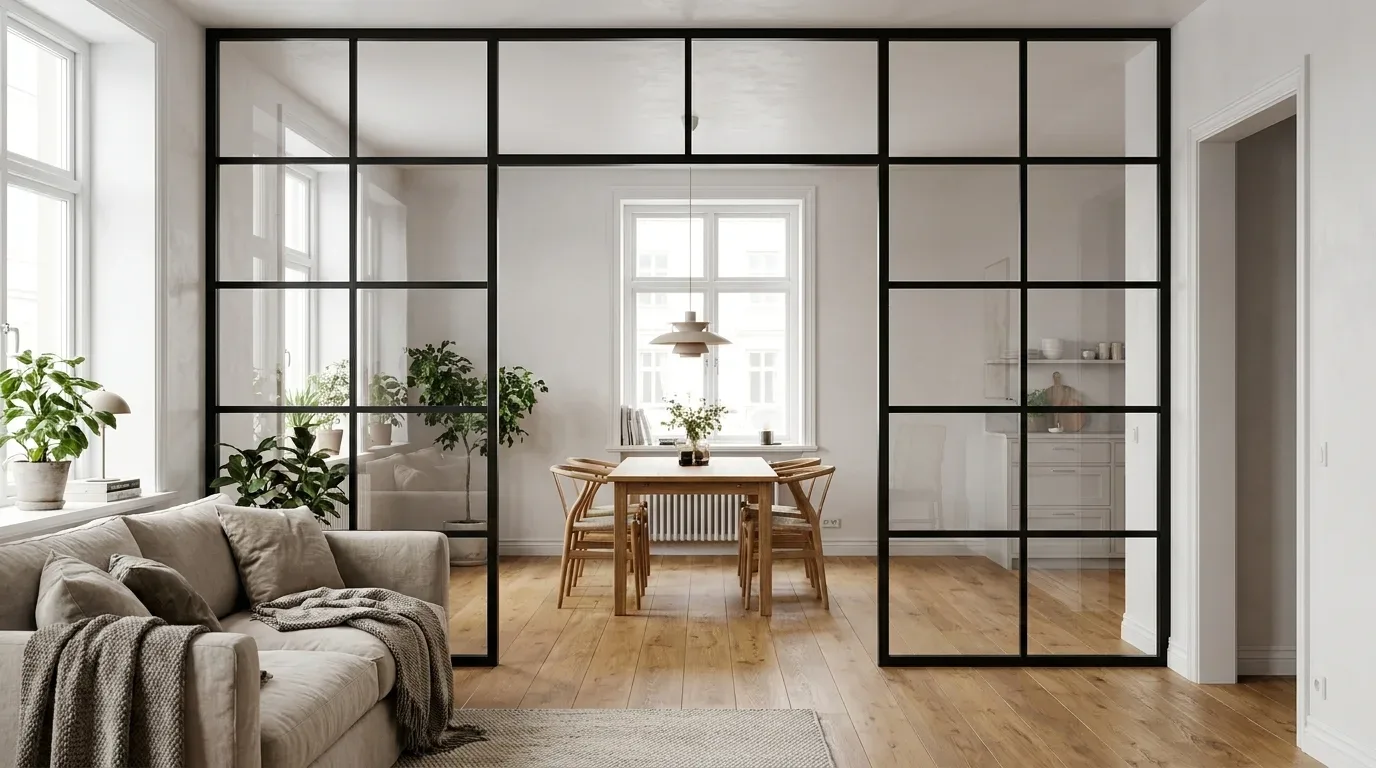
Open-plan living has dominated British interior design for the better part of two decades - but many people are now discovering that a large undivided space is harder to live in than it looks on a property listing. A bespoke steel and glass room divider creates a clear visual boundary between zones - living and dining, sleeping and working, entrance and reception - without the disruption, cost and drying time of stud walling.
Steel and glass partitions read as deliberate architectural elements rather than improvised screens. They have a visual quality closer to an exposed RSJ or a retained original feature than to a piece of furniture. The room divider is a fixed structure; if you need to walk between the two zones, a walk-through aperture without a door can be included in the design.
Shelves, Tables and Benches: Where Steel Meets Solid Wood
The solid wood and steel range from Manufaktur X covers the pieces that make up most of daily life at home:
- Large shelf: Steel frame with solid wood shelves, sized to fit a specific wall or alcove precisely. The alcoves beside a Victorian chimney breast are a natural home for this - made to the exact depth and width of the recess, with integrated cupboards below if needed.
- Dining table: A solid wood or veneer top on a powder-coated steel base, in exactly the dimensions your dining room allows - not the nearest standard size.
- Coffee table: Configured to sit at the right height relative to your specific sofa rather than a hypothetical average one.
- Bench: Solid wood or veneer with a steel frame - works at a dining table, in a hallway, or at the foot of a bed.
- Pipe shelf: Steel tube construction with solid wood shelves - the industrial aesthetic that has defined so much of British interior design since the early 2010s, made to fit your exact wall space.
Cost and Lead Times: What to Expect Realistically
Understanding the Cost of Bespoke
Bespoke furniture costs more upfront than a flat-pack equivalent. But comparing purchase prices in isolation misses the point. Consider a solid oak dining table at £2,000: spread across 20 years of use, that is £100 per year. A comparable high-street piece at £600 with a realistic lifespan of 7-8 years costs roughly £75-85 per year - and at the end of that period, it goes to landfill. The solid oak table, properly maintained, gets re-oiled and carries on.
Solid wood and powder-coated steel can both be refinished after 15-20 years - the wood sanded back and re-oiled, the steel stripped and recoated. Veneered chipboard cannot be refinished once the surface layer is worn through. The entry price for a Manufaktur X loft door is £1,157. Current pricing for all products is shown live in the relevant configurator.
Lead Times: Plan Ahead
Production time at Manufaktur X is 5-6 weeks from order confirmation. This is the manufacturing lead time - it does not include delivery transit. If you are coordinating a refurbishment or a move, build this into your project timeline from the outset rather than ordering reactively.
Is Bespoke Right for Your Situation?
| Factor | Bespoke furniture makes sense | Standard retail may be sufficient |
|---|---|---|
| Room type | Period property, conversion, non-standard dimensions | New-build with standard proportions |
| How long you plan to stay | Long-term home, not planning to move soon | Short-term rental, frequent moves |
| Budget approach | Willing to invest for longevity | Need to minimise upfront spend |
| Design priorities | Specific aesthetic, exact material control | Happy with standard options |
| Sustainability | Important - want something refinishable and long-lived | Less of a priority |
Craftsmanship, Quality and Sustainability
Solid wood is not a stable, inert material - it responds to the seasons. In a British home, that means contraction in winter when the central heating runs and the air dries out, and slight expansion in summer. In our production process, this is accounted for at every stage: the way boards are selected and oriented, the way joints are cut, the tolerances built into the design. A piece of furniture that does not allow for this movement will fail eventually - a piece that is made with it in mind will last for decades.
All Manufaktur X products are manufactured in the EU and pass through quality control before dispatch. The sustainability case for bespoke is straightforward: longer lifespan means fewer replacement purchases; refinishability means fewer complete disposals; EU production means shorter supply chains than furniture manufactured in Southeast Asia. And there is a less quantifiable factor too - furniture you have configured yourself, that fits your home exactly and reflects your choices, tends to stay. It does not get replaced on a whim.
The environmental arithmetic works out:
- Longer lifespan - fewer manufacturing cycles per decade
- Refinishable materials - less waste at end of useful life
- EU production - shorter transport distances
- Higher emotional investment - less impulse replacement
Caring for Solid Wood and Powder-Coated Steel
Bespoke furniture made from quality materials is not high-maintenance - but it does reward basic care:
- Oiled surfaces: Re-oil once or twice a year with a suitable wood oil. This keeps the grain supple, protects against moisture and allows minor surface scratches to be absorbed rather than left as visible marks.
- Waxed surfaces: Similar to oiling - rewax when the surface starts to look dull. Slightly more water-resistant than oil in day-to-day use.
- Powder-coated steel: Wipe with a damp cloth. Avoid abrasive cleaners or wire wool - they will cut through the coating.
- Glass: Standard glass cleaner or a damp microfibre cloth. Nothing specialist required.
- Restoration after years of use: Solid wood can be sanded back to bare wood and refinished - a complete surface renewal without replacing the piece. This is not possible with any veneered or chipboard product.
If you are choosing between an oiled and a lacquered finish, the oiled surface is the better long-term investment. Lacquer can look pristine for longer in the short term, but once it chips or wears through, refinishing is a significant job. An oiled surface ages gracefully and can always be brought back.
Configure Your Bespoke Furniture
The Manufaktur X 3D configurator lets you design loft doors, room dividers, shelves, tables and benches to your exact dimensions, in your chosen materials and finishes - with a live 3D preview and instant pricing at every step. Delivery to the UK includes all customs and import duties, with no hidden charges at checkout.
Browse the full range at manufakturx.co.uk. For complex projects with requirements beyond the standard configurator, you can upload your own sketch and receive a bespoke quote. Questions? The FAQ section covers the most common queries in full.
Frequently Asked Questions About Bespoke Furniture
What exactly is bespoke furniture and when does it make sense to buy it?
Bespoke furniture is made to your precise measurements, material preferences and design requirements - not pulled from a warehouse. It makes the most sense in homes with non-standard dimensions (period properties, conversions, rooms with sloped ceilings or chimney breasts), when you plan to stay in a property long term, and when you want full control over the materials and finish. If you have tried to furnish an alcove or an unusual doorway with standard retail options and been left with gaps or compromises, bespoke manufacture resolves that problem at the source.
Which wood species does Manufaktur X use?
Manufaktur X works exclusively with three hardwoods: oak, beech and ash. All three are chosen for hardness and durability - there are no soft or semi-soft woods in the range. Over 50 stains are available to adjust the tone and colour of each species. For dining tables, coffee tables and benches, both solid glued wood tops and veneer options are available. Shelves are always solid wood.
What is the difference between a loft door and a room divider?
A loft door is a functioning door: it has a frame, a hinge side (left or right), an opening direction, a handle and hinges. It opens and closes. A room divider is a fixed steel and glass partition wall with none of those elements - no hinge, no handle, no opening. It divides a space permanently. If you want to be able to walk between the two zones, a walk-through aperture (an unglazed opening with no door) can be incorporated into the room divider design.
How do I measure correctly for a loft door or room divider?
Measure the width and height of the opening at three points each - left, centre and right for width; top, middle and bottom for height. In a period property, these measurements will often vary by 10-25 mm across the same opening. Always enter the smallest measurement you record. For a loft door, deduct the installation clearance from that figure before entering it in the configurator: allow approximately 5 mm per side (left, right and top) for the fitting gap. The configurator works from your desired finished dimensions, not from raw construction opening sizes.
What glass options are available for loft doors and room dividers?
There are five glass appearance options: clear glass, frosted glass, smoked glass, dark smoked glass and textured glass. Separately, you choose between ESG (toughened safety glass, which breaks into small blunt fragments) and VSG (laminated safety glass, where the interlayer holds broken fragments in place). For most adult households and fixed room dividers, ESG is suitable. For loft doors in homes with children, or for larger panel dimensions, VSG is the more technically robust choice.
How long does production take and what does a loft door cost?
Production time is 5-6 weeks from order confirmation. Loft doors start from £1,157 for the entry-level configuration. Pricing for all products is shown live in the configurator as you build your specification - including delivery to the UK with all customs and duties included.
Can I submit my own drawings if my project is unusual?
Yes. If your project has specific requirements that go beyond the standard configurator options, you can upload your own sketch or technical drawing via the Manufaktur X website. The team will assess what is possible and provide a tailored quotation.
How do I look after solid wood furniture over the long term?
Oiled surfaces should be re-oiled once or twice a year. This keeps the wood protected and means minor surface marks can be worked in rather than standing out. Waxed surfaces should be rewaxed when the sheen starts to dull. After many years of use, solid wood furniture can be sanded back to bare wood and fully refinished - a level of restoration that no veneered or chipboard product can offer. Powder-coated steel simply needs a wipe with a damp cloth; avoid anything abrasive.