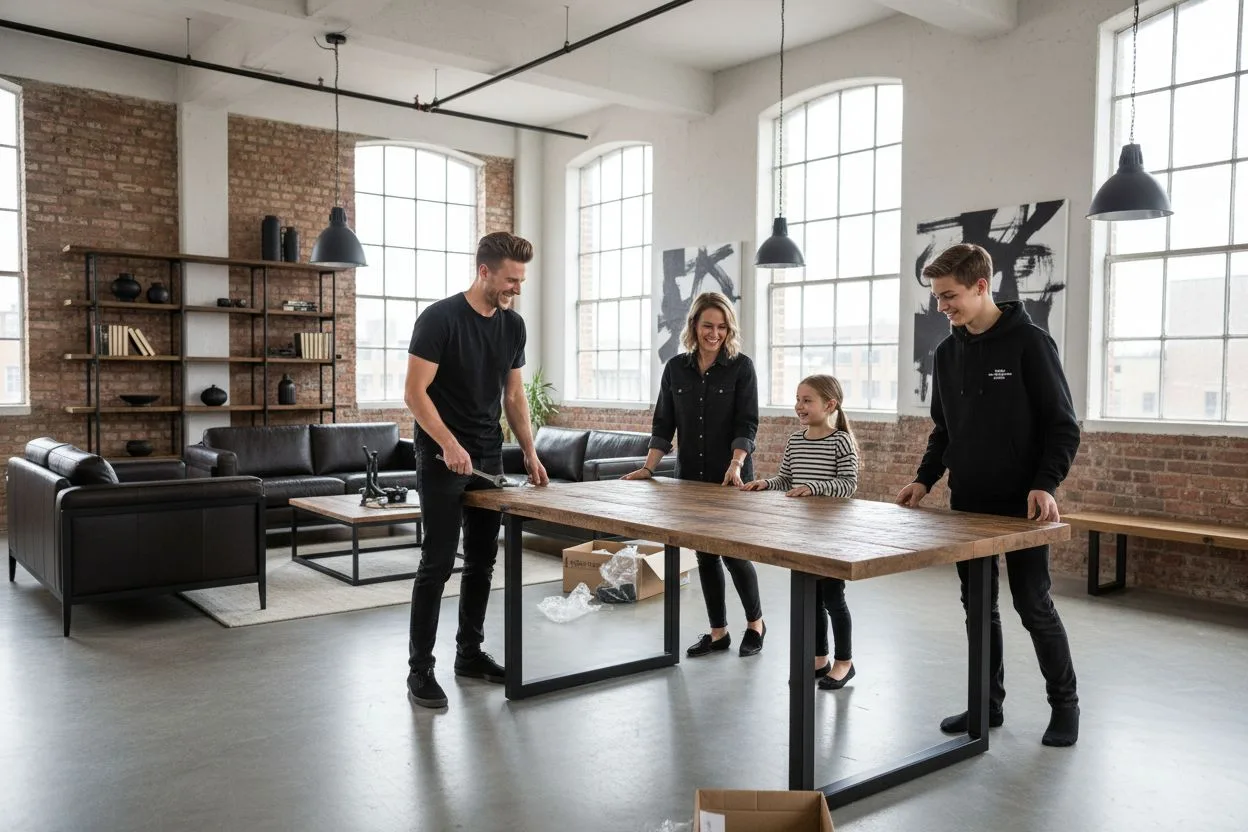
There is a particular satisfaction in a room where everything fits - not approximately, not with a filler strip wedged down the side, but genuinely, precisely fits. If you live in a Victorian terrace with non-standard ceiling heights, an Edwardian semi with deep bay windows, or a period conversion where no two walls run quite parallel, you already know that furniture from a catalogue rarely tells the whole story. Manufaktur X builds individual pieces from powder-coated steel, solid wood and - for loft doors and room dividers - safety glass, made to the exact dimensions you enter. Nothing more, nothing less.
What Is Industrial-Style Bespoke Furniture?
Industrial style is not a trend that peaked and faded. It is a design philosophy rooted in authenticity: materials used honestly, construction shown rather than hidden, and function treated as the starting point rather than an afterthought. Bespoke furniture in this idiom brings that factory-floor directness into domestic spaces with precision craft behind every joint and weld.
The aesthetic has its origins in the conversion of redundant industrial buildings - warehouses, printworks, textile mills - into living spaces from the late 1970s onwards. Early occupants kept what was already there: heavy timber workbenches, iron pipe shelving, raw brick walls. What began as pragmatism became a recognised visual language. Today the same principles translate equally well into a new-build flat in Manchester, a loft apartment in East London, or a barn conversion in the Cotswolds.
What distinguishes genuine industrial style from a superficial interpretation is that nothing is disguised. Welds, bolt heads, wood grain, the texture of powder-coated steel - these are features, not flaws.
Defining Characteristics of the Industrial Aesthetic
- Honest materials: Steel, solid hardwood and glass used without veneers or laminates concealing cheaper substrates beneath
- Visible construction: Bolts, joints and frame members are part of the visual statement, not something to be boxed in
- Functional logic: Every element earns its place - the principle of "form follows function" applied with rigour
- Patina as character: Marks of use are welcomed rather than designed out; the piece improves with age rather than deteriorating
- Restrained colour: Anthracite, black, raw steel grey, warm earth browns - a palette that lets the materials speak
| Characteristic | What it means in practice |
|---|---|
| Material honesty | Steel, solid hardwood and glass - natural texture and structure left visible |
| Exposed construction | Visible joints, bolt heads and frame members used as design details |
| Colour palette | Grey, anthracite, black, rust and earth tones - authenticity over decoration |
| Surface treatment | Minimal processing; natural patina and raw texture are the point |
| Functional aesthetic | Every component has a clear practical purpose; no superfluous ornament |
Variations on the Theme
Industrial style is not monolithic. Depending on the room, the existing architecture and how much warmth you want to introduce alongside the raw elements, it takes several distinct forms:
- Classic Industrial: Maximum rawness - exposed brick, heavy steel, unfinished surfaces, closest to the original warehouse aesthetic
- Modern Industrial: A cleaner, more edited interpretation with precise lines and contemporary detailing
- Urban Loft: Softer forms, textile accents and lighter surfaces that make the look comfortable in a city flat
- Rustic Industrial: Reclaimed timber and worn finishes take the lead, with steel playing a supporting role
- Industrial-Scandi: The warmth and restraint of Scandinavian design tempers the harder edges of industrial materials
- Industrial-Vintage: Raw industrial form combined with nostalgic finds and period-appropriate accessories
Why Commission Bespoke Rather Than Buy Off the Shelf?
The question is reasonable. IKEA and John Lewis both carry industrial-influenced furniture at accessible price points. The honest answer is that they solve a different problem. Standard-width dining tables and fixed-depth shelving units work well in rooms designed around standard dimensions. British housing stock, however, is dominated by periods when standardisation was not the priority - Victorian terraces with alcoves either side of a chimney breast, 1930s semis with rooms that taper slightly, period conversions where the floor plan follows the original building's logic rather than a furniture catalogue's.
When a shelf needs to run the full width of an alcove, or a loft door must fill an opening with a sloped soffit above, or a dining table needs to seat eight in a room that is 310 cm wide rather than 360 cm, standard sizes either fail completely or produce a compromise that never quite looks intentional.
Precision Fit in Rooms That Resist Standard Dimensions
Bespoke industrial furniture is made to the dimensions of your specific space - not adapted to it with spacers and workarounds. In our experience, the most common reason a custom piece does not fit is an error in measurement, not a production fault. That is why the advice holds: always measure at multiple points, because British walls and floors are rarely perfectly plumb or level. Take the smallest measurement you find. For a loft door, subtract the fitting clearance - approximately 5 mm per side (left, right and top) - before entering your desired dimensions into the configurator. Manufaktur X manufactures exactly to the figures you provide.
Durability That Outlasts Flatpack
Oak, beech and ash are hardwoods. They are denser, harder and more resistant to daily wear than the softwoods and composite boards that make up most affordable flat-pack furniture. Powder-coated steel frames are scratch-resistant and carry an even, consistent colour that does not chip the way spray paint can. These materials are not chosen for appearance alone - they are the reason a well-maintained piece will still look purposeful in thirty years.
In our workshop, steel frame sections are powder-coated rather than painted. The process involves electrostatically applying a dry powder and curing it at high temperature, producing a finish that bonds to the metal rather than sitting on top of it. The result is more durable, produces no solvent emissions, and delivers a uniformity of colour that is difficult to match with liquid paint.
Sustainability Through Longevity
There is an environmental case for buying less, but better. A piece of solid oak furniture that lasts four decades displaces several rounds of replacement flatpack. The patina that develops on oak or ash over time is not deterioration - it is the furniture becoming more itself. That is worth considering alongside the upfront cost.
| Aspect | Bespoke industrial furniture | Standard off-the-shelf |
|---|---|---|
| Fit to room | Exact dimensions, no fillers or compromises | Fixed sizes; gaps or overhangs often unavoidable |
| Material quality | Solid hardwood (oak, beech, ash) and powder-coated steel | Often chipboard, MDF or thin veneer over composite |
| Design approach | Authenticity, raw beauty, function-first | Trend-led or purely functional; limited character |
| Longevity | Decades with basic maintenance; patina adds character | Replacement typically within 5-10 years |
| Production | Handcraft combined with CNC precision | Industrial mass production |
Materials at Manufaktur X: What Goes Into Every Piece
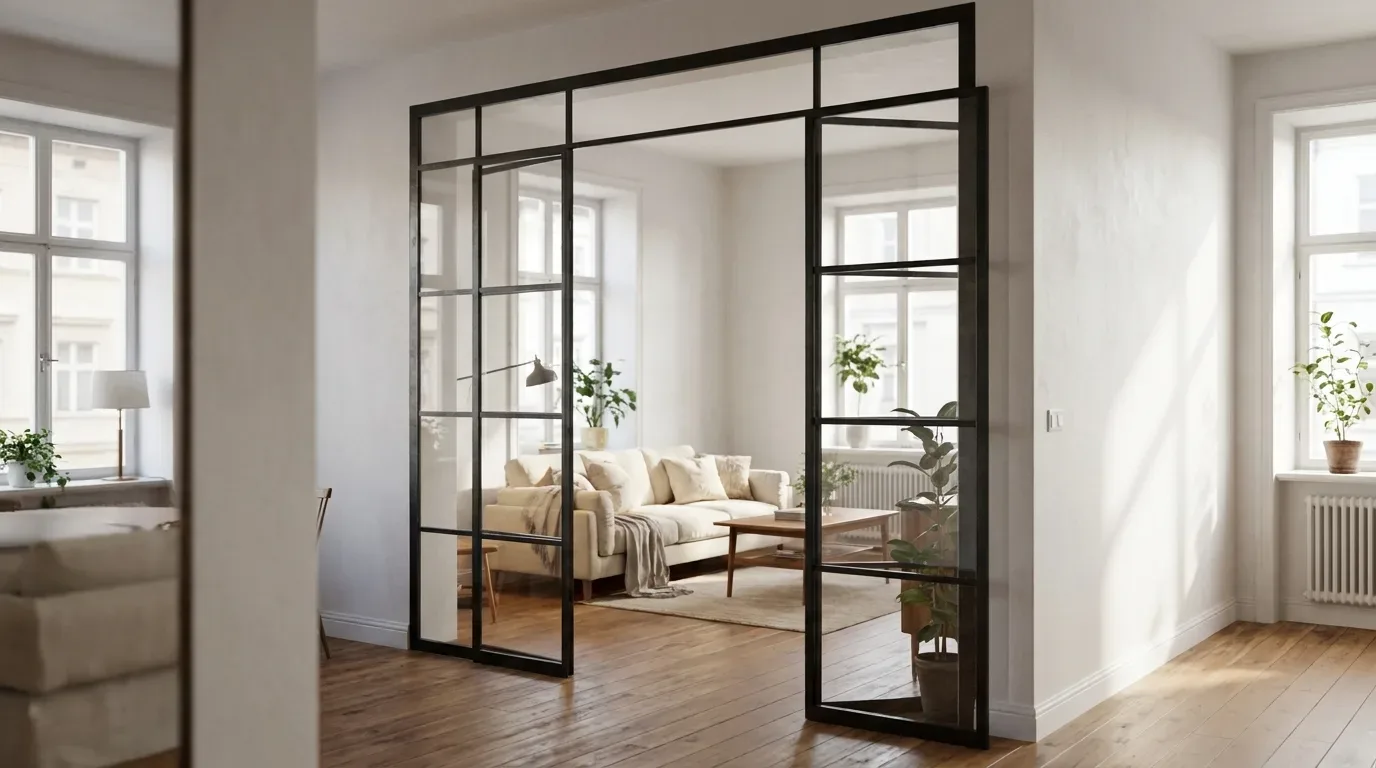
The material choice either makes an industrial piece convincing or exposes it as imitation. Manufaktur X works exclusively with solid hardwood, powder-coated steel, and - in loft doors and room dividers - safety glass. There are no shortcuts in the material list.
Solid Hardwood: Oak, Beech and Ash
Three species, all hardwoods, each with distinct character. Oak offers a pronounced open grain and excellent hardness - it is the most familiar choice for an industrial aesthetic and ages particularly well. Beech is finer-grained and slightly lighter in tone, lending itself to cleaner, more contemporary interpretations of the style. Ash has a striking, almost graphic grain pattern and a natural pale blonde colour that takes stain beautifully.
All three are substantially harder than pine and will resist dents and surface marks far better in daily use. Over 50 wood stain finishes are available, ranging from light natural tones through to deep, dark treatments that push oak towards near-black.
It is worth noting that table and bench tops are available either as solid glued-board construction (genuine solid wood, the default option) or as a veneered board - the configurator makes the distinction clear. Shelves, whether the large shelf or the pipe shelf, are always solid wood throughout.
Steel Frames: Powder Coating in Any RAL Colour
All steel frames are powder-coated - not painted. Anthracite (RAL 7016) and matt black (RAL 9005) are the most popular choices for an industrial finish; warm white (RAL 9010) works well in spaces that lean towards Industrial-Scandi. Any RAL colour is available if you have something more specific in mind. The powder-coating process produces a finish that is scratch-resistant, even in tone across the whole frame, and considerably more environmentally friendly than solvent-based paint - no VOC emissions during application.
Glass: Five Options for Loft Doors and Room Dividers
Glass is only part of the construction in two products: the loft door and the room divider. Within the configurator, five glass designs are available:
- Clear glass - maximum transparency and light transmission
- Frosted glass - soft privacy screening while still allowing light through
- Smoked glass - a tinted look with slight reduction in visibility
- Dark smoked glass - stronger tint for more privacy
- Textured glass - a surface pattern that scatters light in an interesting way
For glass type, both ESG (toughened safety glass) and VSG (laminated safety glass) are available. For larger dimensions - particularly tall loft doors or wide room dividers - Manufaktur X recommends VSG for the additional stability and safety it provides.
The Full Product Range from Manufaktur X
Every product sits in one of two categories: steel-and-glass pieces, and steel-and-solid-wood pieces. Here is what that means for each item.
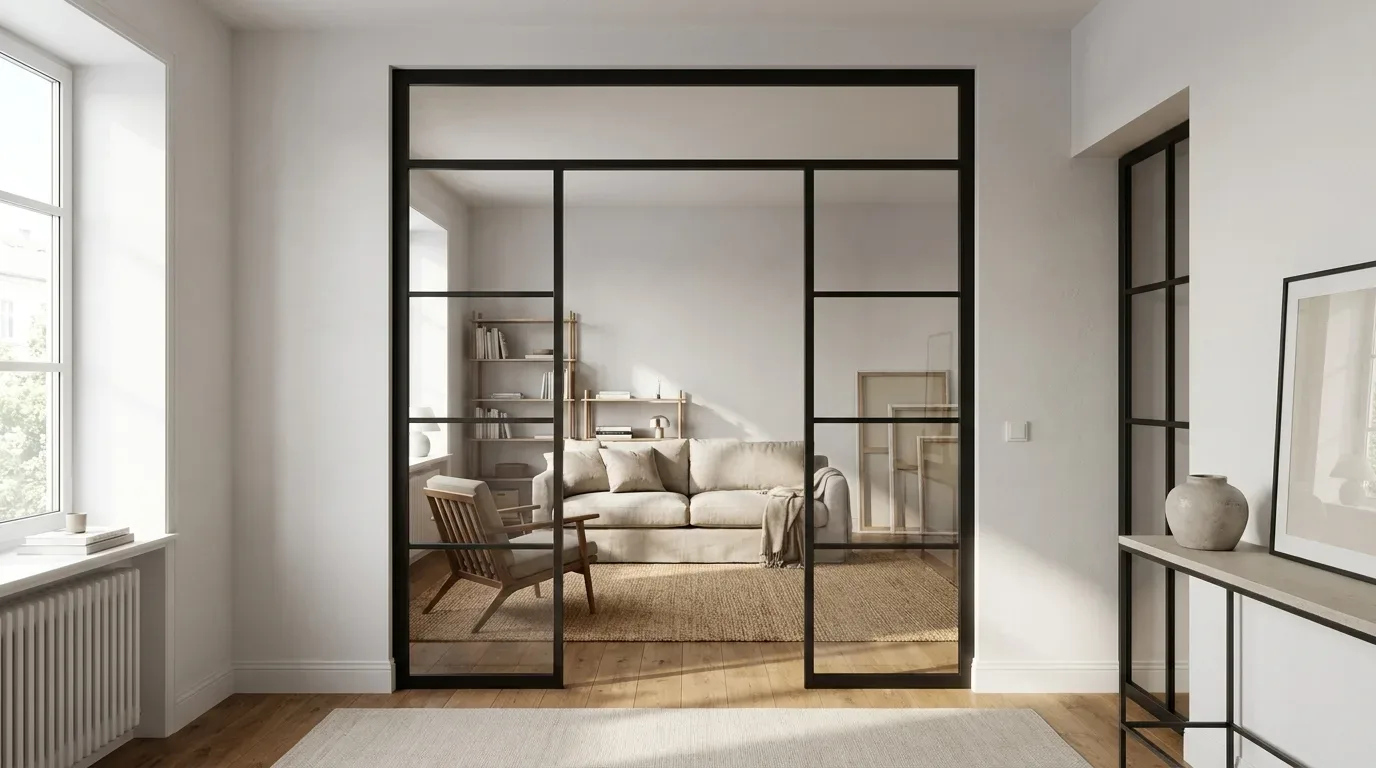
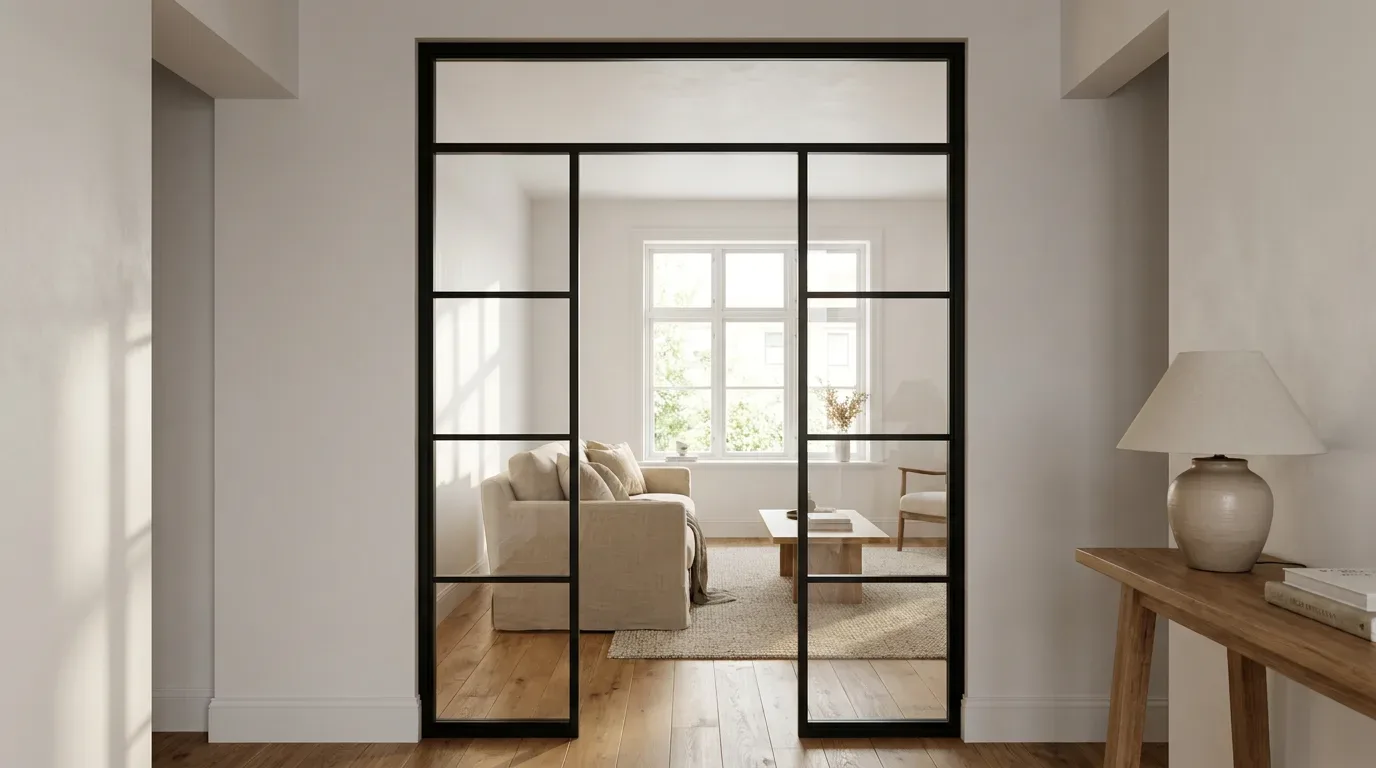
Loft Door - a Genuine Steel and Glass Door Made to Size
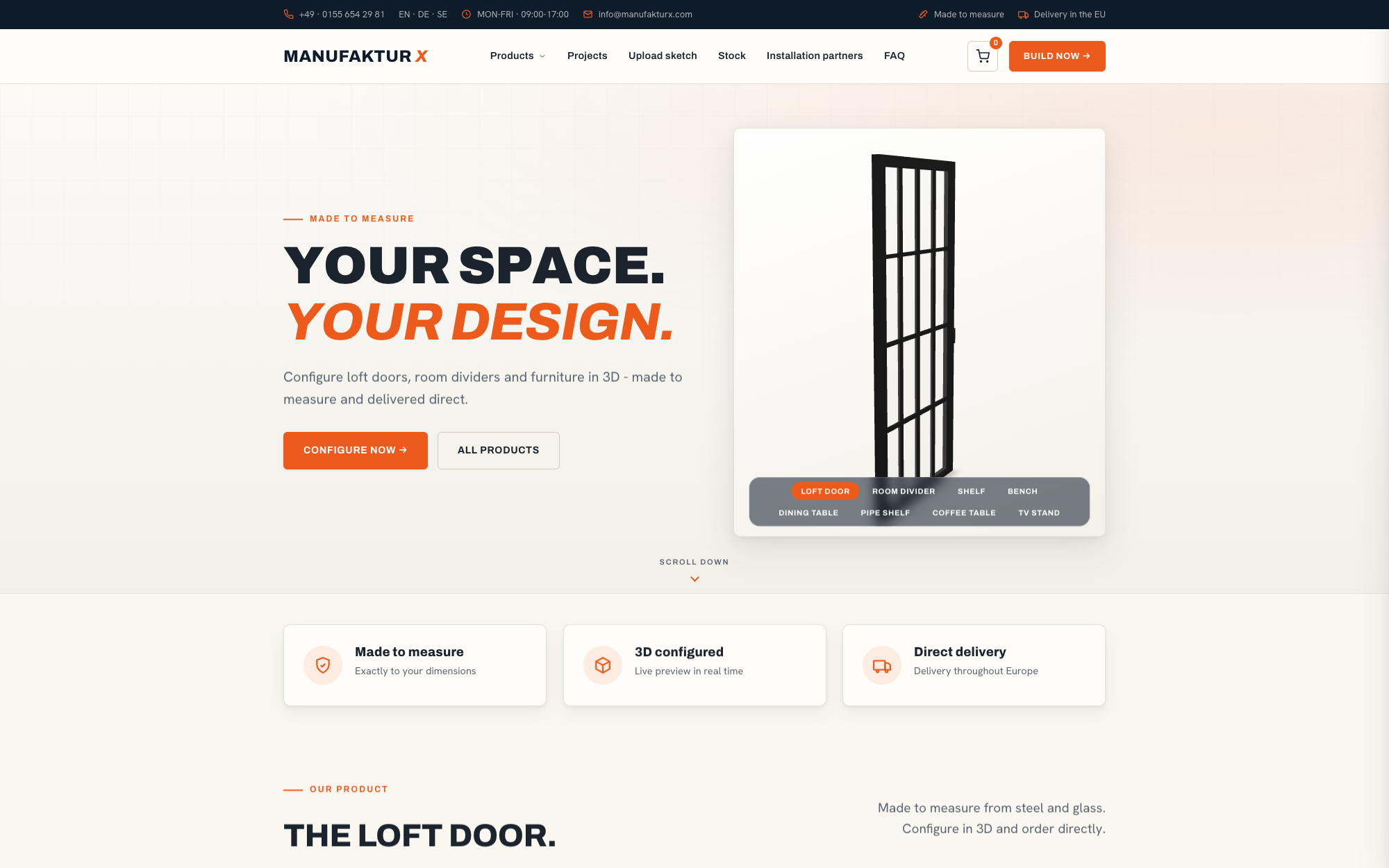
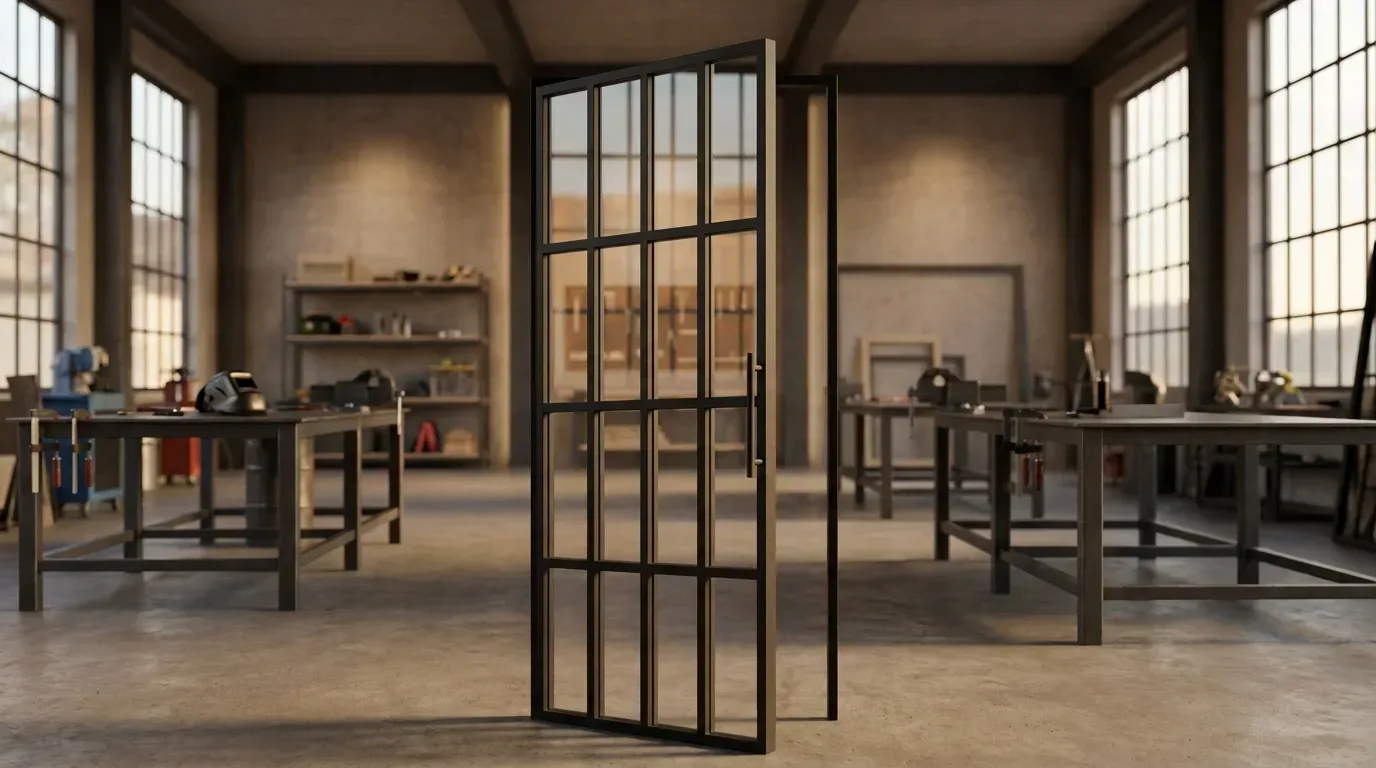
The Manufaktur X loft door is a real hinged door - not a partition, not a sliding panel. It has a door stop (hinge side selectable as left or right), a configurable opening direction and opening angle, and hinges. Three handle designs are available: Long, Discreet and Half-Moon. The slender steel profiles and generous glass panels deliver the classic factory look that has become one of the defining features of the industrial interior in British homes.
This product works particularly well in Victorian and Edwardian properties where original internal openings often have non-standard heights - typically anywhere between 195 cm and 230 cm - that would leave a standard door looking undersized or needing awkward packing at the head.
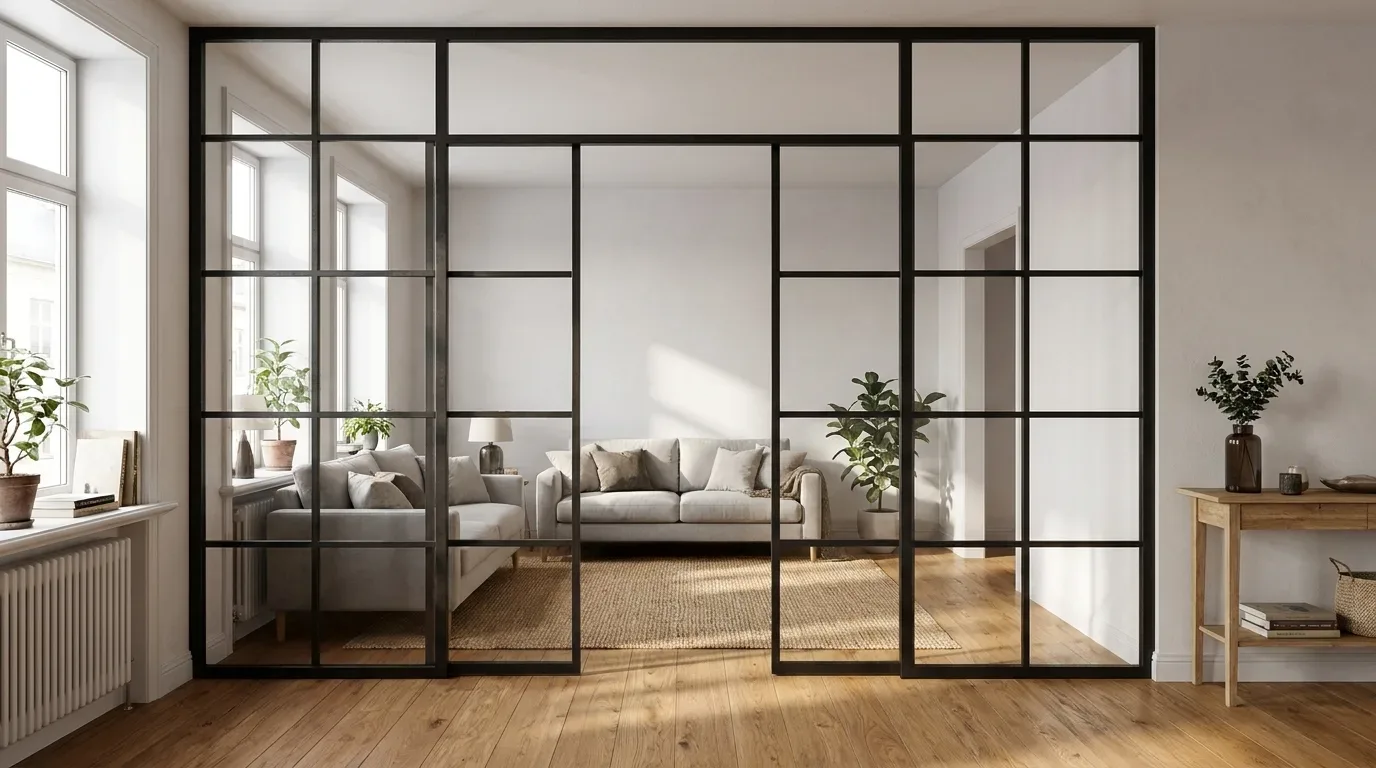
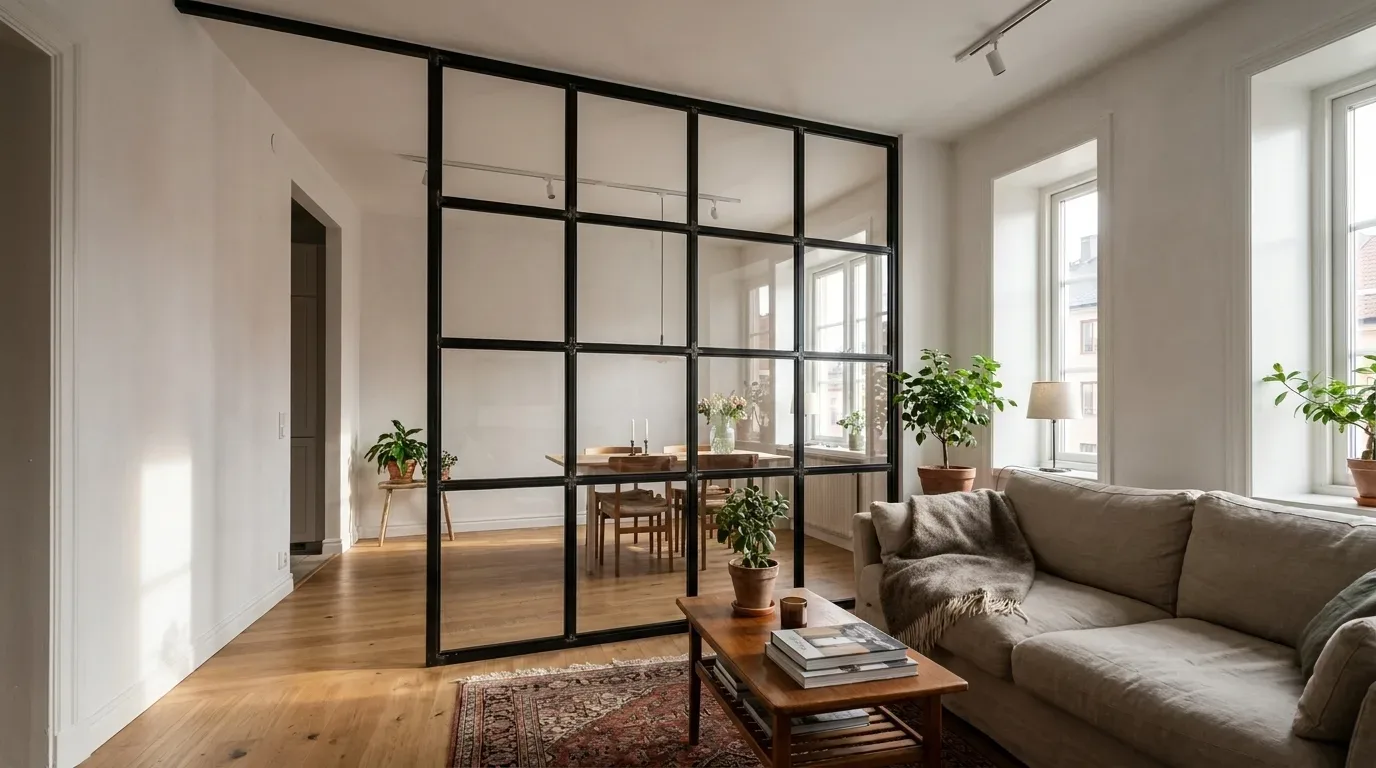
Room Divider - a Fixed Steel and Glass Partition Wall
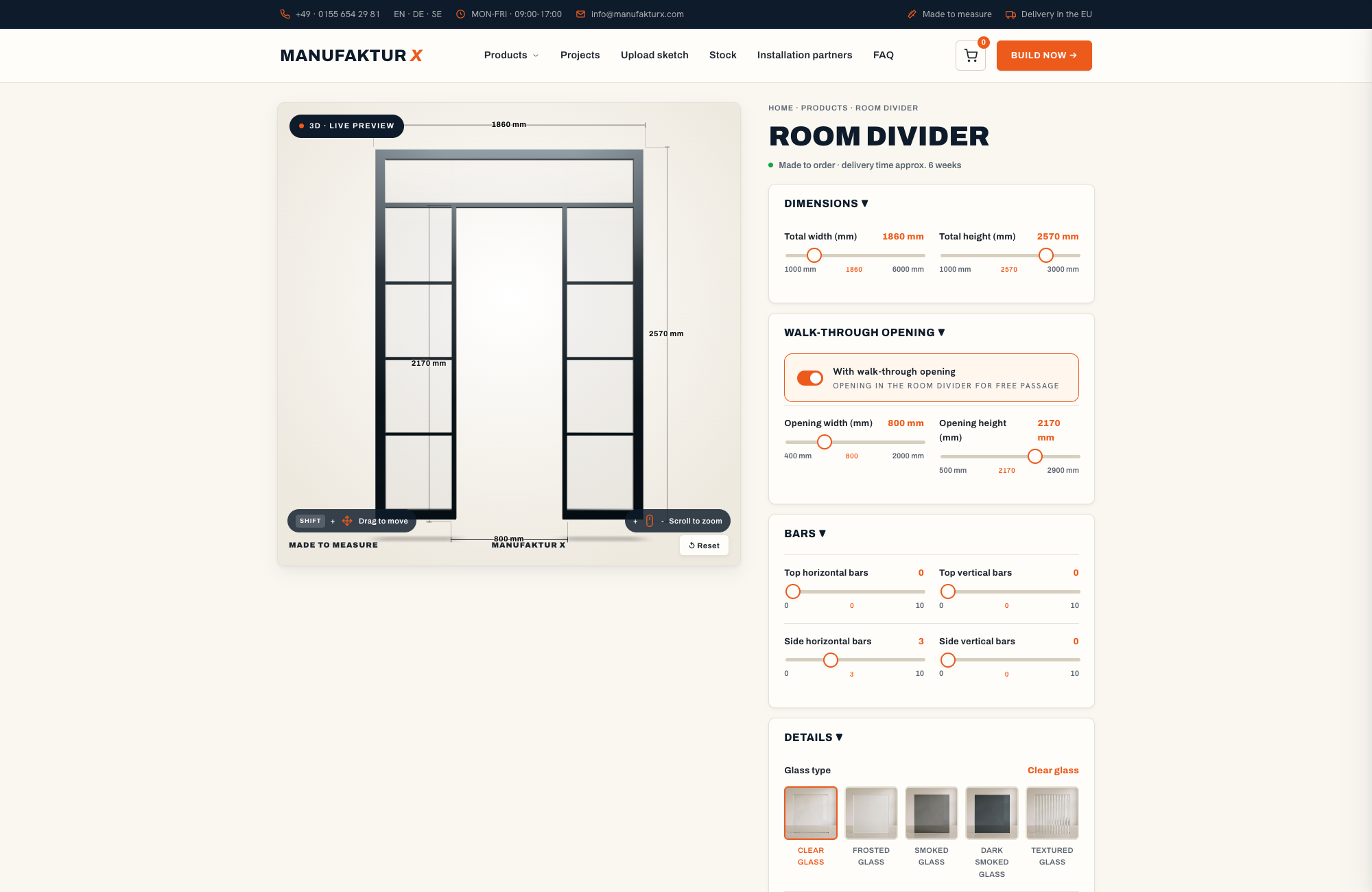
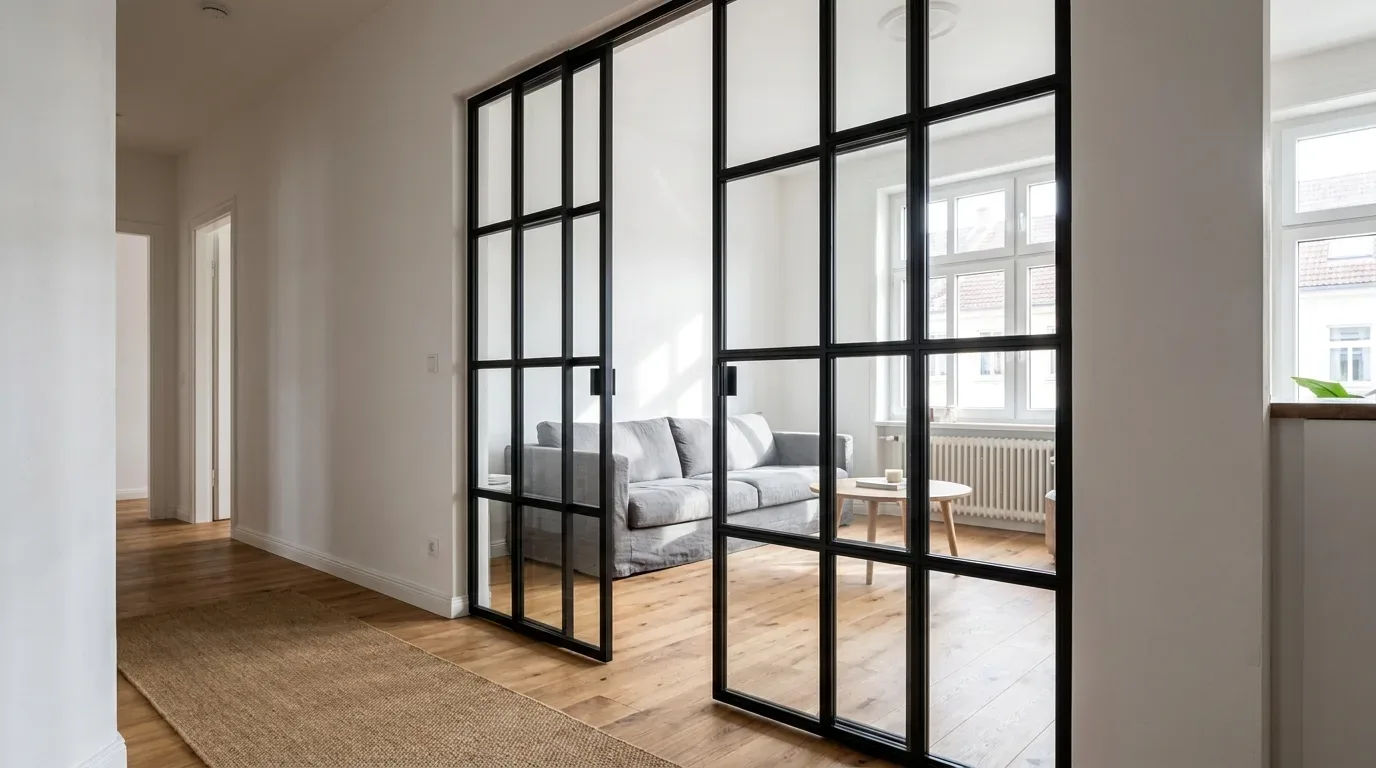
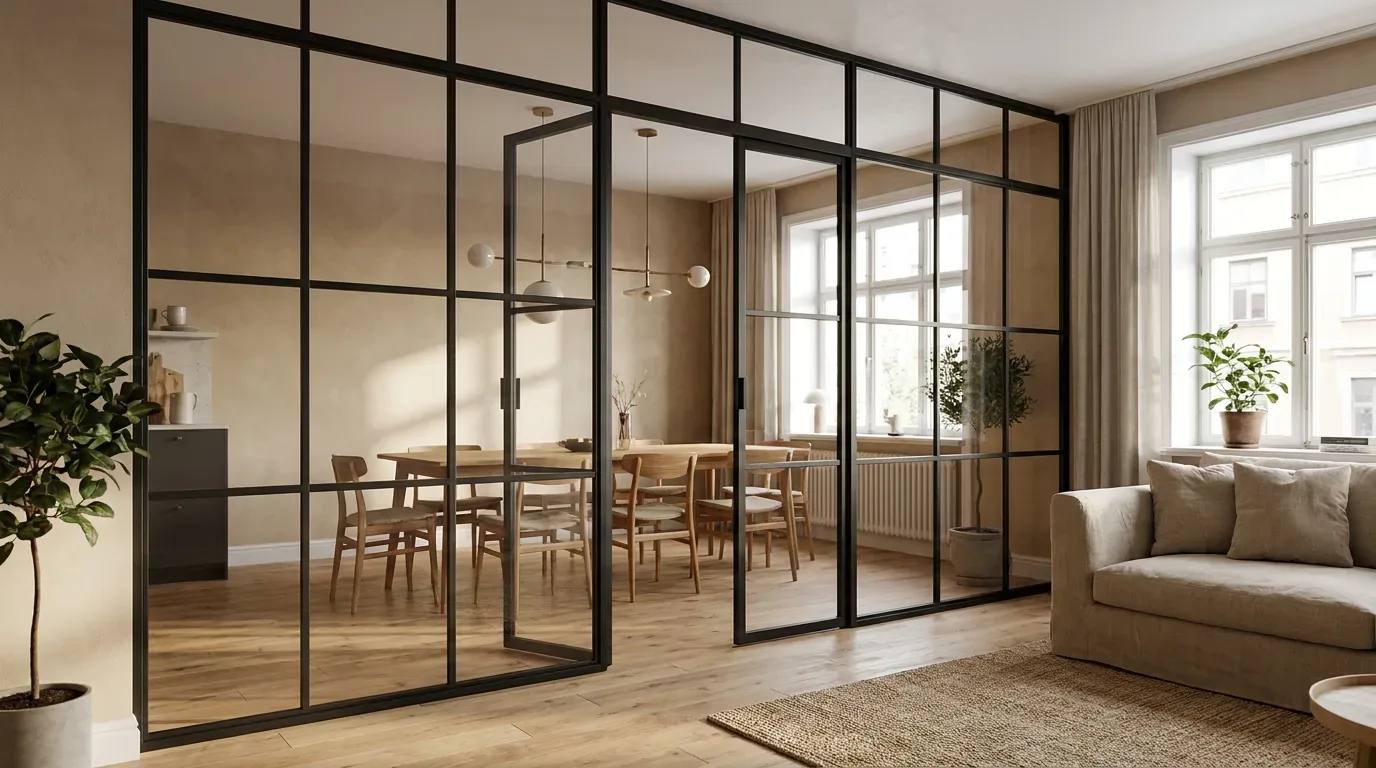
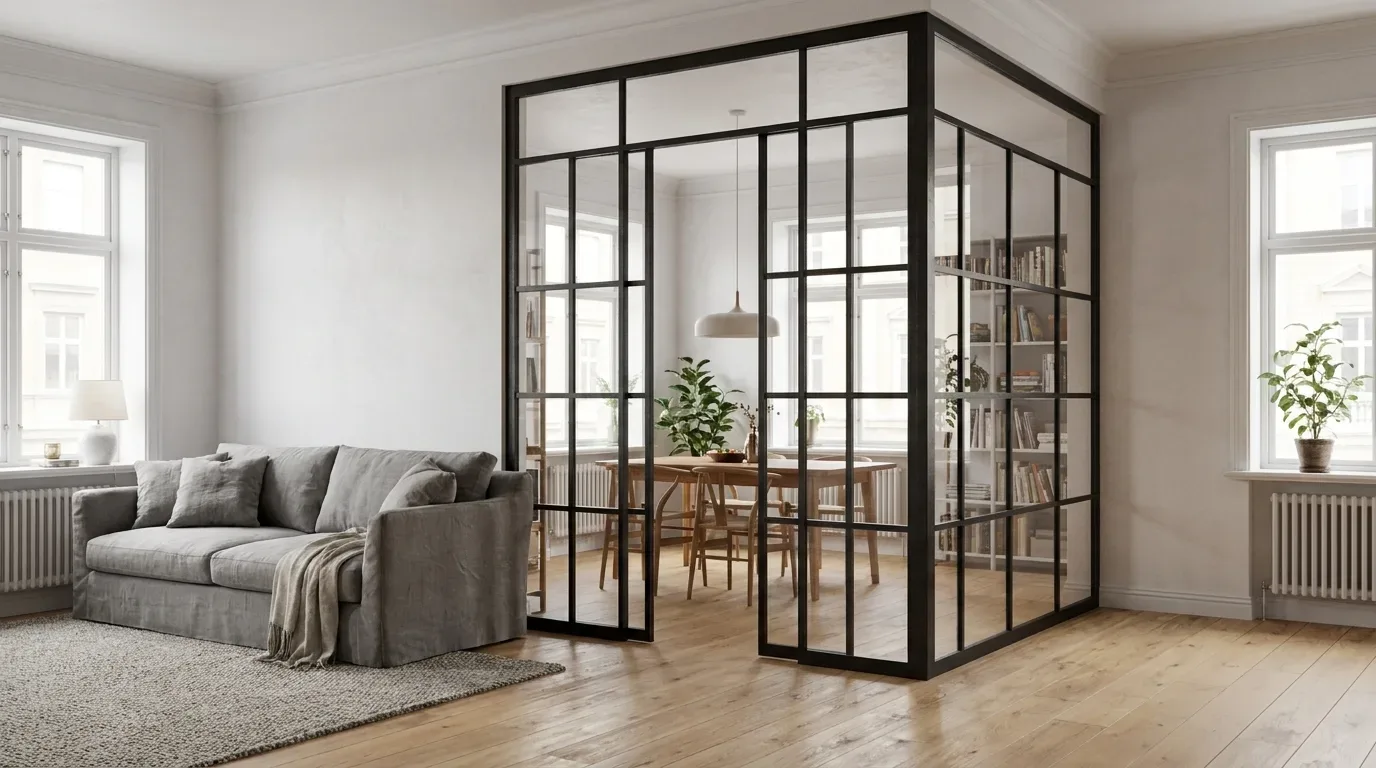
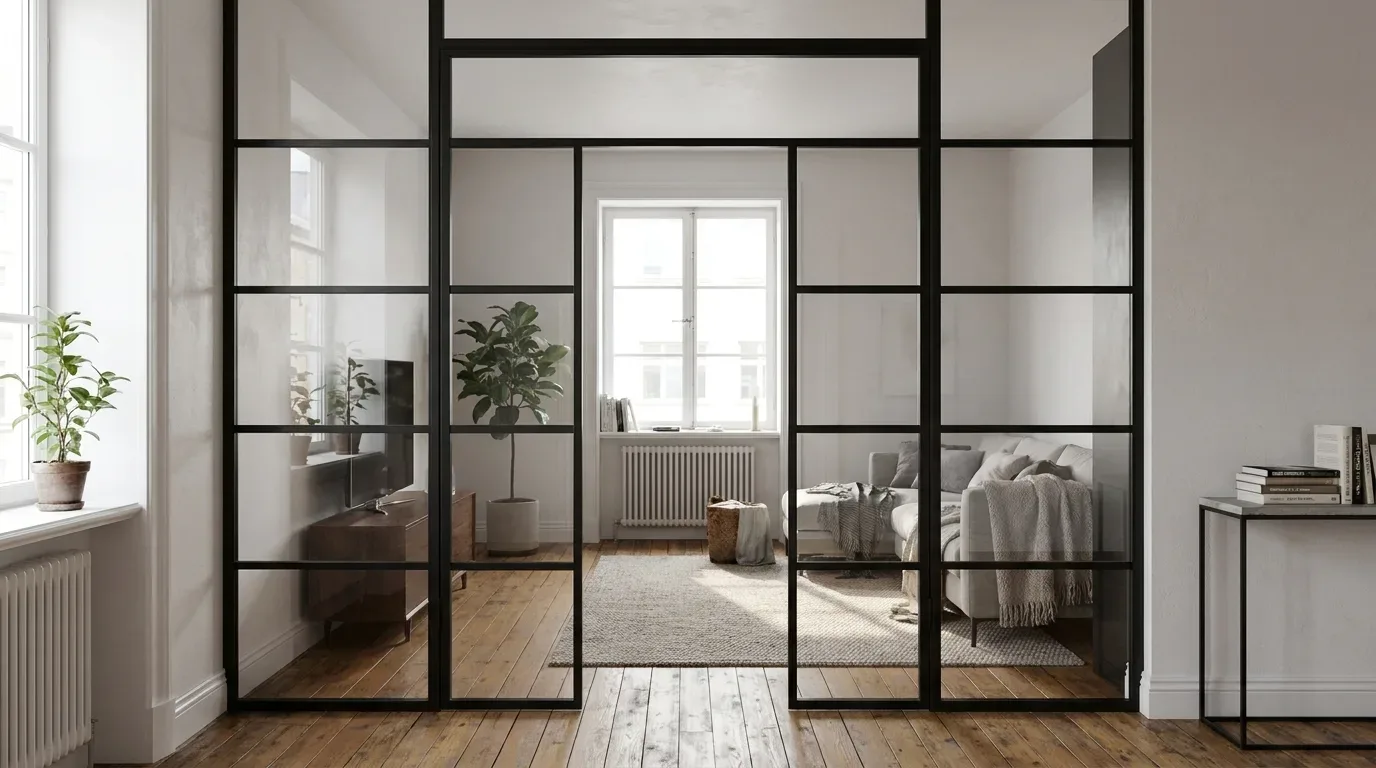
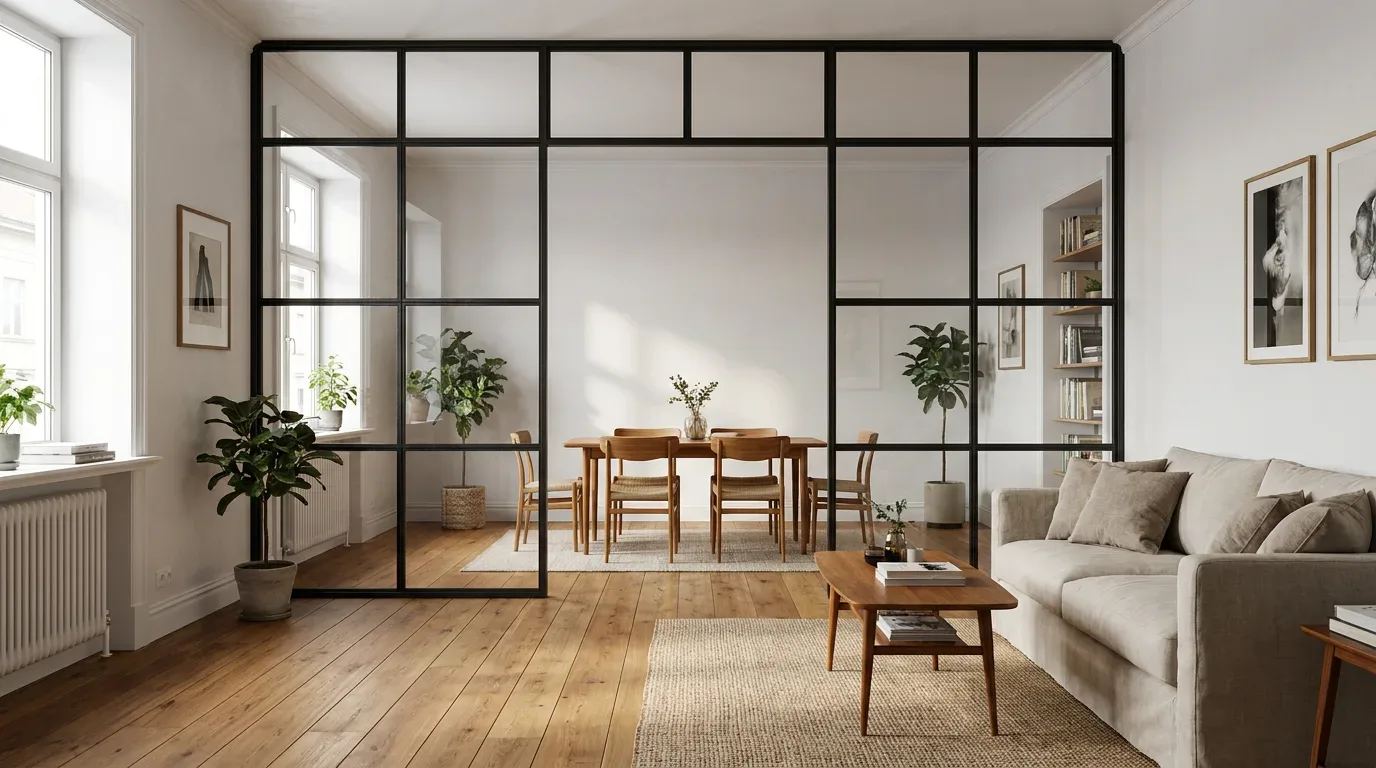
The Manufaktur X room divider is a permanently installed steel-and-glass wall - it does not open, swing or move. There is no door stop, no opening direction, no handle and no hinges. An open walkthrough can optionally be included as a gap within the structure, giving access without a door. This makes the room divider the right choice when you want to permanently define zones within an open-plan space - separating a home office from a living area, for instance - while keeping light moving through the glass panels.
The distinction matters: the room divider is a fixed wall. The loft door is a functioning door. They serve different purposes and the configurator for each reflects that difference clearly.
Large Shelf - Steel Frame with Solid Hardwood Shelves
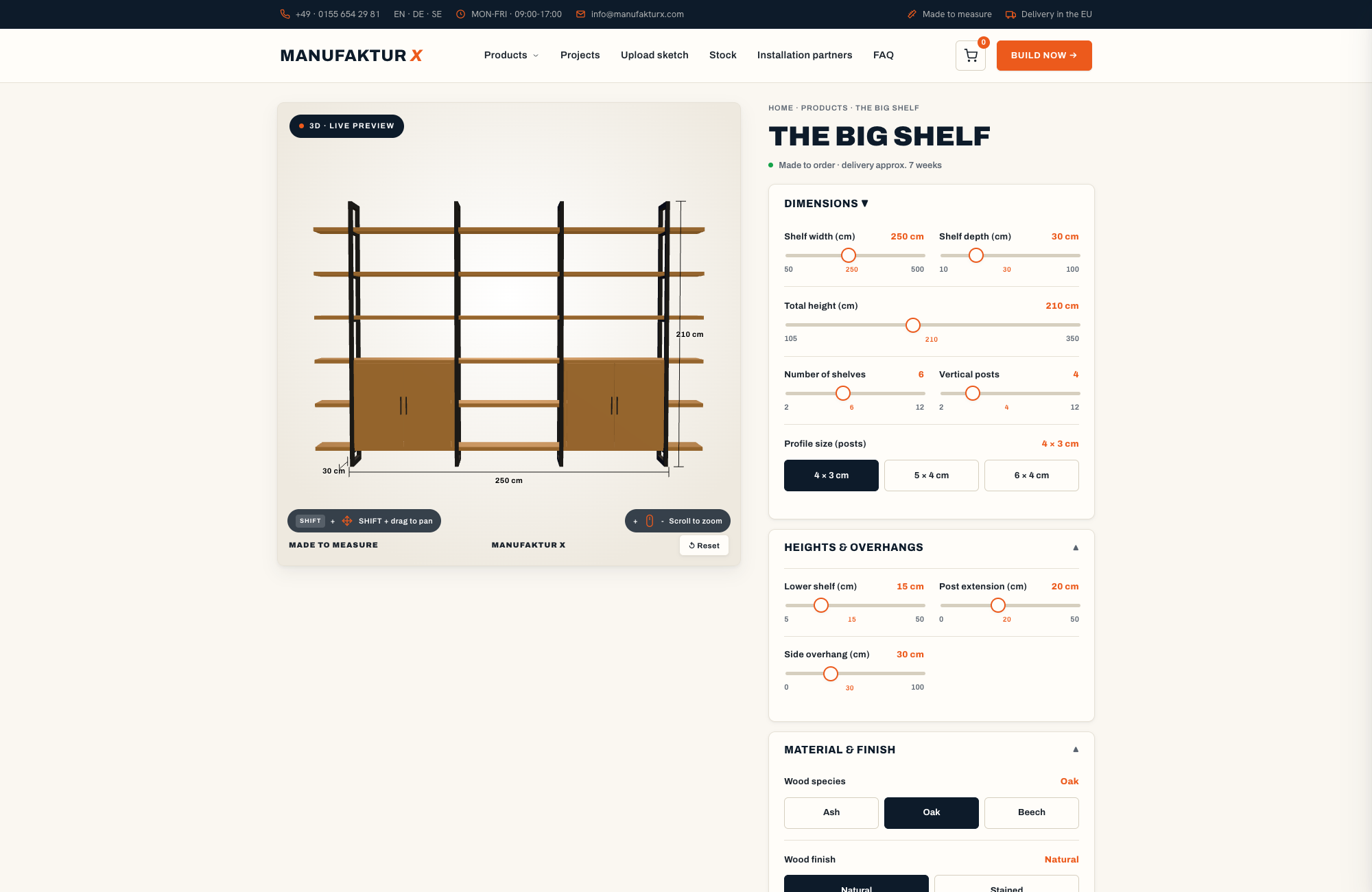
The large shelf pairs a steel frame with solid hardwood shelf boards in oak, beech or ash. Enclosed wooden cabinet sections can be added as an option. There is no glass involved - this is purely a steel-and-solid-wood construction that works as a room divider, a wall-mounted storage solution, or a freestanding shelving unit. Shelf boards are always solid hardwood throughout.
Dining Table and Coffee Table - Solid or Veneered Top on a Steel Frame
The dining table and the coffee table both combine a hardwood top in oak, beech or ash with a steel base. No chipboard, no glass, no composite - just two materials that summarise what industrial design means at the domestic scale: visible wood grain on the top surface, clean steel geometry below. Table tops are available as solid glued-board construction or as a veneered option; the configurator makes this choice explicit.
Bench - Solid Wood and Steel
The bench uses the same pairing: a hardwood seat in oak, beech or ash on a steel frame. Straightforward, robust, functional. As a standalone piece it works in a hallway or at the foot of a bed; alongside the dining table it creates a considered industrial grouping that is increasingly popular as an alternative to a full set of dining chairs.
Pipe Shelf - Steel Tube and Solid Hardwood
The pipe shelf is industrial design without ambiguity: steel tube as the structural and visual element, solid hardwood shelf boards in oak, beech or ash, connections left visible. No glass. It is the kind of piece that references the original warehouse aesthetic most directly and suits exposed brick walls particularly well.
Five Trends Shaping Bespoke Industrial Furniture Right Now
The industrial style continues to evolve. These are the directions that are currently influencing how bespoke pieces are designed and used in British homes.
1. Minimalism With Character
The move is towards fewer, more deliberate pieces - clean lines punctuated by unexpected details rather than rooms saturated with industrial references. Loft doors and room dividers have become the standard-bearers for this approach: they introduce the factory aesthetic through a single architectural element without overwhelming the rest of the room.
2. Materials as a Sustainability Statement
Oak, beech and ash are materials with known, measurable longevity. Powder-coated steel resists corrosion and surface damage for decades under normal domestic use. This is not a marketing claim - it is the straightforward material science behind both. Commissioning one well-made piece and keeping it for thirty years is a more credible sustainability position than replacing affordable furniture every five.
3. Digital Configuration Meets Traditional Craft
The Manufaktur X 3D configurator makes the process of ordering bespoke furniture feel immediate rather than daunting. Enter your dimensions, choose your material, select a steel colour - the price updates in real time, and the visual preview shows you the piece as it will look in your chosen specification. Delivery costs and lead times are shown transparently before you complete the order. There are no hidden surprises at checkout.
4. Flexible Rooms for Hybrid Living
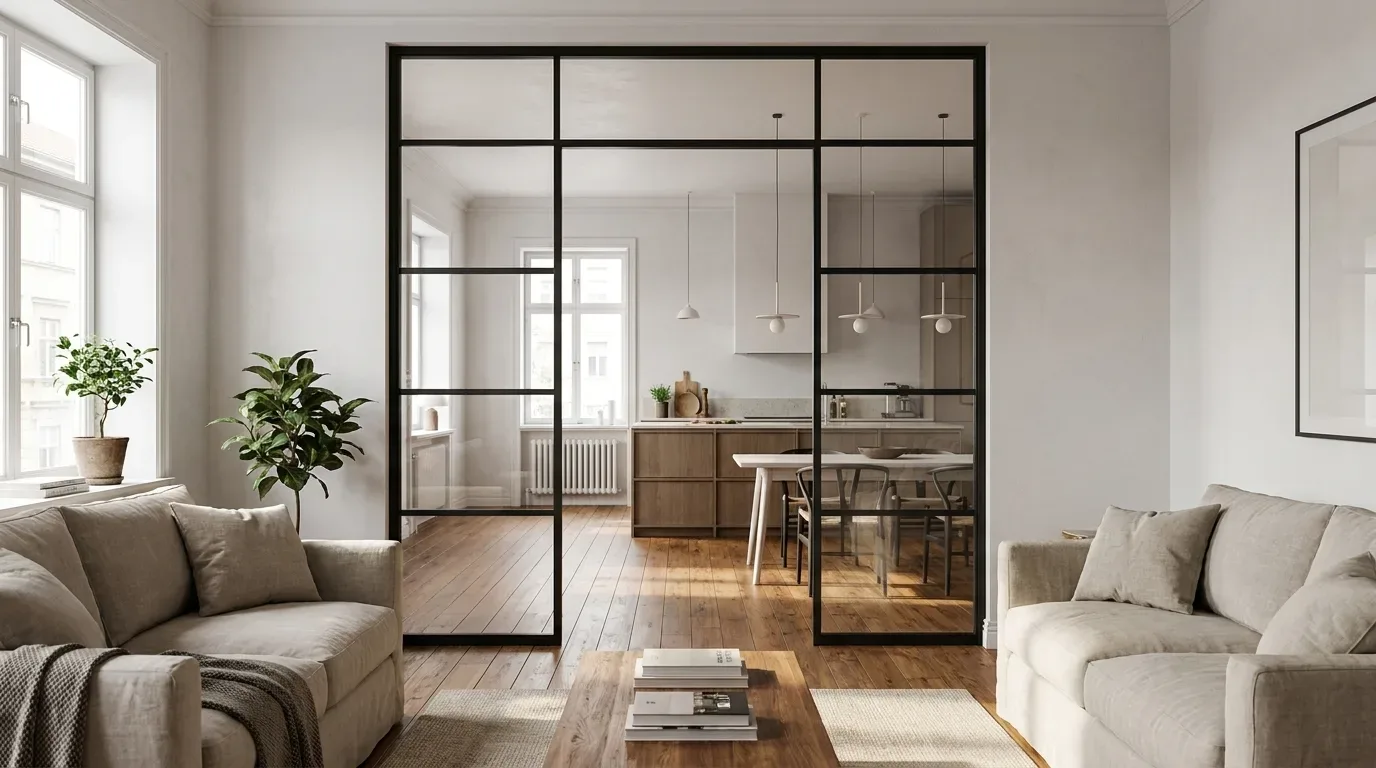
The shift towards working from home has made room flexibility a genuine design consideration rather than an estate agent's talking point. A bespoke loft door between a kitchen and a reception room, or a room divider that separates a desk space from a living area in an open-plan flat, addresses this need without structural work. The loft door gives full separation when required; the room divider creates a permanent visual boundary while keeping light flowing.
5. Visible Craft as a Counter to Mass Production
There is growing appetite for pieces where you can see how they were made - where the weld is not hidden under a plastic cap, where the wood grain is not buried under lacquer. This is the original premise of industrial style, and it aligns neatly with a broader cultural shift away from the anonymous uniformity of mass production. Every piece from Manufaktur X is an individual item; no two are identical because no two sets of customer dimensions are identical.
Bringing Industrial Style Into a British Home: Room by Room
You do not need warehouse proportions to make industrial style work. The principles translate into period properties and modest modern flats alike - the key is balancing rawness with warmth.
Structuring Open-Plan Spaces
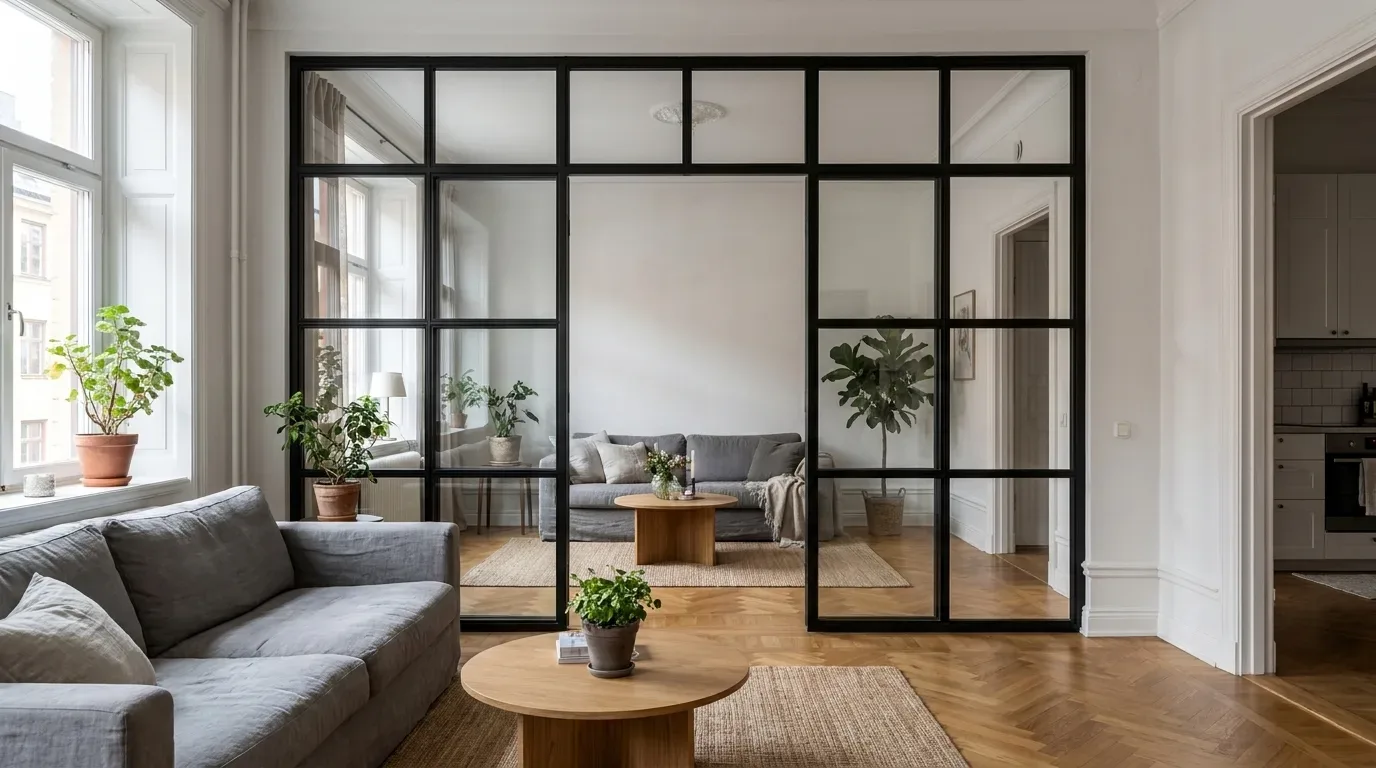
Open-plan ground floors are common in extended Victorian and Edwardian homes, and increasingly so in new-build flats. The industrial aesthetic suits open plans well, but open plans often need some definition - a visual separation between cooking and eating, or between working and relaxing.
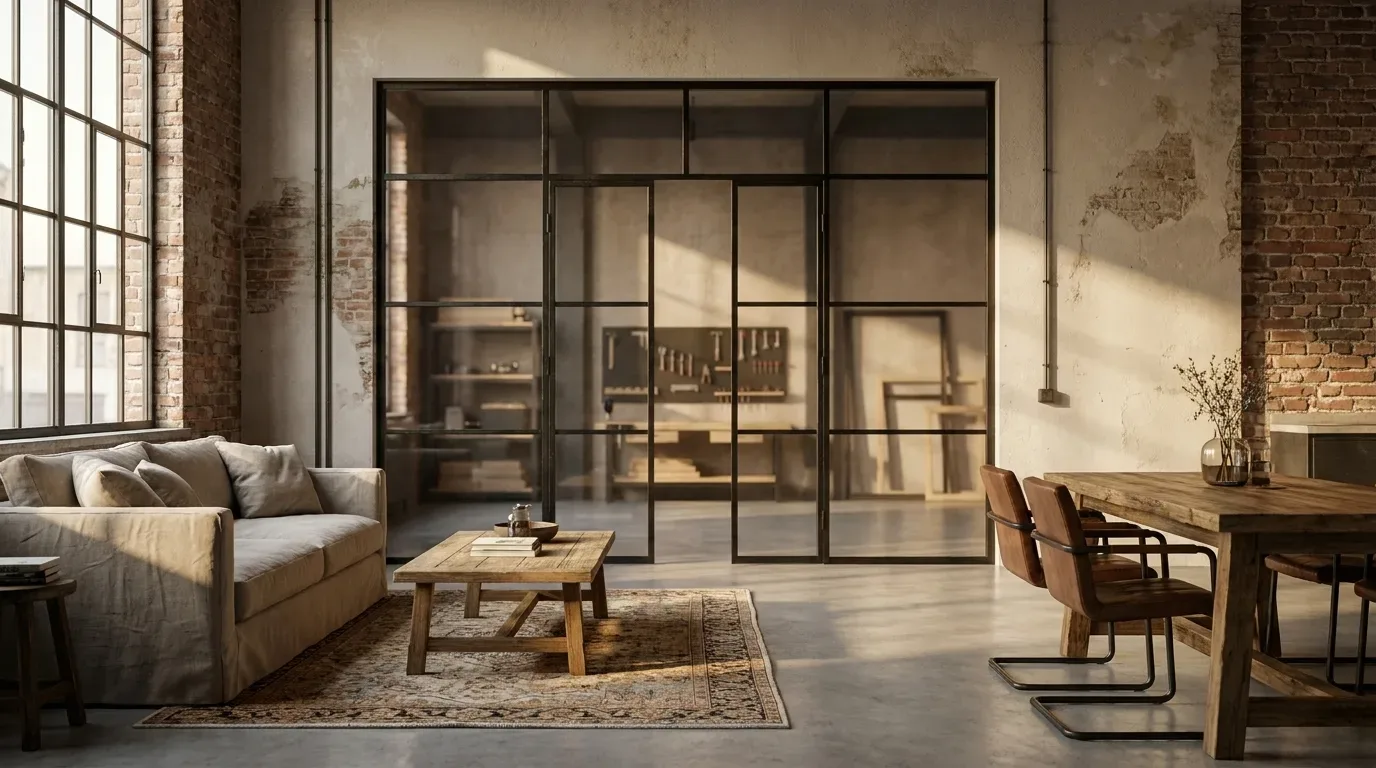
A steel-and-glass room divider provides that structure without closing the space down. Glass keeps the light moving; the steel frame provides the architectural punctuation. A loft door does the same thing with the added ability to physically close off a space when needed. The choice depends entirely on whether you want a permanent boundary or a flexible one.
Combining Materials Effectively
- Steel and iron: Frame and structural elements - the backbone of the industrial look
- Solid hardwood: Table tops, shelf boards and seat surfaces - warmth against the harder materials
- Concrete and stone: Floors and exposed walls - particularly at home in converted industrial buildings or basement extensions
- Glass: In combination with steel frames, specifically in loft doors and room dividers
The tension between warm and cool, soft and hard, is what gives industrial interiors their energy. A bare oak dining table surface against a matt black steel frame; a glass and steel loft door against a white-painted Victorian plaster wall - the contrast does the work.
Colour: Restraint Is the Discipline
Greys in multiple tones, black as an accent, warm browns and rust for softness, white for contrast against darker elements. Bold colour is used sparingly if at all - perhaps a single cushion or a pendant shade that introduces a deliberate note. The steel powder-coating options at Manufaktur X cover the full RAL range if you want to move away from the obvious anthracite, but the industrial palette is where this style is most at home.
Making Industrial Style Liveable
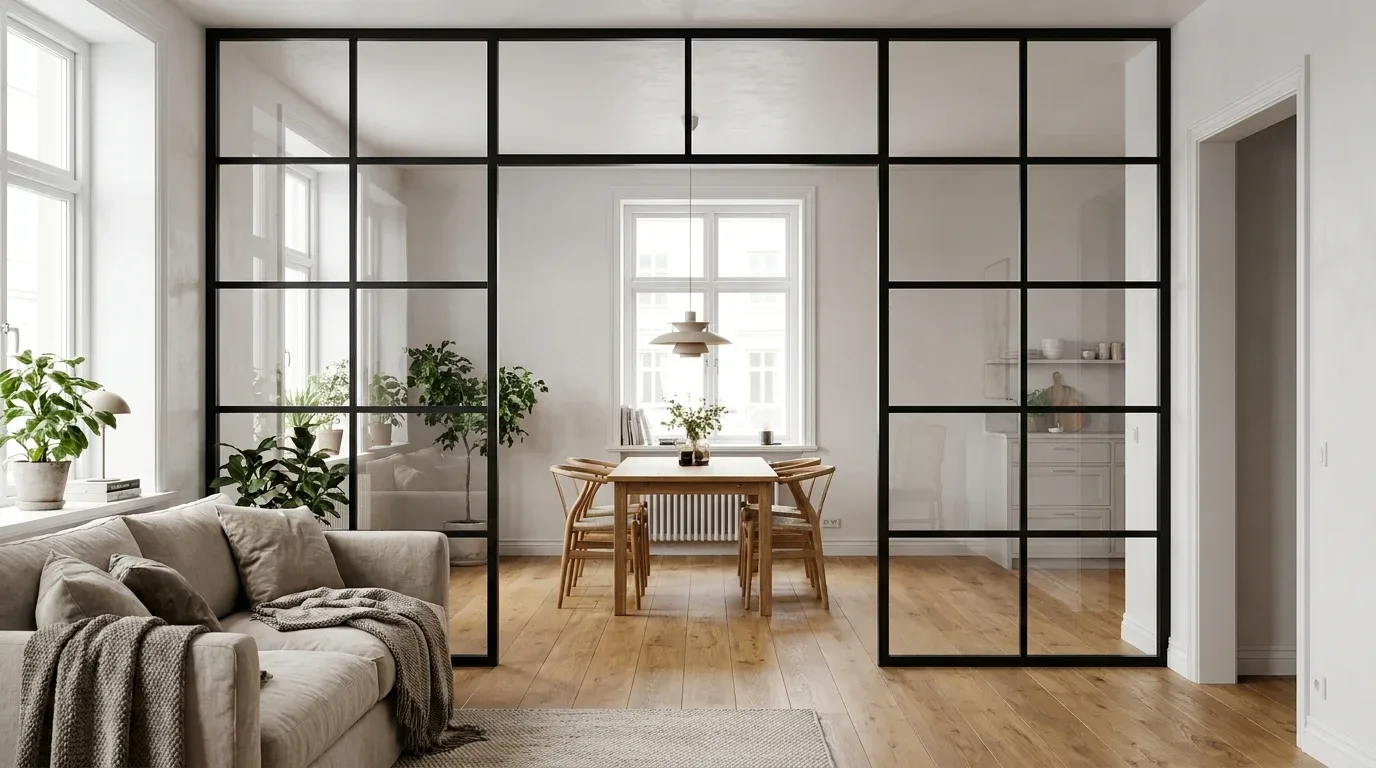
The risk with industrial interiors is that they tip from purposeful into cold. A few counterweights keep the balance:
- Large, generous sofas - leather works particularly well and develops its own patina
- Natural-fibre textiles: linen, cotton, wool throws - softness against hard surfaces
- Rugs with graphic patterns or a vintage quality underfoot
- Houseplants as an organic contrast to steel and glass
- Edison-style bulbs and metal-shade pendants for warm, directional light
Industrial Style in Smaller Rooms
A terraced house bedroom or a compact flat kitchen does not disqualify industrial style - it just requires more selectivity. A few approaches that work well in smaller British rooms:
- Wall-mounted pipe shelves with visible brackets maximise storage without taking up floor space
- A loft door with clear or frosted glass panels opens a room visually by borrowing light from an adjacent space
- Lighter powder-coating colours - warm white or light grey rather than anthracite - prevent a small room from feeling heavy
- A single exposed brick section or a run of steel pipe shelving is often enough to establish the aesthetic without committing every surface
How a Bespoke Piece Is Made: The Process at Manufaktur X
Understanding how the furniture is made helps explain why the approach produces results that off-the-shelf cannot replicate.
Step 1: Measuring Your Space
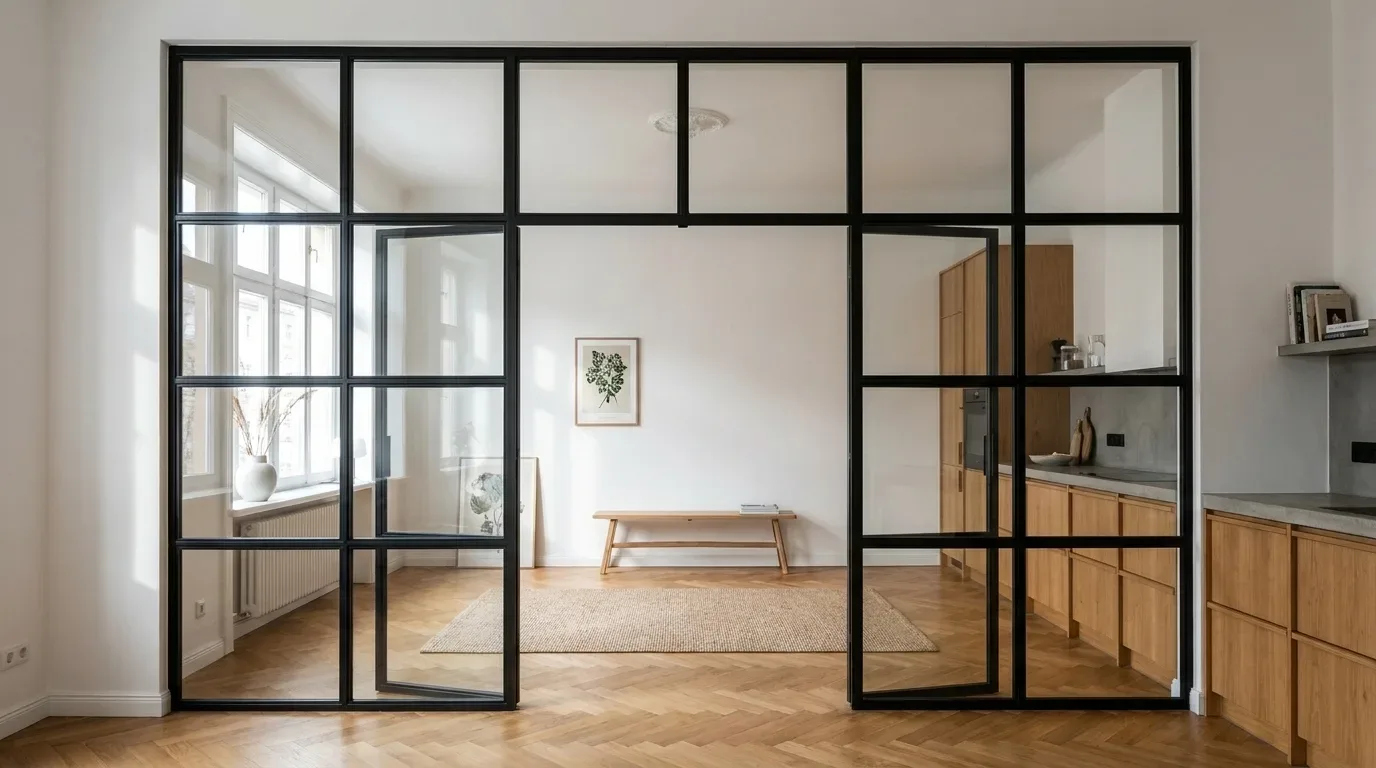
Measure at several points, not just one. British period properties in particular have walls that are rarely perfectly plumb and floors that are rarely perfectly level - a measurement taken at one end of an opening can differ meaningfully from one taken at the other. The rule is always to work from the smallest measurement you find. For a loft door, deduct the fitting clearance - approximately 5 mm per side on the left, right and top - before entering your final dimensions. The production process matches exactly what you enter; there is no adjustment stage after manufacture.
Step 2: Using the Configurator
The online configurator is built around real-time transparency. Enter your dimensions, choose your wood species and stain finish, select your steel colour from the RAL range, and pick your glass design and type if you are configuring a loft door or room divider. The price updates immediately with every change. Production lead time is 5-6 weeks, and this is stated clearly alongside delivery costs before you confirm the order - no last-minute additions at checkout.
Step 3: Unusual Situations - the Sketch Service
Some spaces do not fit neatly into a standard configurator. Sloped ceilings above a loft hatch, alcoves with irregular angles, or a room divider that needs to meet a structural column at an odd angle - these are the situations where the sketch upload service comes in. Upload a drawing with your dimensions and notes, and the Manufaktur X team will assess feasibility and return a bespoke quote.
Step 4: Production and Delivery to the UK
Once confirmed, the order moves into production: CAD drawings are prepared, CNC machinery handles the precision cutting and profiling, and the finishing and assembly stages are carried out by hand. The finished piece is delivered directly to your UK address, with all customs duties and import formalities handled - there are no unexpected charges on arrival. Production time is 5-6 weeks from order confirmation.
Manufaktur X produces furniture in the EU to EU quality standards. Every piece is made to order; nothing ships from a warehouse of ready-made stock.
Loft Door vs Room Divider: The Key Differences
These two products are often confused because they look superficially similar. They are fundamentally different in function.
| Feature | Loft Door | Room Divider |
|---|---|---|
| Function | Working door - opens and closes | Fixed partition wall - does not move |
| Hinge side | Selectable left or right | None |
| Opening direction / angle | Configurable | Not applicable |
| Handle | Yes - Long, Discreet or Half-Moon | None |
| Hinges | Yes | None |
| Access through | By opening the door | Optional open gap within the frame |
| Glass options | 5 designs (clear, frosted, smoked, dark smoked, textured) | 5 designs (clear, frosted, smoked, dark smoked, textured) |
| Steel colour | Any RAL colour | Any RAL colour |
Industrial Style vs Industrial Design: Worth Distinguishing
The two terms overlap in name but describe different things. Industrial design as a professional discipline is a problem-solving process - it covers ergonomics, production economics, user research and prototyping. It is the field responsible for everything from a well-designed door handle to a car dashboard.
Industrial style as an interior aesthetic borrows from the visual language of industrial architecture and manufacturing: raw materials, exposed structure, functional logic. When people search for "bespoke industrial furniture," they mean the aesthetic - pieces designed and built according to those visual and material principles. That is what Manufaktur X produces.
| Feature | Industrial Design (discipline) | Industrial Style (interior aesthetic) |
|---|---|---|
| Focus | User experience, function, commercial viability | Aesthetic of industrial materials and construction |
| Goal | Practical, producible products for broad use | Authentic, characterful living spaces |
| Materials | Variable - whatever the product requires | Steel, solid hardwood, concrete, glass |
| Process | Research, prototyping, testing, manufacture | Material selection, handcraft, bespoke production |
Caring for Industrial Furniture
Bespoke industrial pieces are designed to last for decades. Maintenance is less demanding than most people expect.
Solid Hardwood
- Oil or wax the surface periodically - this keeps the wood supple and provides a degree of moisture resistance
- Avoid prolonged direct sunlight and very dry central heating environments, both of which can cause movement in solid wood over time
- Minor surface scratches can be addressed with light sanding along the grain followed by re-oiling
- Wipe up spills promptly - solid wood is robust but not waterproof
Powder-Coated Steel
- A damp cloth is all that is normally needed - powder coating is straightforward to keep clean
- Avoid abrasive pads and harsh chemical cleaners, which can degrade the surface over time
- If the coating is chipped or scratched through to bare metal, address it promptly to prevent rust forming beneath
Glass Panels
- Standard glass cleaner and a lint-free cloth work on both ESG and VSG panels
- Nothing abrasive on the glass surface
- Clear glass panels in particular benefit from regular fingerprint removal to maintain their transparency
Pricing: What Does Bespoke Industrial Furniture Cost?
All prices shown on manufakturx.co.uk are in GBP and include delivery to the UK, with customs duties and import formalities handled. The exact price for any piece depends on your chosen dimensions, material, finish and configuration options - every variable affects the outcome, and the configurator reflects this in real time.
| Product | From | Note |
|---|---|---|
| Lofttür | £995 | Lowest possible option |
| Raumteiler | £1.900 | Steel + laminated glass, custom width |
| Großes Regal | £2.750 | Solid wood, steel frame, floor-to-ceiling |
| Esstisch | £1.360 | Solid wood, steel frame |
| Couchtisch | £995 | Solid wood, steel frame |
| Sitzbank | £945 | Solid wood, steel frame |
| TV-Board | £1.325 | Solid wood, steel frame |
| Rohrregal | £915 | Modular pipe shelf |
Frequently Asked Questions About Bespoke Industrial Furniture
What makes bespoke industrial furniture different from standard industrial-style pieces?
Standard industrial-style furniture uses the visual cues of the aesthetic - dark metal finishes, visible hardware, raw-looking surfaces - but is produced to fixed dimensions from standardised components. Bespoke industrial furniture is built to your exact measurements from genuine hardwood (oak, beech or ash) and powder-coated steel, with every configuration decision - wood species, stain finish, steel colour, glass type and design - made by you. At Manufaktur X, no two pieces are identical because no two orders specify the same dimensions.
Which wood species does Manufaktur X use?
Manufaktur X works exclusively with three hardwood species: oak, beech and ash. All three offer natural hardness, pronounced grain character and long service life - qualities that matter in the industrial aesthetic where the wood surface is meant to be seen, not covered. Over 50 stain finishes are available across the range.
What is the difference between a loft door and a room divider?
A loft door is a functioning hinged door with a door stop (left or right), configurable opening direction and angle, hinges, and a choice of three handle designs (Long, Discreet or Half-Moon). A room divider is a fixed, permanently installed steel-and-glass wall with no moving parts - no hinges, no handle, no door stop. An open walkthrough gap can be included within the room divider if access is needed. They serve fundamentally different purposes.
What glass options are available?
Five glass designs are available for both loft doors and room dividers: clear, frosted, smoked, dark smoked and textured. For glass type, the choice is between ESG (toughened safety glass) and VSG (laminated safety glass). Manufaktur X recommends VSG for larger dimensions - particularly tall doors or wide room divider spans - where the additional structural integrity is beneficial.
How do I measure correctly for a bespoke loft door?
Measure the opening width and height at several points - at least three across the width and three up the height - and use the smallest figure you find in each direction. For the loft door, subtract approximately 5 mm per side (left, right and top) to allow for fitting clearance. Enter your desired finished dimensions into the configurator; Manufaktur X manufactures precisely to the figures you provide. The most common reason a custom door does not fit is a measurement error, not a production issue.
How long does production take and is delivery to the UK included?
Production takes 5-6 weeks from order confirmation. Delivery to any UK address is included in the price shown in the configurator, with all customs duties and import formalities handled. There are no additional charges on delivery.
Can I use industrial-style furniture in a period property?
Yes - and it often works particularly well. Victorian and Edwardian properties have architectural bones (high ceilings, deep mouldings, original floorboards) that provide an interesting contrast against the rawness of steel and hardwood. A bespoke loft door in matt anthracite against a white-painted Victorian plasterwork surround, or a solid oak dining table with a black steel base in a room with original sash windows, creates a dialogue between periods rather than a conflict. The key is in the quality of the individual pieces - neither side of the contrast should look cheap.
Can I order something that is not in the standard configurator?
Yes. The sketch upload service at Manufaktur X is designed for situations that fall outside the standard configurator options - sloped ceilings, unusual alcove shapes, structural columns that interrupt a clean run. Upload a sketch with your dimensions and a note explaining the situation; the team will assess what is achievable and provide an individual quote.