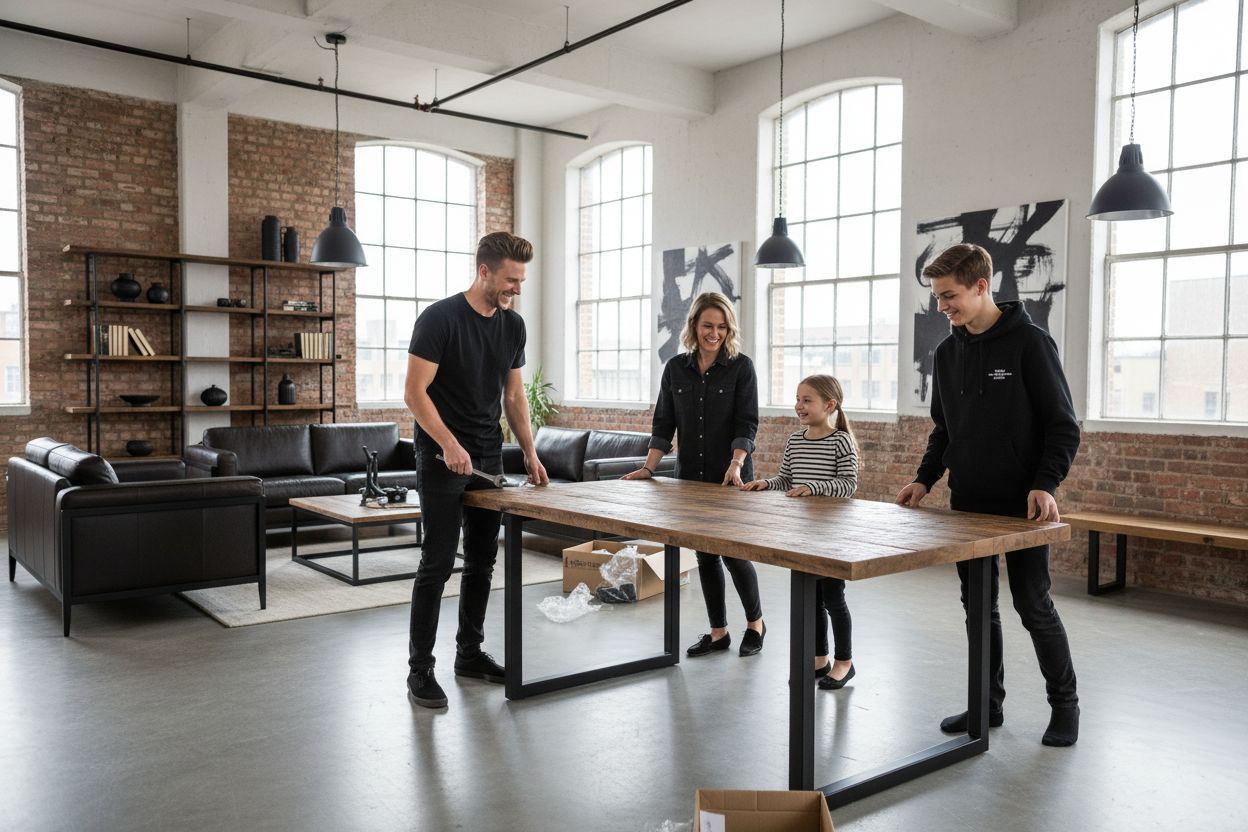
There's a particular satisfaction in living with furniture that genuinely fits — not squeezed in, not shimmed out with fillers, but made precisely for the space it occupies. If you've ever stood in a Victorian conversion or an open-plan warehouse flat and thought "nothing off the shelf will ever look right here," you already understand the appeal of bespoke industrial furniture. Manufaktur X makes exactly that: individual pieces crafted from solid wood, robust steel, and safety glass, built to the millimetre, entirely by hand.
What Is Industrial-Style Furniture — and Why Does It Work So Well in British Homes?
The industrial aesthetic has its roots in the repurposing of old factories and mill buildings — a movement that began in New York lofts but found fertile ground in British cities, where Victorian warehouses, converted railway arches, and Edwardian terraces with exposed brickwork proved natural backdrops. The style celebrates what other interiors hide: the structure, the joinery, the raw grain of the wood, the weld seam on the steel.
Unlike many trends, industrial design is fundamentally honest. Materials are chosen for their character rather than their ability to look like something else. A solid oak tabletop isn't pretending to be marble. A powder-coated steel frame isn't imitating brass. That authenticity is precisely why the style has endured — and why bespoke manufacture is so well suited to it. When the material itself is the statement, its quality and fit matter enormously.
The Core Principles of Industrial Design
- Raw, honest materials: Steel, solid wood, concrete, and glass — chosen for their natural character, not disguised
- Structural visibility: Bolts, welds, brackets, and frames treated as design details rather than hidden away
- Form follows function: Every element earns its place; nothing purely decorative
- Patina as a quality marker: Wear and age add character rather than diminishing value
- A restrained colour palette: Charcoal, black, rust, and earth tones reinforce the sense of authenticity
| Design Principle | How It Appears in Industrial Interiors |
|---|---|
| Material character | Steel, solid wood, and glass with visible natural texture |
| Structural honesty | Exposed joints, bolts, and frames as deliberate design features |
| Colour palette | Grey, rust, anthracite, black, and earth tones |
| Surface treatment | Minimal finishing, natural patina, raw aesthetic |
| Functional beauty | No superfluous decoration — every element has a purpose |
Styles Within the Style: Finding Your Version of Industrial
Industrial design isn't a single, rigid look. Depending on your space and personal taste, it can take several distinct directions:
- Classic Industrial: Maximum rawness — original factory elements, exposed steelwork, unplastered brick
- Modern Industrial: A cleaner, more paired-back interpretation with sharp lines and contemporary pieces
- Urban Loft: Softer forms, textile accents, and lighter surfaces for a more liveable feel
- Rustic Industrial: Heavily weighted towards reclaimed wood and weathered finishes
- Industrial-Scandi: The warmth of Scandinavian minimalism softening the harder industrial edges
- Industrial-Vintage: Raw aesthetics blended with antique finds and nostalgic objects
Bespoke vs. Off-the-Shelf: Why Custom-Made Changes Everything
Most furniture is designed for a fictional average room. Yours isn't average — it has a chimney breast in an unexpected place, a ceiling that drops at one end, or a doorway that's 30 cm narrower than any standard frame. Bespoke furniture starts from a completely different premise: your space defines the piece, not the other way around.
Precision Fit and True Individuality
A bespoke loft door made to your exact opening looks categorically different from a standard door with filler strips tacked on. The proportions are right. The steel frame sits flush. The glass panels have the visual weight they were designed to have. That's not a subtle difference — it's the difference between furniture that belongs in a room and furniture that's merely present in it.
Materials Built to Last Generations
Solid hardwood and powder-coated steel outlast chipboard and veneer by decades. More than that, they age well — solid oak develops depth and warmth over time, and a steel frame that acquires a few honest marks of use only looks more authentic. In an era when most flat-pack furniture is destined for landfill within five years, that longevity matters.
Sustainability Through Longevity
The most sustainable piece of furniture is the one you never have to replace. Custom-made pieces from solid materials represent a genuine alternative to the cycle of cheap, disposable interiors — and in the context of industrial design, where the aesthetic itself values endurance and honest wear, that philosophy feels entirely consistent.
| Aspect | Bespoke Industrial Furniture | High-Street / Off-the-Shelf |
|---|---|---|
| Fit | Made to your exact dimensions | Fixed standard sizes only |
| Materials | Solid hardwood, robust steel, safety glass | Typically chipboard, veneer, or MDF |
| Design approach | Authentic, structurally honest, functionally beautiful | Trend-driven or purely functional |
| Longevity | Decades of use; develops character with age | Short lifespan; difficult to repair |
| Production | Skilled handcraft with precision machinery | Mass production |
Materials, Finishes, and Colours at Manufaktur X
The credibility of industrial-style furniture stands or falls on material quality. Here's what goes into every piece made at Manufaktur X.
Solid Wood: Oak, Beech, Ash, Walnut, Cherry, and Pine
Every piece uses solid hardwood — no engineered boards, no veneer faces. Oak, beech, and ash are the workhorse choices: all three offer natural density, a strong grain character, and the kind of longevity that makes them worth investing in. Walnut, cherry, and pine are also available for those seeking a warmer or more distinctive tone. Over 50 different stain finishes let you dial in everything from pale, barely-there natural tones to deep, moody darks — all of which remain visible as wood, never painted over.
Steel: Powder Coated in Any RAL Colour
All steel frames are finished with powder coating — a process in which electrostatically charged powder is applied to the metal and then cured in an oven. The result is a finish that is scratch-resistant, uniformly coloured, and more environmentally friendly than conventional wet paint. Anthracite (RAL 7016) and matt black (RAL 9005) are the most popular choices for industrial interiors, but any RAL colour is available — including the white (RAL 9010) that works beautifully in period properties where you want industrial structure without visual weight.
Glass: Five Designs, Two Safety Types
Glass features exclusively in the steel-and-glass products — the loft door and the room divider. It's important to distinguish between glass designs (the visual appearance) and glass types (the structural safety specification).
Five glass designs are available in the configurator:
- Clear glass — maximum transparency and light transmission
- Frosted glass — privacy with retained light diffusion
- Smoked glass — a light tint with subtle obscuration
- Dark smoked glass — deeper tint for more pronounced privacy
- Textured glass — a surface pattern that scatters light attractively
For glass type, you can choose between ESG (toughened safety glass) and VSG (laminated safety glass). For larger panel dimensions, VSG is recommended for additional stability and security.
The Full Product Range from Manufaktur X
Every product is made to order in the EU from solid wood, steel, and — where appropriate — safety glass. The range divides neatly into steel-and-glass pieces and steel-and-solid-wood pieces.
Loft Doors — Steel and Glass Built to Your Opening
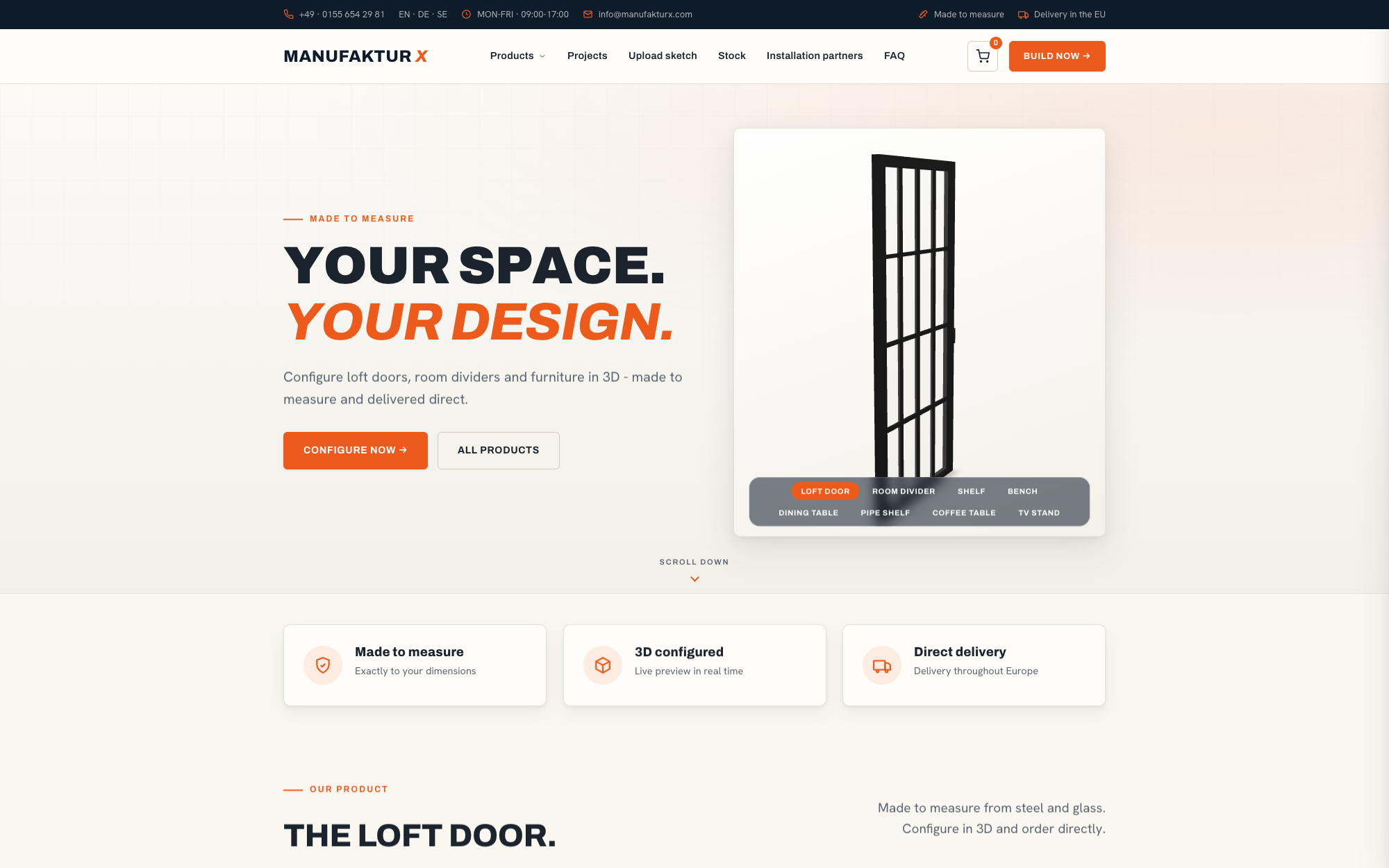
The Manufaktur X loft door is a fully functional hinged door — not a partition, not a sliding panel. It has a door stop (left or right hand as specified), a configurable opening direction and swing angle, hinges, and a choice of three handle designs: Elongated, Discreet, and Crescent. Slim steel profiles, generous glass panels, and a clean factory aesthetic. Prices start from £999 for the entry configuration, with the exact price updated live in the configurator as you build your specification.
Room Dividers — Fixed Steel and Glass Partition Walls
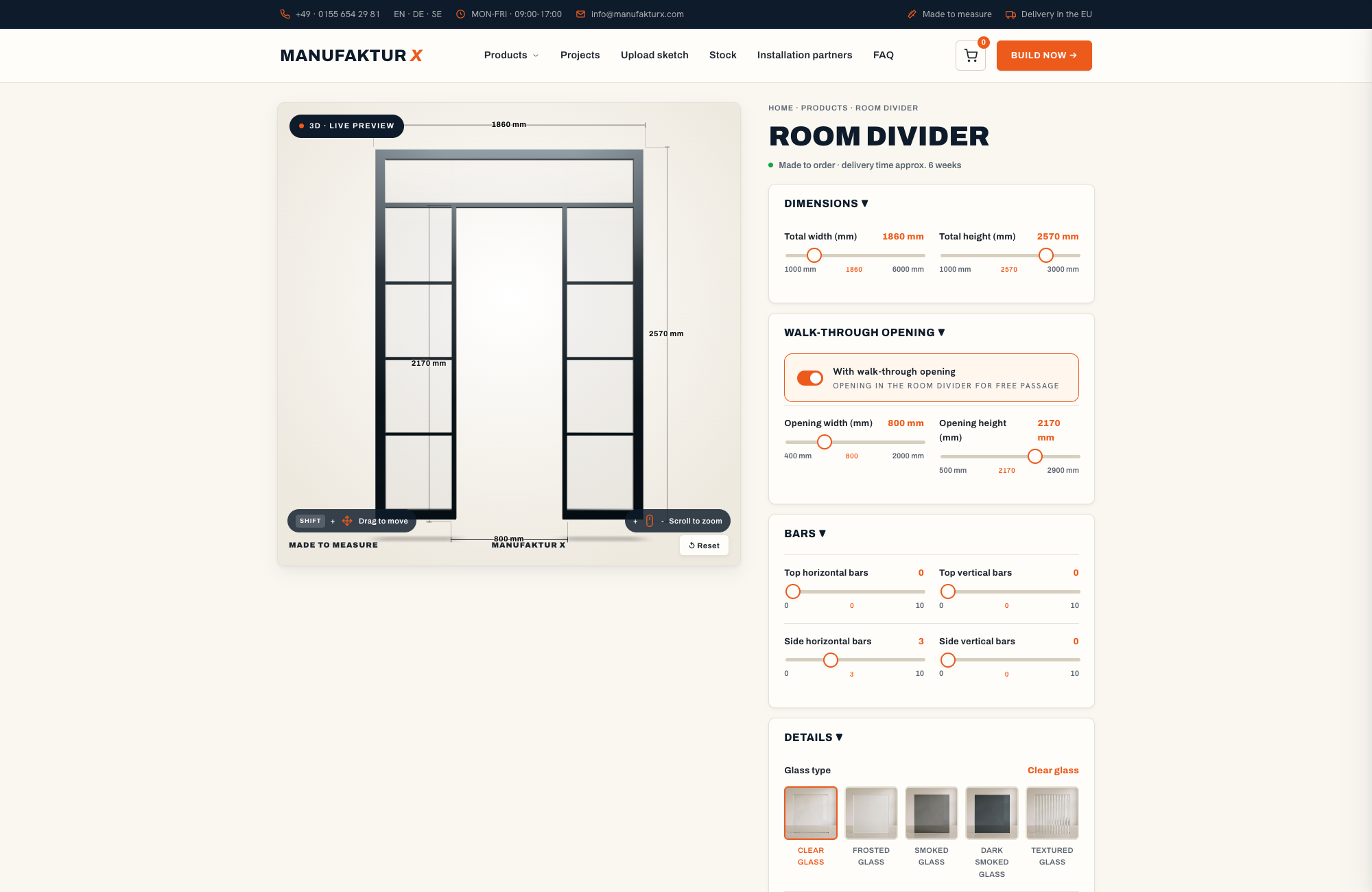
The Manufaktur X room divider is a permanently installed steel and glass partition — structurally fixed, with no moving parts. There are no hinges, no handles, no door stop. What it offers instead is a way to zone an open-plan space without closing it off entirely: glass panels keep light circulating while the steel frame defines the boundary. An optional walk-through opening can be incorporated as a gap without a door, preserving flow between spaces.
This distinction matters: if you want to open and close a space depending on the time of day, you need a loft door. If you want a permanent visual and structural division that still allows light to pass, the room divider is the right choice.
Large Shelving Units — Steel Frame with Solid Wood Shelves
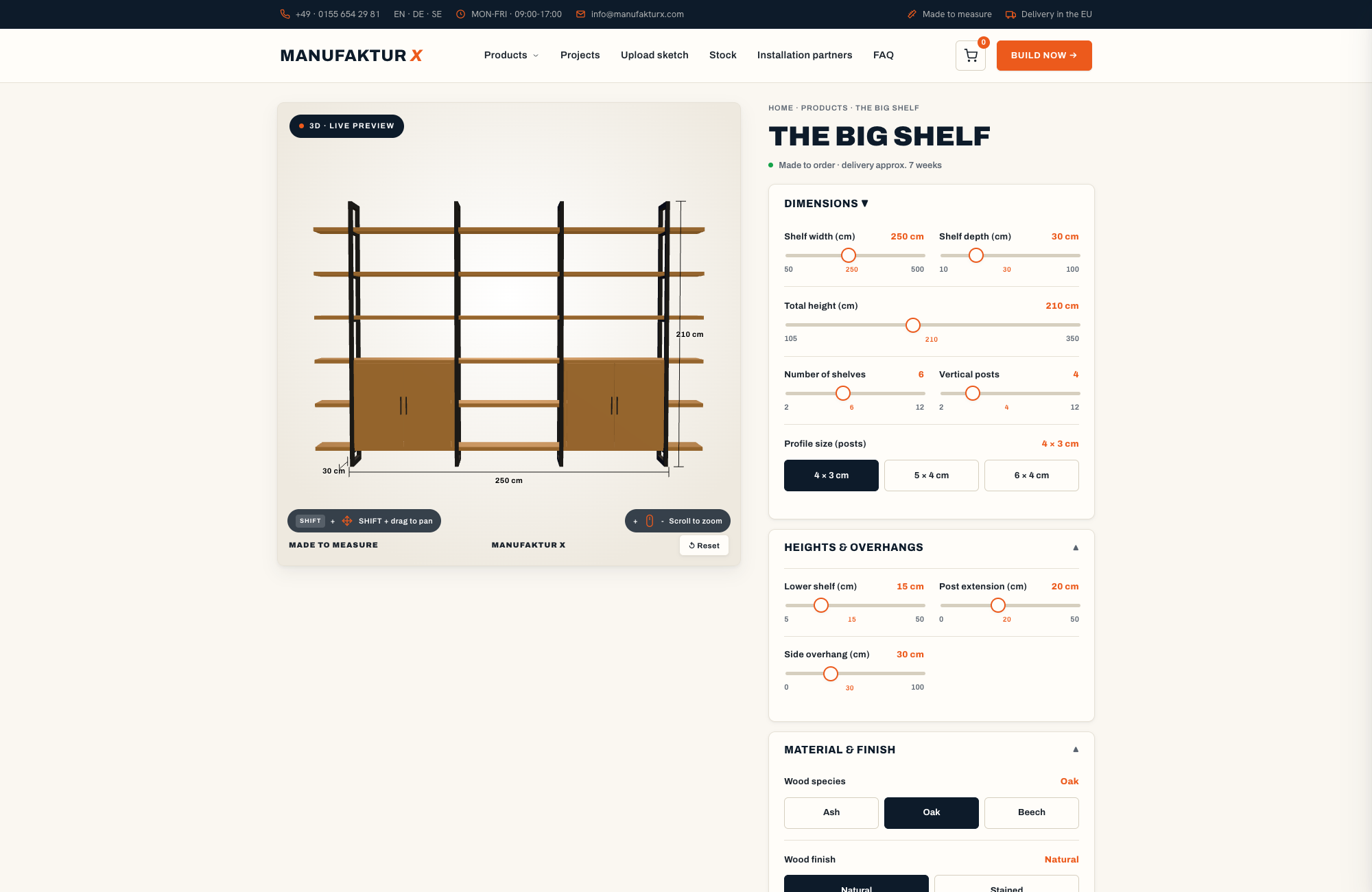
The large shelf pairs a powder-coated steel frame with solid wood shelves in oak, beech, or ash. Optional enclosed cabinet sections can be integrated. No glass — a pure steel-and-wood construction that functions as a room divider, a display unit, or a storage wall, depending on how you configure it.
Dining Tables and Coffee Tables — Solid Wood on Steel
The dining table and coffee table share the same material logic: a solid wood top in oak, beech, or ash on a powder-coated steel base. No glass, no engineered board — just two materials that express the industrial aesthetic with complete clarity. The visible wood grain and the clean steel legs do all the work.
Benches — Solid Wood Seat, Steel Frame
The bench combines a solid wood seat in oak, beech, or ash with a steel frame. Straightforward, robust, and versatile — equally at home at the end of a dining table or as a standalone piece in an entrance hall or bedroom.
Pipe Shelves — Industrial Scaffolding Aesthetic
The pipe shelf makes no attempt to hide its industrial credentials: steel pipe as the structural element, solid wood shelves in oak, beech, or ash, visible fixings. It reads as genuinely industrial rather than industrial-influenced — the kind of shelving that looks at home against an exposed brick wall or in an alcove alongside period architectural details.
Five Trends Shaping Industrial Interiors Right Now
Bespoke industrial furniture sits at the intersection of several broader interior design movements currently reshaping British homes.
1. Minimalism with Substance
The reaction against maximalism isn't about empty rooms — it's about choosing fewer things and choosing them well. Loft doors and room dividers have become the defining objects of this trend: they create zones and visual structure while remaining largely transparent, adding presence without clutter.
2. Designing for the Long Term
Sustainability in interiors increasingly means buying less but buying better. Solid hardwoods and powder-coated steel are materials that repairers and restorers can work with fifty years from now — something that cannot be said for the chipboard-and-foil construction of most high-street furniture.
3. The 3D Configurator as a Design Tool
The ability to specify a piece to your exact requirements online — entering your precise dimensions, selecting your wood species and stain, choosing your steel colour, and seeing an updated price instantly — has changed how people approach bespoke furniture. The Manufaktur X 3D configurator does exactly this: a real-time preview with transparent pricing, no sales conversations required before you know what something will cost.
4. Flexible Living Spaces
The widespread adoption of hybrid working has made the separation of work and living spaces within the home a practical necessity rather than a luxury. A bespoke loft door allows a study or home office to be visually and physically distinct from the rest of the living space during working hours, then opened up again in the evening — without any structural work.
5. Visible Craftsmanship
As a counter-movement to mass production, handmade and visibly hand-finished pieces have acquired a cultural value they haven't held since before industrialisation. The appeal is both aesthetic and ethical — knowing that a specific person made a specific object to a specific brief, rather than a machine producing ten thousand identical units.
Bringing Industrial Design into Your Home, Room by Room
The industrial aesthetic doesn't require a warehouse conversion or a double-height ceiling. It works in Victorian terraces, Edwardian flats, and contemporary new-builds alike — the principles scale to the space.
Zoning Open-Plan Spaces
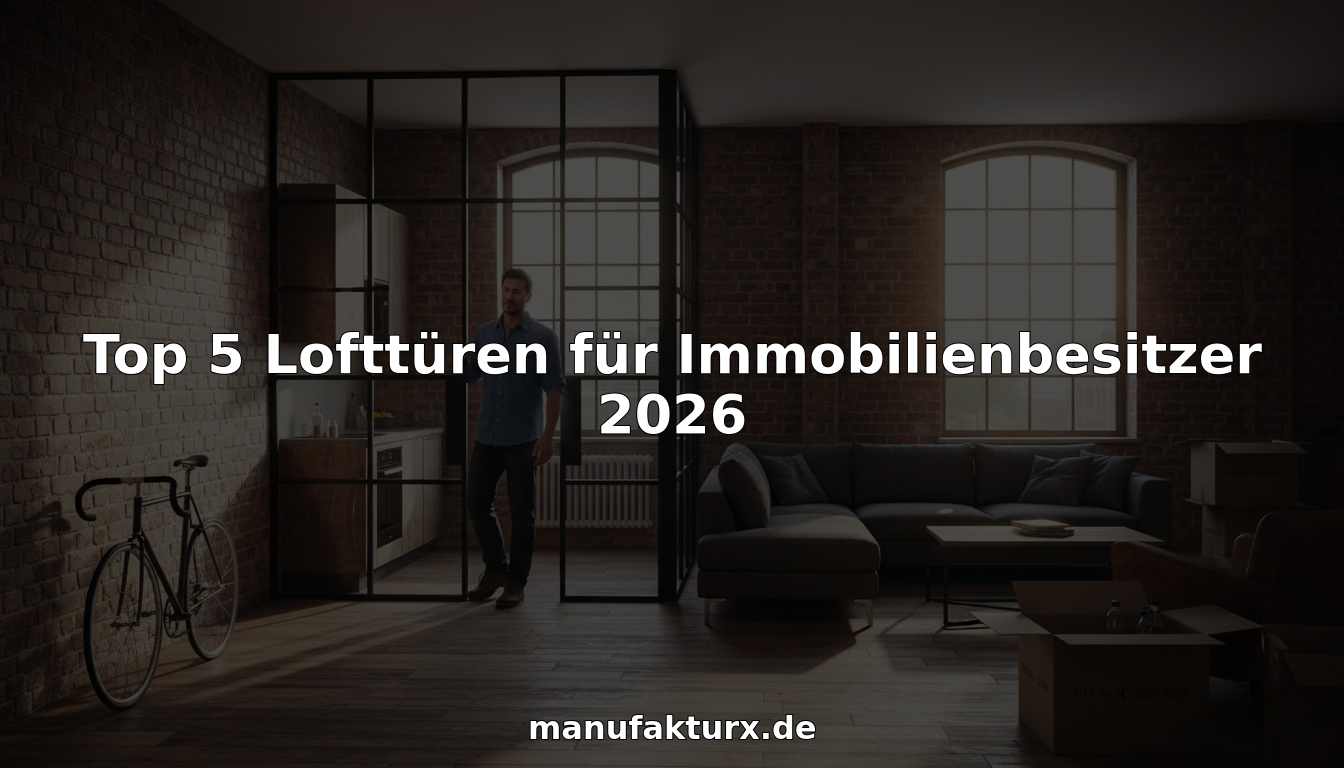
Open-plan layouts are natural companions to the industrial aesthetic, but they often need some internal structure. A room divider or loft door creates that structure without sacrificing the sense of openness — glass panels maintain the light and the sightlines while the steel frame does the spatial work.
The choice between the two products depends on what you need: the room divider is the right answer when you want a permanent architectural division; the loft door is the right answer when you want the flexibility to open up or close off as circumstances demand.
Combining Materials Effectively
- Steel: As frames, shelving structures, and table bases — powder-coated for durability or left to develop a natural surface over time
- Solid wood: As tabletops, shelf surfaces, and bench seats — oiled or stained to preserve and enhance the natural grain
- Concrete and stone: As floors and walls — raw and unclad to complement the furniture
- Glass: Paired with steel frames in loft doors and room dividers to maintain light circulation
The power of these combinations lies in contrast: warm against cool, soft against hard, organic against geometric. That tension is the visual engine of industrial design.
Colour in Industrial Interiors
The industrial palette is deliberately restrained: various shades of grey, black as an accent, warm browns and rusts for depth, white for contrast. Strong colours are used sparingly, if at all — a single deep teal or ochre cushion can anchor a room without disrupting the overall character. The full RAL range is available for steel finishing, but the most compelling industrial interiors tend to stay within a narrow tonal range.
Softening the Aesthetic for Everyday Living
Left untempered, industrial interiors can feel cold. The solution is straightforward:
- Deep, comfortable sofas — leather ages particularly well alongside industrial materials
- Textiles in natural fibres: linen, cotton, wool, and chunky knits
- Rugs with graphic patterns or vintage character underfoot
- Houseplants as an organic counterpoint to steel and glass
- Edison-style filament bulbs and metal-shaded pendants for warm, directional light
Industrial Style in Smaller British Homes
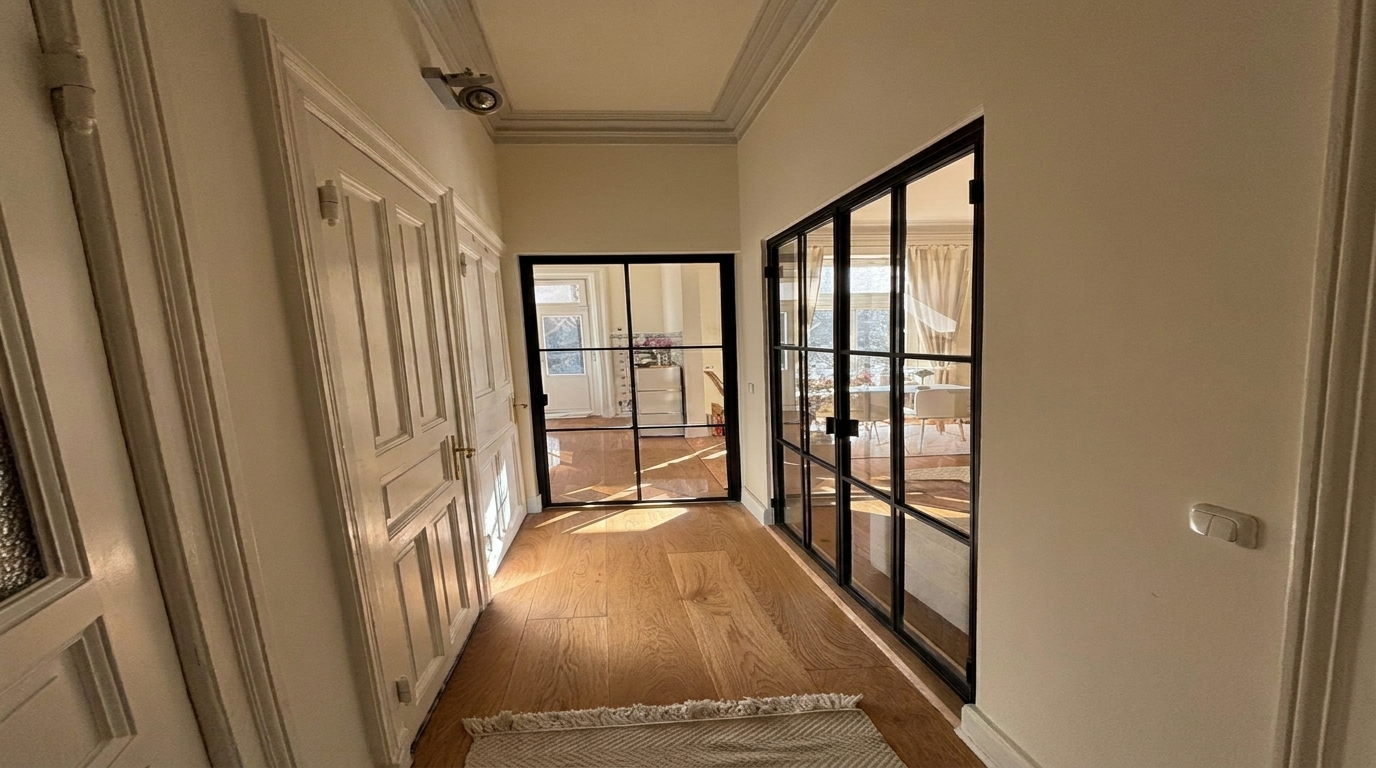
A two-bed Victorian terrace or a compact city flat can carry the industrial aesthetic just as effectively as a warehouse conversion — the key is selectivity. A single piece of well-chosen industrial furniture does more for a room than a collection of loosely related items. A loft door with clear glass panels makes a narrow hallway feel longer and more connected. A pipe shelf against a chimney breast breast brings structure and character without taking up floor space.
How a Manufaktur X Piece Is Made: From Measurement to Delivery
Every order follows the same process — precise, transparent, and structured around your specific requirements.
Step One: Taking Accurate Measurements
Measure at multiple points — walls and floors are rarely perfectly square, particularly in older British properties. The rule is to work from your smallest measurement: this prevents the finished piece from not fitting the space. For a loft door specifically, deduct the installation gap from your smallest measurement — approximately 5 mm clearance per side (left, right, and top). You enter your exact desired dimensions directly into the configurator; Manufaktur X manufactures to those numbers precisely.
Step Two: Configure Online with Live Pricing
The online 3D configurator lets you enter your dimensions, choose your wood species, stain finish, steel colour, and glass design. The price updates instantly with each selection — no hidden extras, no quote request required before you know what you're looking at. Delivery costs and lead times are displayed transparently in the basket.
Step Three: Bespoke Requests via Sketch Upload
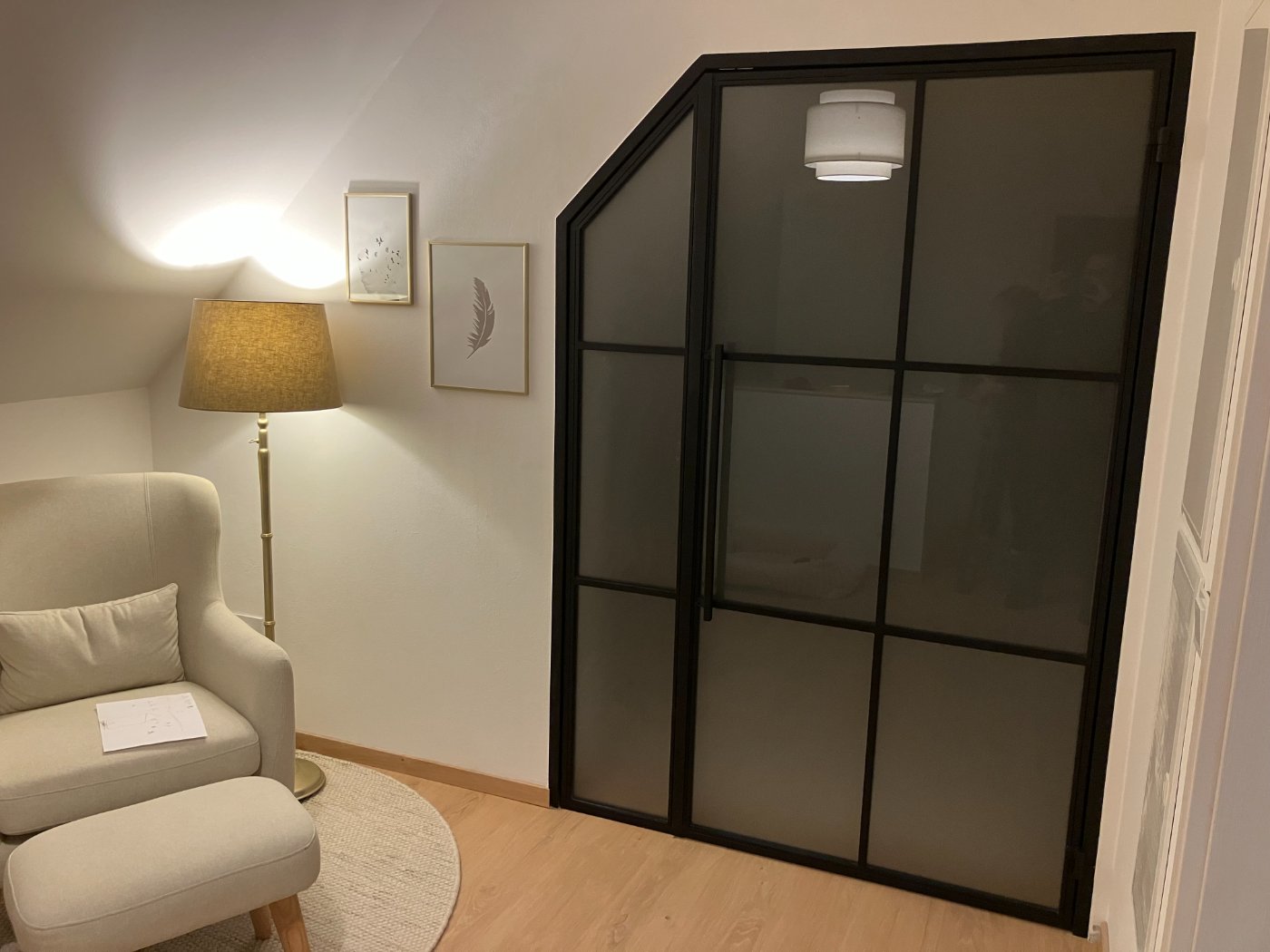
For unusual spaces — an angled wall, a non-rectangular opening, an attic room with a sloping ceiling — you can upload a sketch directly to the Manufaktur X team. They'll assess the feasibility and provide a personalised quotation for configurations that fall outside the standard configurator range.
Step Four: Manufacture and Delivery to the UK
Once your order is placed, production begins: CAD design for structural planning, CNC machining for precise cutting and shaping, then manual finishing and quality control. Lead time is 5–6 weeks. Delivery is made directly to your address anywhere in the UK, with all customs duties and import charges handled — no surprises at the door.
Loft Door vs. Room Divider: Choosing the Right Product
These two products are frequently confused, but they serve fundamentally different purposes.
| Feature | Loft Door | Room Divider |
|---|---|---|
| Function | Fully operational hinged door | Fixed partition wall — no moving parts |
| Door stop | Yes — left or right hand | No |
| Opening direction/angle | Yes — fully configurable | No |
| Handle | Yes (Elongated, Discreet, or Crescent) | No |
| Hinges | Yes | No |
| Passage through | By opening the door | Optional walk-through gap without door |
| Glass designs | 5 options (Clear, Frosted, Smoked, Dark Smoked, Textured) | 5 options (Clear, Frosted, Smoked, Dark Smoked, Textured) |
| Steel colour | Any RAL colour | Any RAL colour |
Pricing: What to Expect
The entry-level loft door configuration starts from £999 — the exact price depends on your specified dimensions, glass design, handle choice, and any additional options, and is shown live in the configurator as you build your specification. For all other products, current starting prices are visible directly in the relevant configurator or in the price overview below.
| Product | From | Note |
|---|---|---|
| Lofttür | £995 | Lowest possible option |
| Raumteiler | £1.900 | Steel + laminated glass, custom width |
| Großes Regal | £2.750 | Solid wood, steel frame, floor-to-ceiling |
| Esstisch | £1.360 | Solid wood, steel frame |
| Couchtisch | £995 | Solid wood, steel frame |
| Sitzbank | £945 | Solid wood, steel frame |
| TV-Board | £1.325 | Solid wood, steel frame |
| Rohrregal | £915 | Modular pipe shelf |
Caring for Your Industrial Furniture
Bespoke furniture made from quality materials is low maintenance — but a small amount of periodic care will keep everything looking its best for decades.
Solid Wood
- Oil or wax the surface periodically to maintain condition and protect against moisture
- Avoid prolonged direct sunlight and very low humidity environments
- Minor surface scratches can be addressed by light sanding followed by re-oiling
- Wipe spills promptly — solid wood is robust but not waterproof
Powder-Coated Steel
- Wipe down with a damp cloth — powder coating is highly resistant to everyday marks
- Avoid abrasive cleaners or scouring pads, which can break down the surface
- Address any chips or scratches promptly to prevent rust forming beneath the coating
Safety Glass
- Clean ESG and VSG panels with standard glass cleaner and a lint-free cloth
- Avoid abrasive materials that could scratch the surface
- On clear glass panels, regular cleaning of fingerprints maintains the best visual effect
Ready to Configure? Start Your Bespoke Piece Today
If you know what you want — a space that actually reflects how you live, furniture that fits the room rather than compromising it — the next step is straightforward. Visit manufakturx.co.uk, choose your product, enter your exact dimensions, and watch the price update in real time. No sales calls, no waiting for a quote, no ambiguity about what you're ordering or what it will cost.
For anything outside the configurator's standard range — unusual shapes, complex room situations, multi-element installations — upload a sketch and the team will come back with a bespoke quotation. Every piece is manufactured to your specified dimensions, delivered to your UK address with all duties included, within 5–6 weeks of order.
Frequently Asked Questions
What woods are available, and can I choose the finish?
Manufaktur X works exclusively with solid hardwood: oak, beech, ash, walnut, cherry, and pine. Over 50 stain finishes are available, ranging from pale natural tones to deep, dark shades. All finishes remain visibly wood — nothing is painted or laminated over.
What is the difference between a loft door and a room divider?
A loft door is a fully operational hinged door with a door stop, configurable opening direction, hinges, and a choice of three handle designs. A room divider is a permanently fixed steel and glass partition with no moving parts — no hinges, no handles, no door stop. An optional walk-through gap can be incorporated into a room divider if access between spaces is needed without a door.
Which glass designs and types are available?
Five glass designs are available in the configurator: clear, frosted, smoked, dark smoked, and textured. For glass type, you can choose between ESG (toughened safety glass) and VSG (laminated safety glass). For larger panel sizes, VSG is recommended for enhanced stability.
Do I measure the construction opening or enter the dimensions I want?
You enter your exact desired finished dimensions into the configurator — not the raw construction opening size. For loft doors, remember to deduct your installation gap (approximately 5 mm per side) from your smallest measurement before entering dimensions.
How long does production take, and how is delivery handled?
Production takes 5–6 weeks from the date your order is placed. Delivery is made directly to your UK address, with all customs duties and import charges covered — there are no additional costs to pay on arrival.
Where are Manufaktur X products made?
All pieces are made in the EU, by skilled craftspeople using CNC precision machinery for cutting and shaping, followed by manual finishing and quality control. Every order is built to the exact dimensions specified in your configuration.
Can industrial-style furniture work in a period property or smaller home?
Absolutely. Industrial design is particularly effective in Victorian and Edwardian properties, where exposed brickwork, high ceilings, and original architectural details provide natural counterpoints to steel and glass. In smaller spaces, the key is fewer, more carefully chosen pieces — a single loft door or pipe shelf can be enough to establish the character of the room without overwhelming it.
What is powder coating, and why does it matter?
Powder coating is a finishing process in which dry powder is electrostatically applied to the steel surface and then heat-cured to form a hard, even layer. Compared to conventional paint, it is more scratch-resistant, produces a more uniform colour, and generates less environmental waste during application. All steel frames from Manufaktur X are powder coated as standard, in any RAL colour.