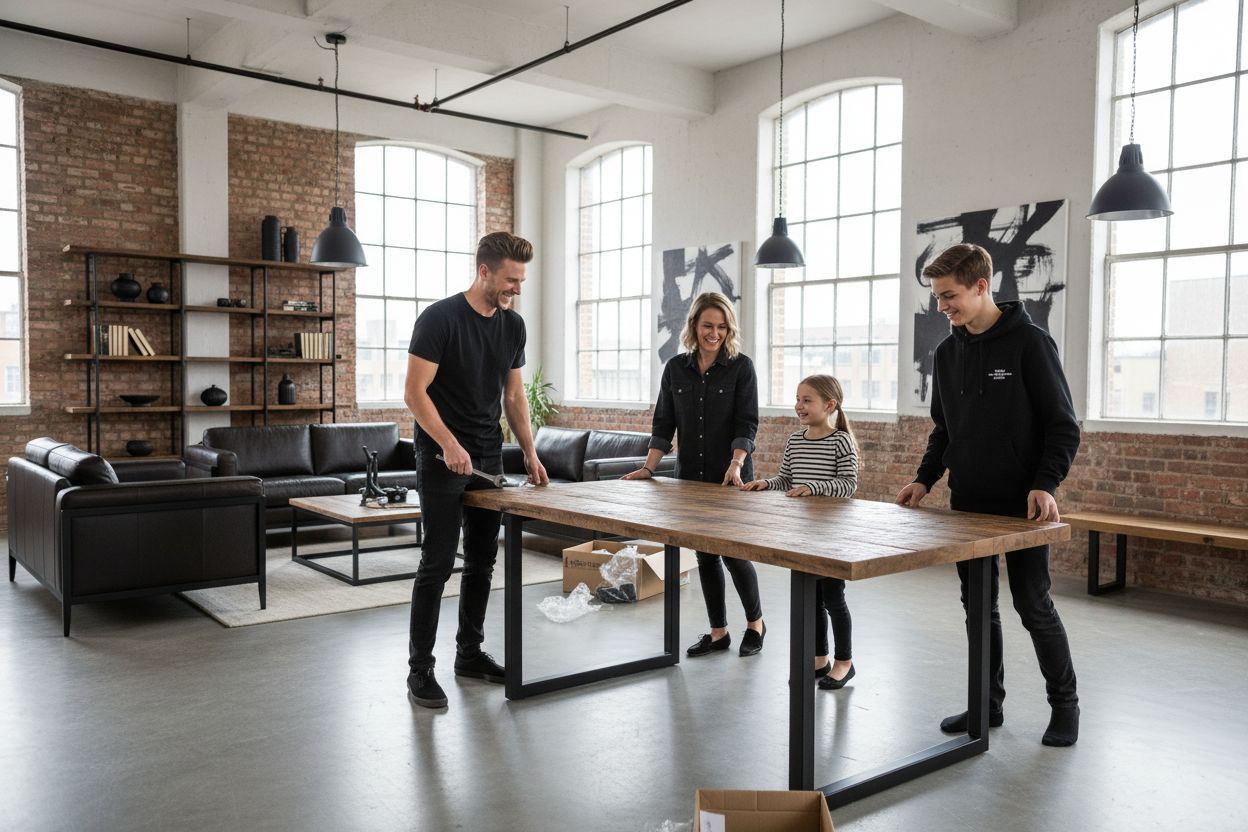
There's a particular satisfaction that comes from a room where everything fits — not approximately, not after a bit of fiddling with filler strips, but precisely. Whether you're working with a Victorian conversion in Bristol, a warehouse flat in Manchester, or a period property with awkward alcoves and non-standard ceiling heights, off-the-shelf furniture rarely rises to the challenge. Bespoke industrial furniture is the answer: pieces crafted from steel, glass, and solid wood to your exact dimensions, combining raw material honesty with serious making skill.
What Defines the Industrial Interior Style?
The industrial aesthetic didn't emerge from a mood board. It grew organically when former factories and warehouses across New York, London, and other cities were converted into living spaces during the 1970s and 1980s. The first residents didn't hide the bones of the building — they celebrated them. Exposed steel beams, bare brick, heavy timber floors, and iron pipework became the décor. What started as necessity became one of the most enduring interior design movements of the modern era.
At its core, the industrial style is about authenticity. Materials are chosen for their character, not their perfection. A weld seam is part of the design. The grain of solid oak is something to show off, not paint over. Wear and patina are signs of quality, not neglect.
The Hallmarks of Industrial Design in the Home
- Honest materials: Steel, solid wood, concrete, and glass — each with visible texture and natural character
- Exposed construction: Bolts, joints, and structural elements used as decorative features rather than hidden away
- Form follows function: Every component earns its place; nothing purely decorative
- Patina as a virtue: Marks of use become part of a piece's story over time
- Restrained colour palette: Anthracite, charcoal, black, rust, and warm earth tones — colours that let materials speak
| Characteristic | How it Applies in Industrial Interiors |
|---|---|
| Material honesty | Steel, solid wood, and glass used with visible natural structure |
| Structural expression | Visible fixings, joints, and frames as intentional design details |
| Colour palette | Greys, blacks, rusts, and earth tones that reinforce authenticity |
| Surface treatment | Minimal finishing — natural patina and raw texture are the point |
| Functional aesthetic | No superfluous decoration; every element has a clear purpose |
Industrial Style Variations: Finding Your Fit
The industrial look isn't monolithic. Depending on the space, the existing architecture, and how much warmth you want to introduce, there are several distinct directions to explore:
- Classic Industrial: Maximum rawness — original factory elements, heavy steel, exposed brickwork and bare concrete
- Modern Industrial: A cleaner, more refined interpretation with sharp lines and contemporary furniture pieces
- Urban Loft: Softer forms, textile layering, and lighter surfaces that make industrial spaces feel genuinely liveable
- Rustic Industrial: Reclaimed timber, aged metal, and a strong emphasis on natural materials with history
- Industrial-Scandi: The warmth of Scandinavian design softens the harder edges of the industrial palette
- Industrial-Vintage: Raw structure paired with nostalgic finds and antique pieces for a collected, characterful result
Why Choose Bespoke Over High-Street Furniture?
Anyone who has spent time living with furniture that was genuinely made for their space — not coaxed into it — understands the difference immediately. This isn't about luxury for its own sake. It's about consequences. Standard furniture is designed around average rooms. Your room almost certainly isn't average.
Precision Fit and Personal Vision
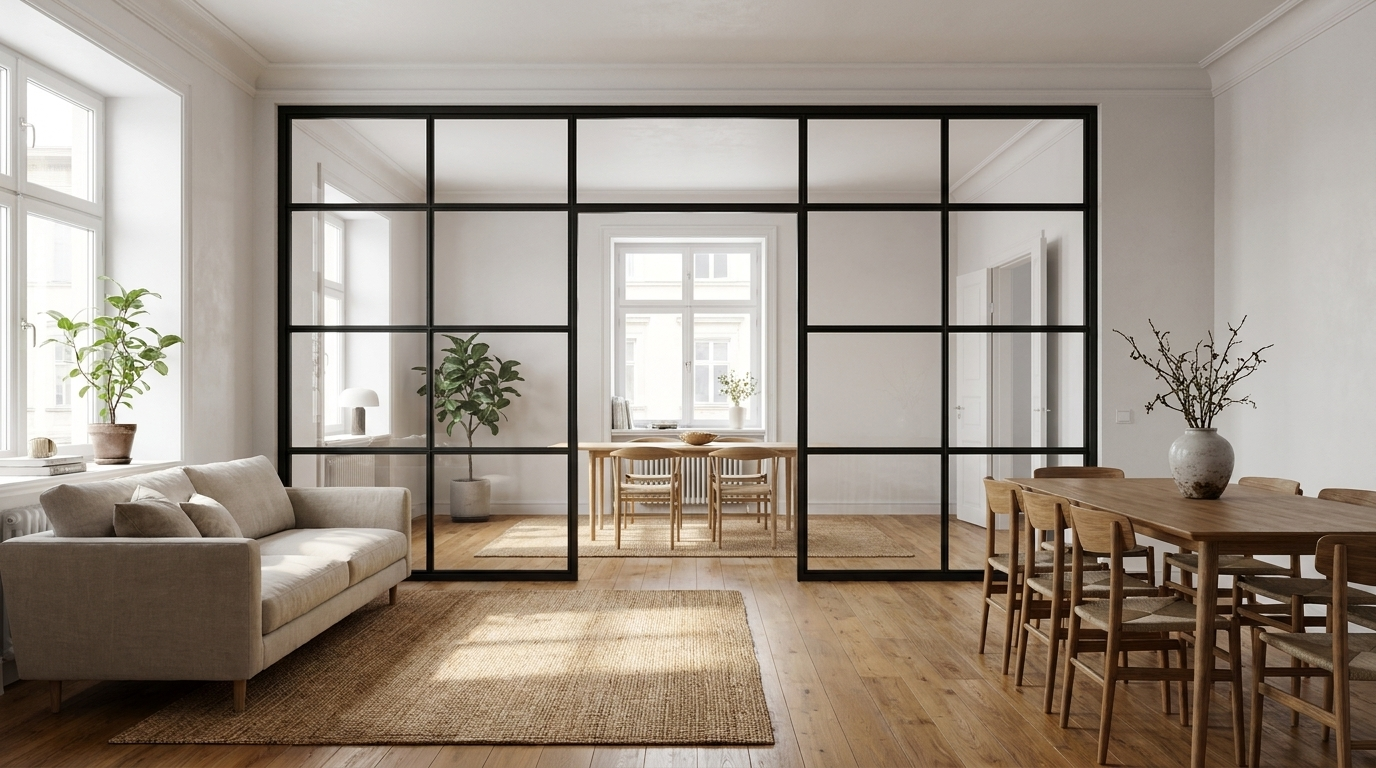
A loft door fitted to the millimetre looks fundamentally different from one shimmed in with packing strips. A dining table made to the exact width of your kitchen-diner feels like part of the room, not a compromise within it. Bespoke industrial furniture starts from your dimensions and your intentions — not from what happens to be in stock.
Materials That Last Generations
Solid wood and steel outlast chipboard, veneer, and composite materials by decades. More than that, they age well. A solid oak tabletop develops a richer patina over the years. A powder-coated steel frame holds its colour and resists daily wear. The furniture you buy once and keep forever is, in any honest calculation, the more sustainable and more economical choice.
Against the Flatpack Mentality
The flatpack model depends on replacement. Buy it, assemble it, replace it in five years when it's worn out or out of fashion. Bespoke industrial furniture operates on an entirely different logic — pieces made to last, designed to be repaired, and built from materials that become more characterful with age. That's a different relationship with the things you own.
| Factor | Bespoke Industrial Furniture | High-Street / Flatpack |
|---|---|---|
| Fit | Made to your exact dimensions | Standard sizes, compromises required |
| Materials | Solid wood and steel | Typically chipboard, veneer, or composite |
| Design | Authentic, raw beauty with functional purpose | Trend-driven or purely functional |
| Longevity | Decades of use; patina improves with age | Short lifespan; designed for replacement |
| Making | Traditional craft combined with modern precision | Industrial mass production |
Materials, Finishes, and Colours at Manufaktur X
The industrial aesthetic lives or dies by its materials. A steel frame in the wrong finish or a wood species that lacks character will undermine even the best design intent. At Manufaktur X, the material palette is deliberately focused: solid wood, robust steel, and — for loft doors and room dividers — safety glass.
Solid Wood: Oak, Beech, Ash, and More
The solid wood range at Manufaktur X includes oak, beech, ash, pine, walnut, and cherry — all hardwoods chosen for natural strength, pronounced grain, and longevity. These are properties the industrial style demands be visible, not concealed beneath paint or laminate. Over 50 stain options are available as a wood finish, ranging from pale natural tones through to deep, rich darks.
Steel Frames: Powder Coated in Any RAL Colour
Every steel frame is finished with powder coating — a process that delivers a harder, more even surface than conventional paint, with excellent scratch resistance and a consistent colour that holds up to daily use. Powder coating is also a more environmentally responsible finishing method. Anthracite (RAL 7016), matt black (RAL 9005), and off-white (RAL 9010) are the most popular choices for industrial interiors, but any RAL colour is available — including custom shades that might suit a period property or a more eclectic scheme.
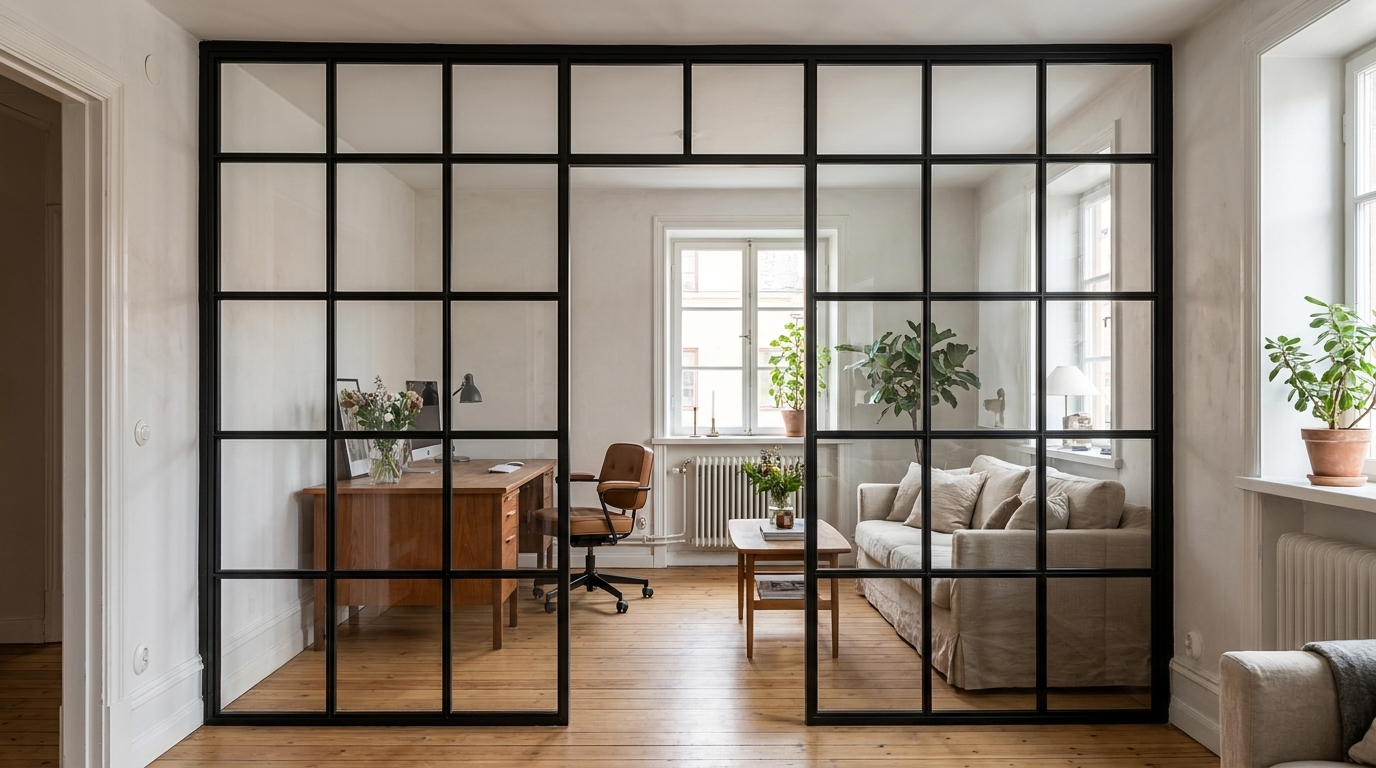
Glass Options for Loft Doors and Room Dividers
Glass is used exclusively in the steel-and-glass products — the loft door and the room divider. Five glass designs are available in the configurator:
- Clear glass — maximum transparency and light flow
- Frosted glass — soft visual privacy while maintaining brightness
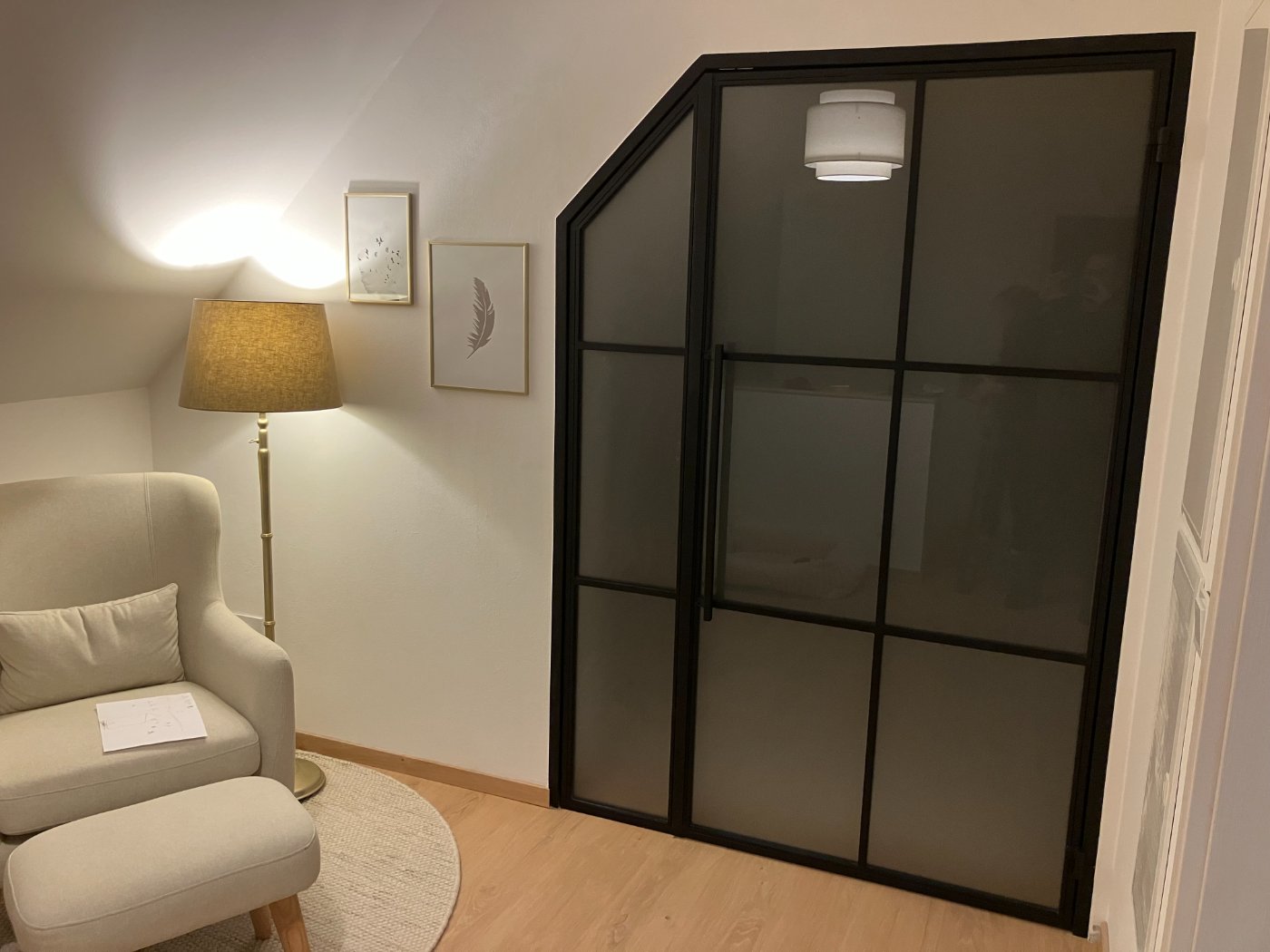
- Smoked glass — tinted appearance with a subtle reduction in visibility
- Dark smoked glass — stronger tint for greater privacy
- Textured glass — surface patterning that scatters light in an interesting way
Regarding glass types: both ESG (toughened safety glass) and VSG (laminated safety glass) are available. For larger dimensions, Manufaktur X recommends VSG for additional structural integrity and safety.
The Full Product Range: What Manufaktur X Makes
Every piece in the Manufaktur X range is made to order in solid wood, steel, and — where specified — glass. The range divides naturally into steel-and-glass products and steel-and-solid-wood furniture.
Loft Doors — a Proper Steel and Glass Door, Made to Measure
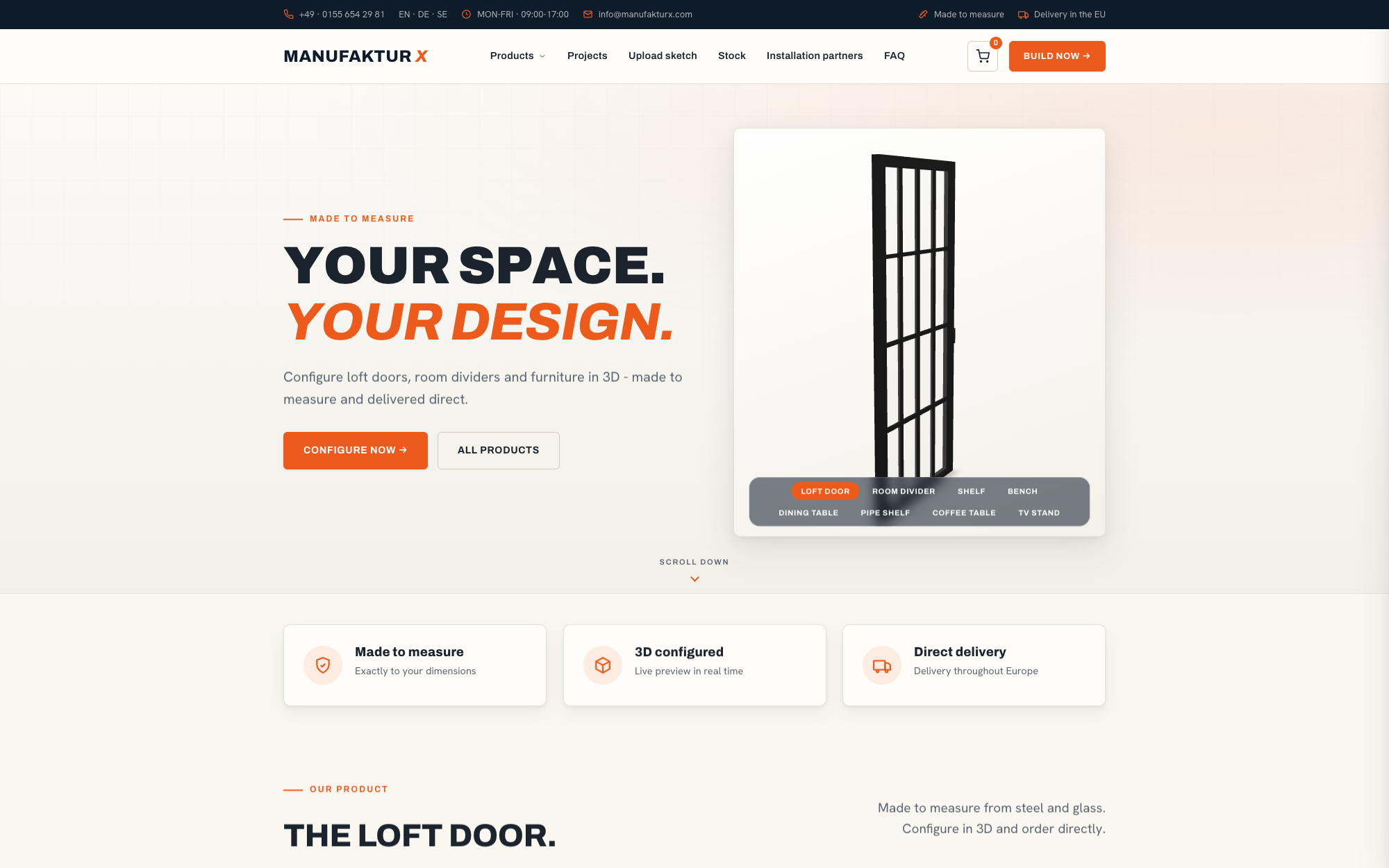
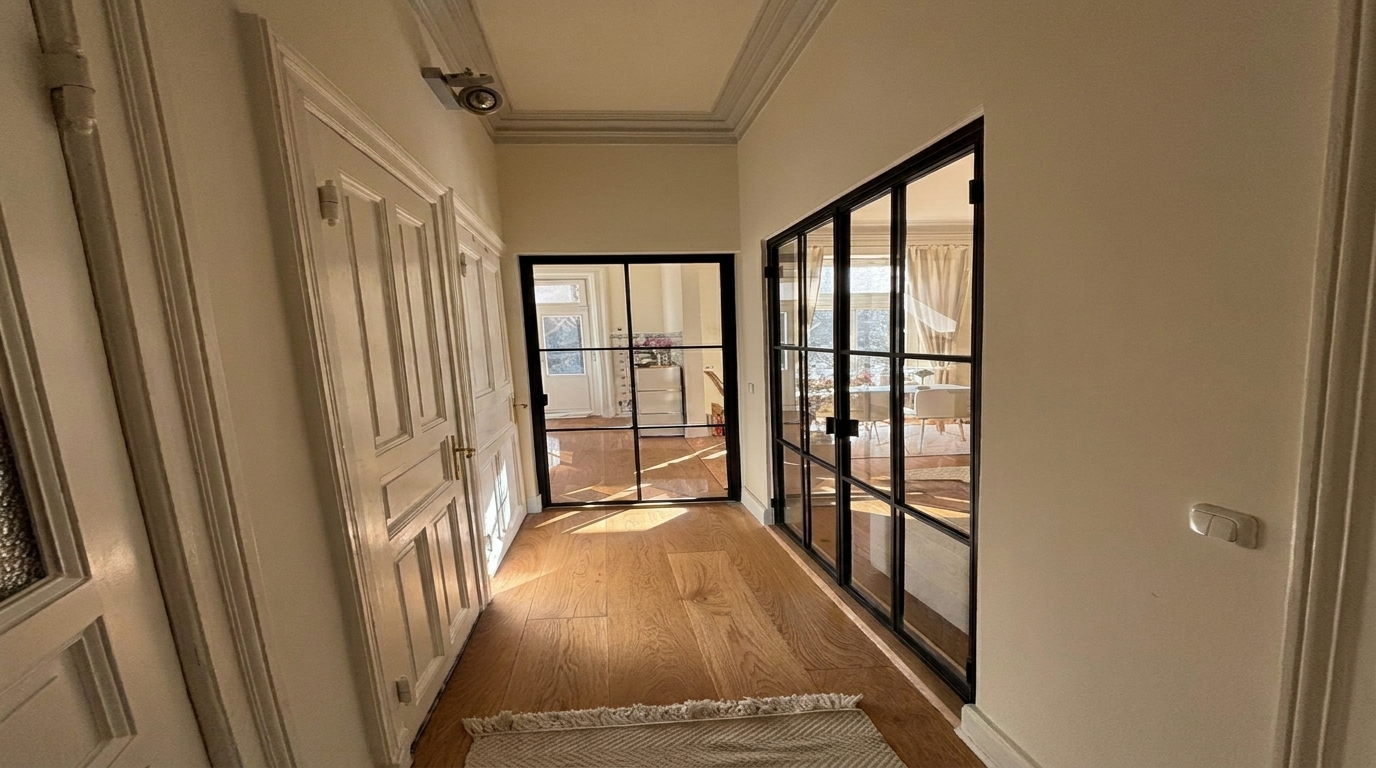
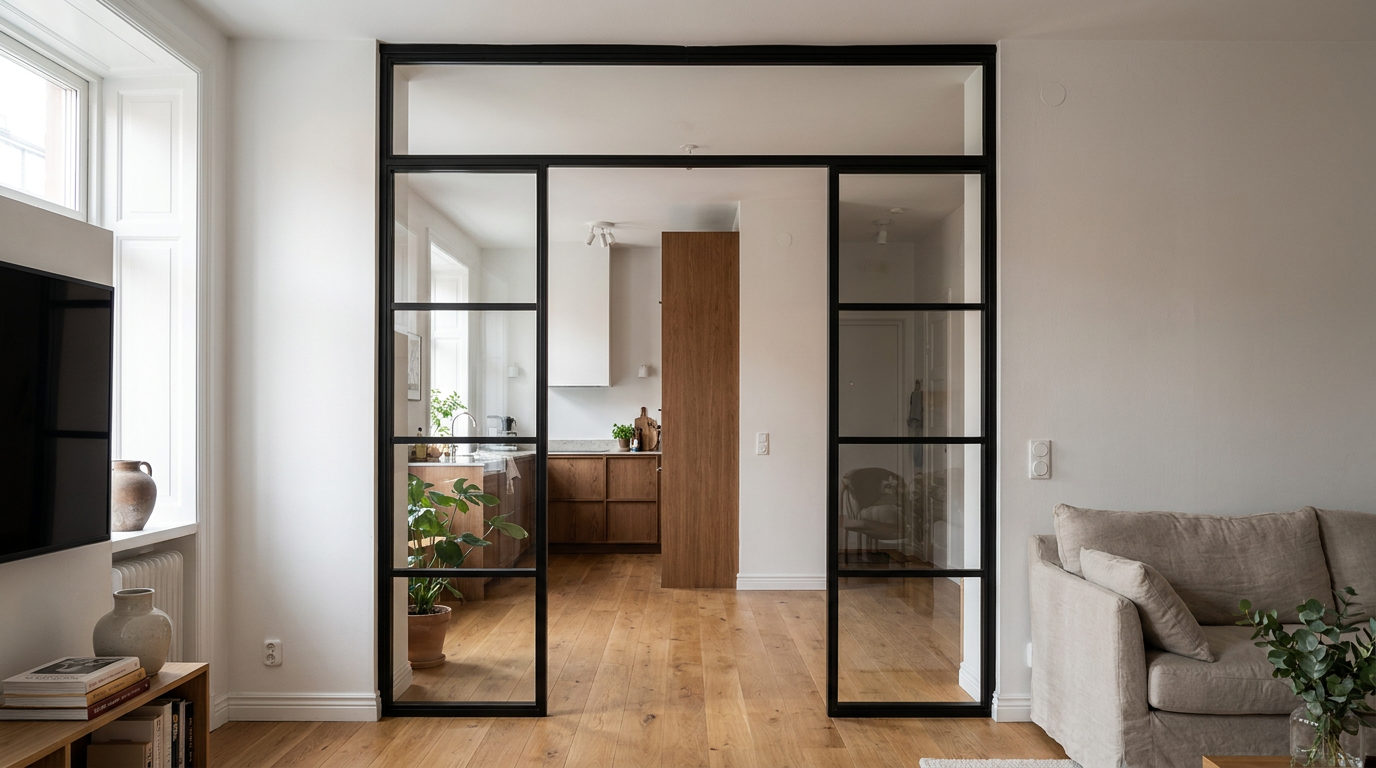
The Manufaktur X loft door is a functioning door with a proper door stop (left or right hinge configuration), a defined opening direction and angle, and full hardware. Three handle designs are available in the configurator: Elongated, Subtle, and Half-Moon. Slim steel profiles, generous glass panels, and a clean factory aesthetic — this is the piece that transforms a doorway into a design statement.
Room Dividers — Fixed Steel and Glass Partition Walls
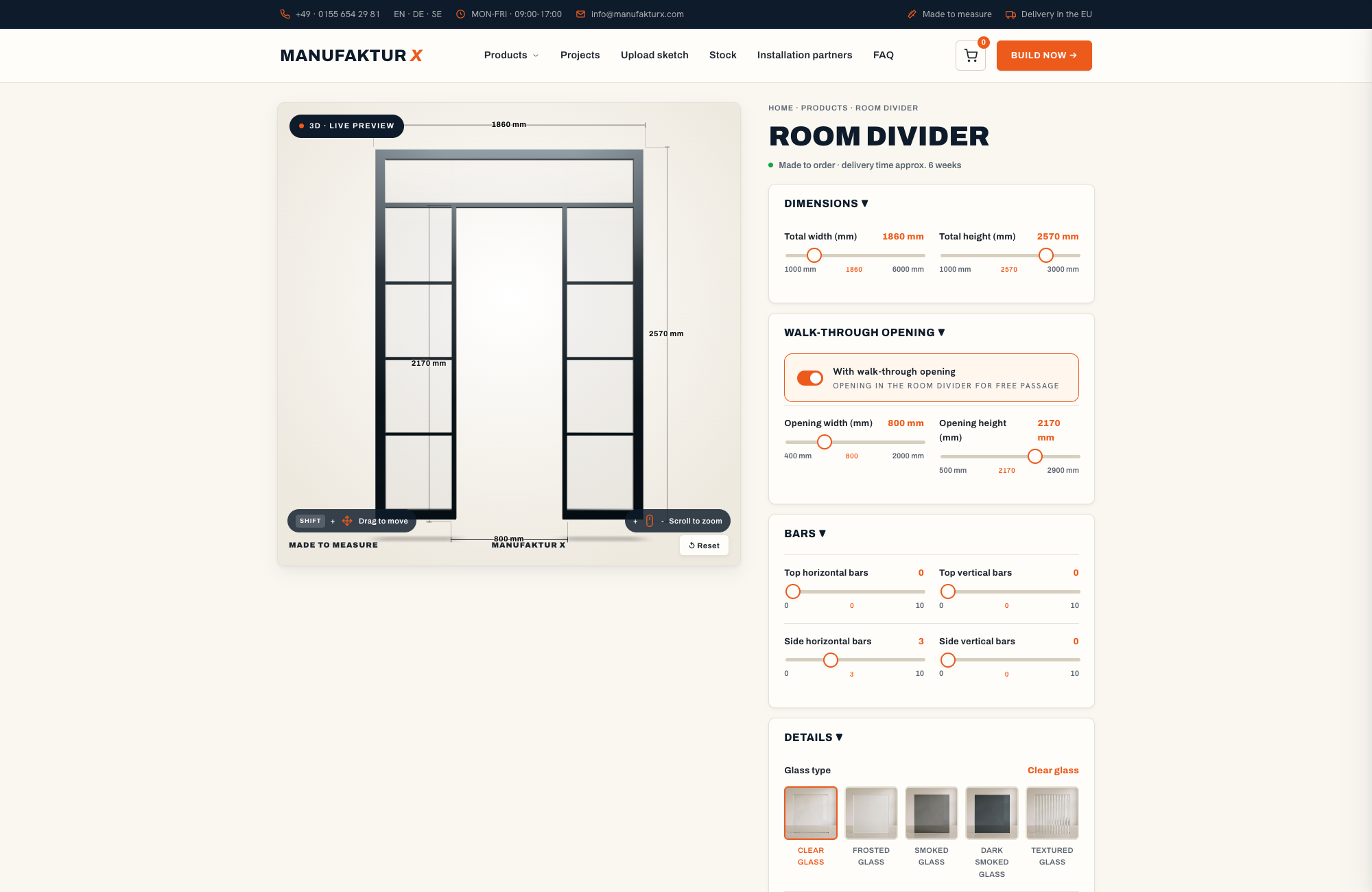
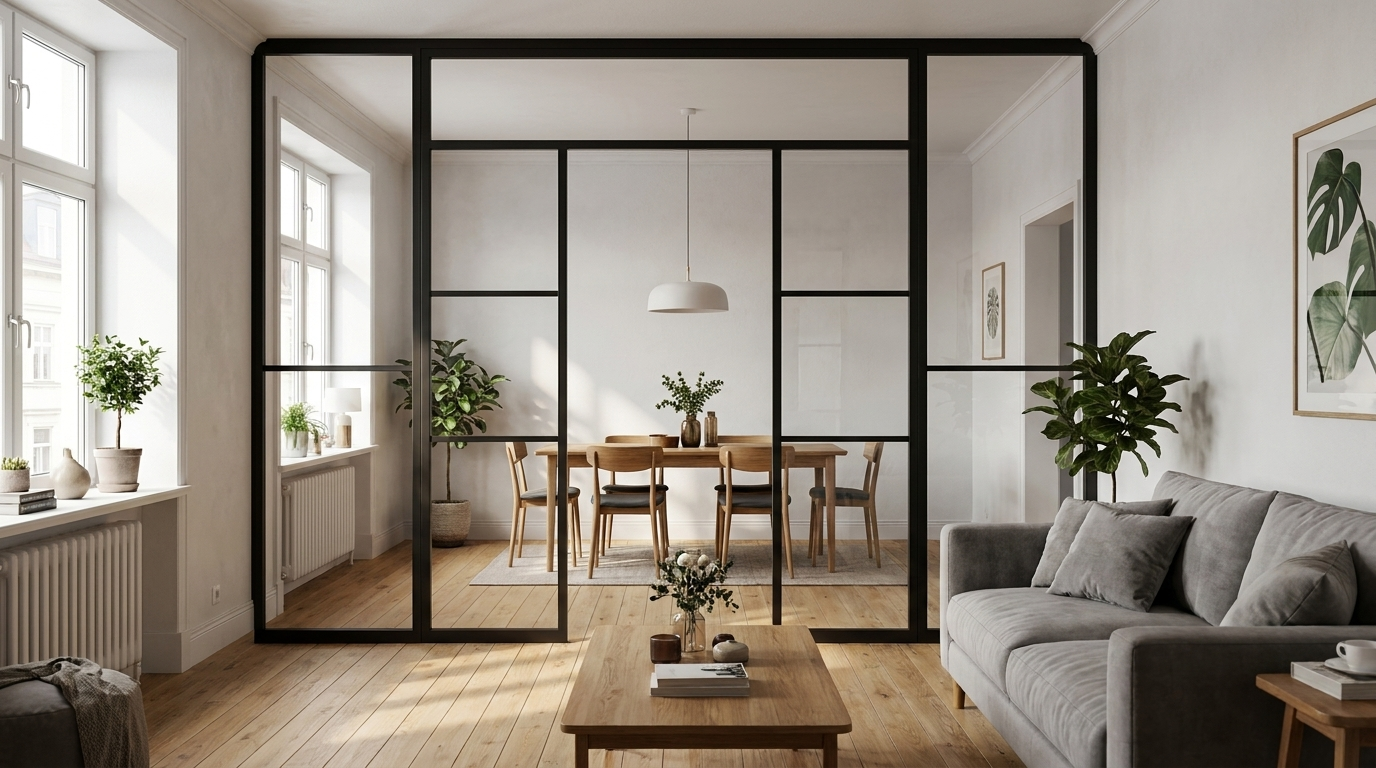
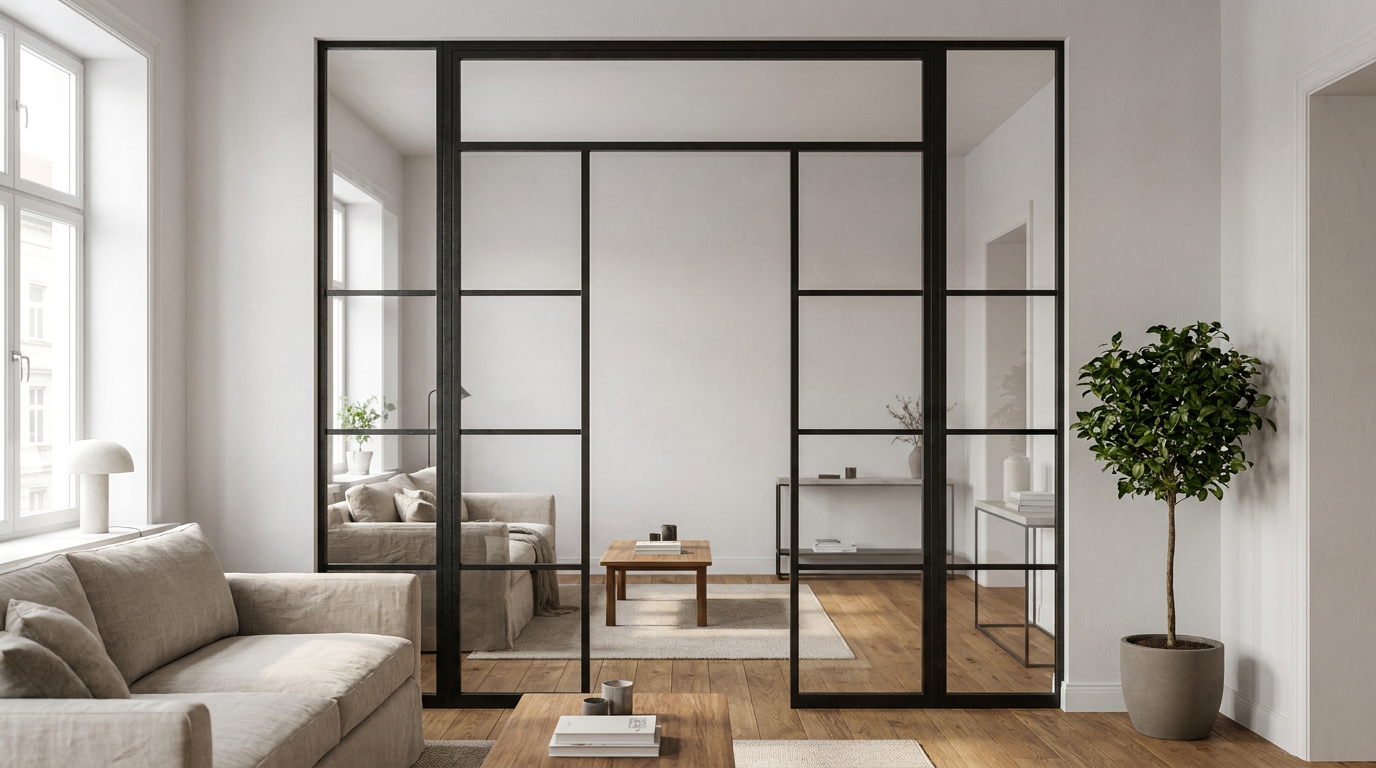
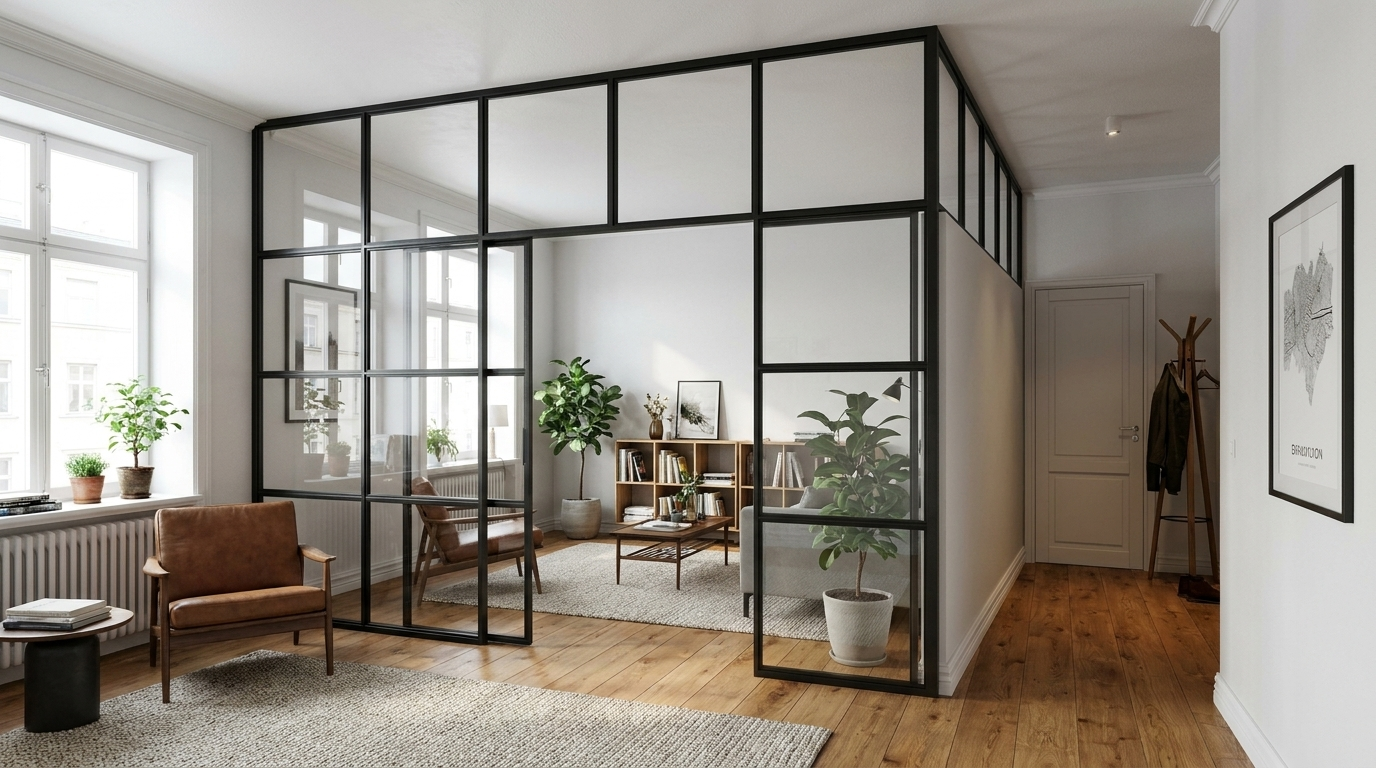
The Manufaktur X room divider is a permanently installed steel and glass partition — not a moveable screen, and emphatically not a door. There are no hinges, no handles, and no opening mechanism. It can optionally include a walk-through opening — an unframed gap without a door — which allows circulation whilst maintaining the visual structure of the partition. It's particularly well suited to open-plan conversions where you want to define zones without closing them off.
Large Shelving Unit — Steel Frame with Solid Wood Shelves
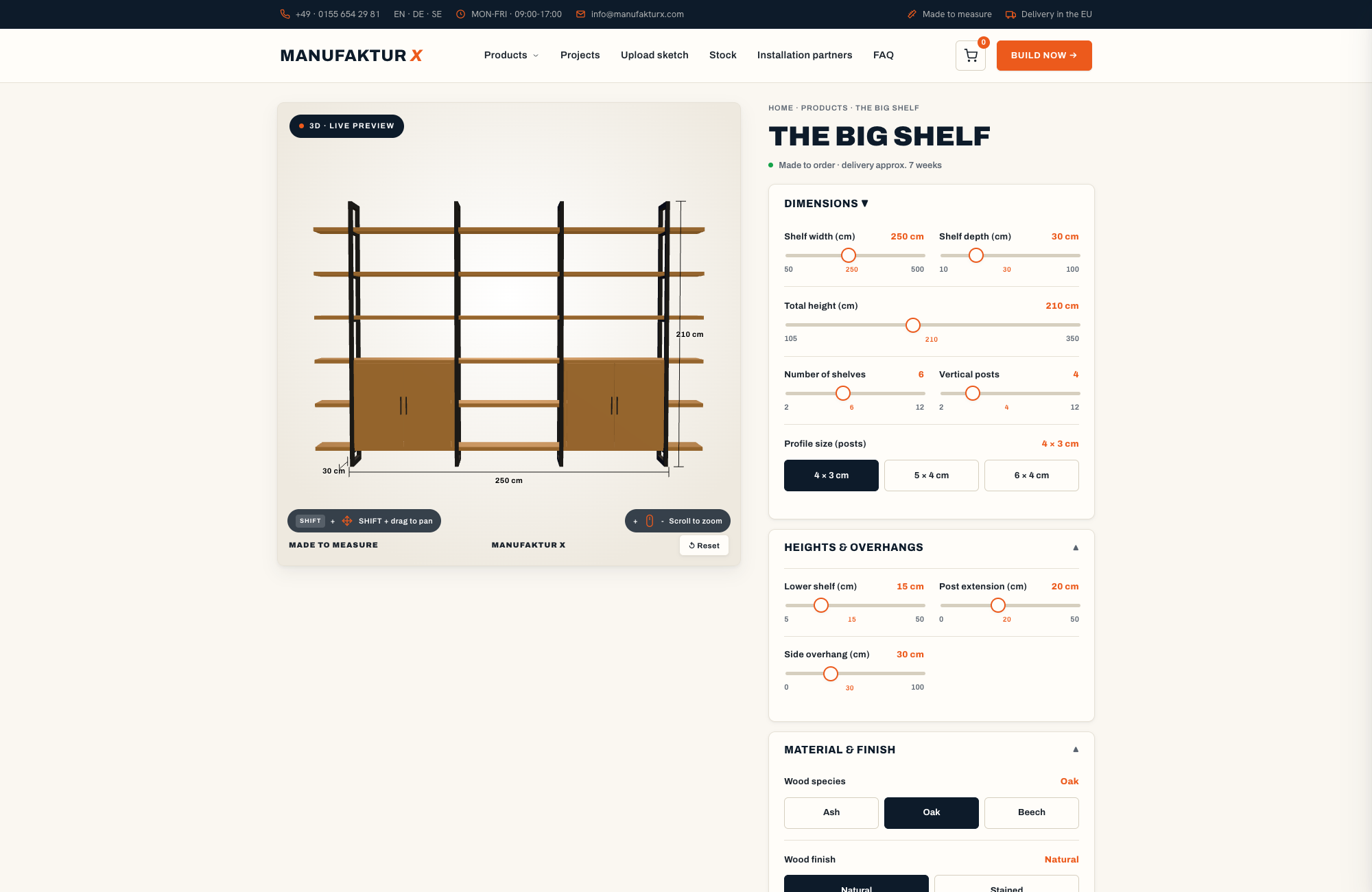
The large shelving unit pairs a steel frame with solid wood shelves in oak, beech, or ash. Optional integrated wooden cupboards are available. No glass — this is a pure steel-and-solid-wood construction that works as a room divider, a wall unit, or a freestanding storage solution.
Dining Tables and Coffee Tables — Solid Wood on a Steel Base
Both the dining table and the coffee table pair a solid wood top — oak, beech, or ash — with a steel base. No chipboard, no glass, no compromise. Two materials that define the industrial look: visible wood grain on top, clean steel geometry beneath.
Benches — Solid Wood and Steel
The bench combines a solid wood seat — oak, beech, or ash — with a steel frame. Straightforward, robust, and built to last. Works as a standalone piece or paired with the dining table for a cohesive industrial ensemble.
Pipe Shelf — Steel Pipe and Solid Wood
The pipe shelf is industrial design without any equivocation: steel pipes as the structural element, solid wood shelves in oak, beech, or ash, exposed fixings, clear construction. No glass. It's at home in a kitchen, a hallway, or a home office — anywhere that benefits from functional storage with genuine character.
Industrial Interior Trends Shaping Bespoke Furniture Right Now
The industrial style continues to evolve. Here are five directions currently influencing how bespoke pieces are being designed and used in UK homes.
1. Minimalism With Edge
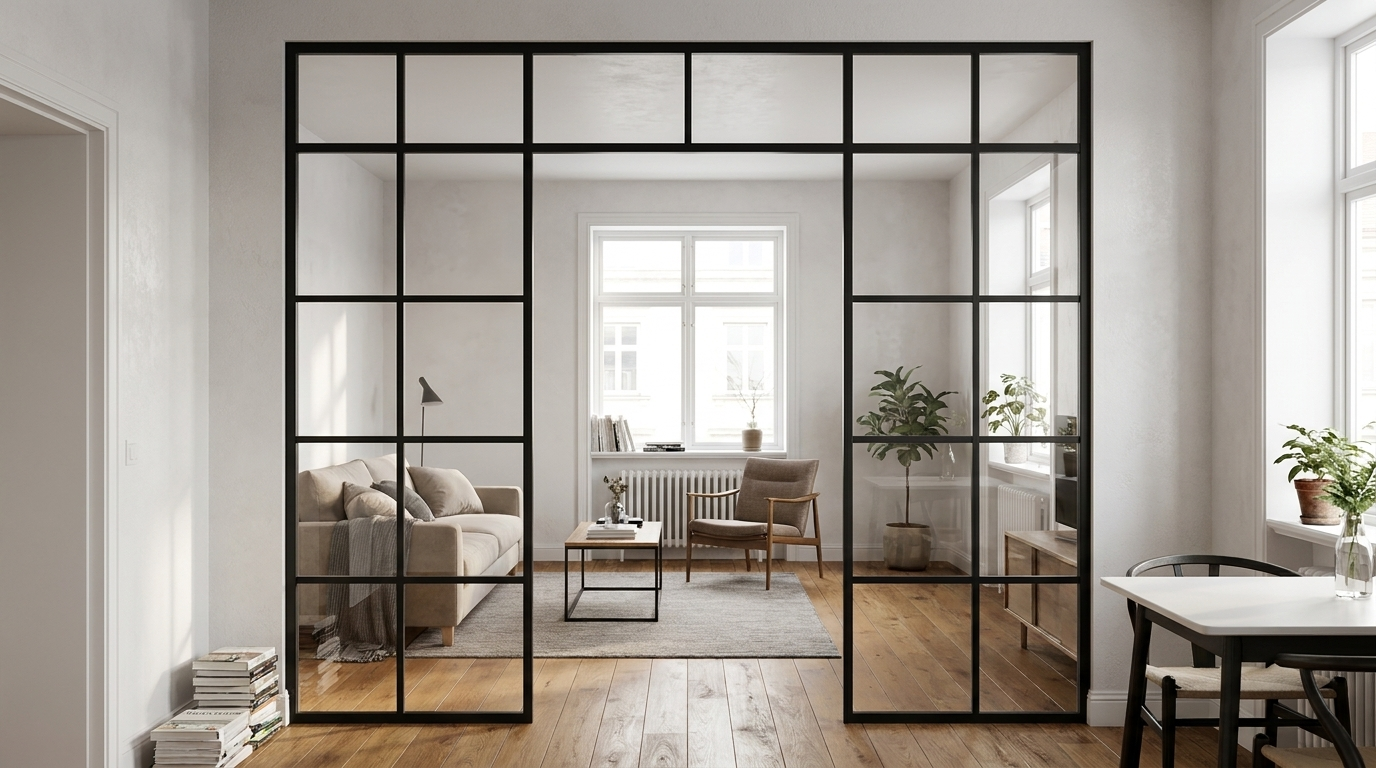
Less but deliberate: monochrome schemes punctuated by a single material contrast, clean lines interrupted by an unexpected detail. Loft doors and room dividers have become emblematic of this approach — transparent, light-filled, industrially framed. In Victorian terraces and Edwardian semis across the UK, a steel-framed loft door reads as both respectful of the architecture and confidently contemporary.
2. Sustainability Built Into the Brief
Commissioning something bespoke from solid materials is, in itself, an act of sustainability. Solid wood and powder-coated steel don't need replacing every few years. They can be repaired. They develop character rather than deteriorating. That's not a marketing claim — it's what these materials do.
3. The Digital Configurator as Design Tool
Craft and digital planning are increasingly working together. The Manufaktur X online configurator lets you enter your exact dimensions, choose your materials, select your glass design and steel colour, and see the price update in real time. There are no hidden costs — delivery charges and lead times are shown clearly at checkout. For UK customers, all customs duties and import costs are handled, so the price you see is the price you pay.
4. Flexible Spaces for Modern Living
The shift towards home working has permanently changed how British homes need to function. A spare bedroom doubling as a study, a kitchen-diner that needs a degree of separation from the living room, an open-plan ground floor that occasionally needs dividing — bespoke loft doors and room dividers solve these problems without structural work. Open in the evening, closed for a video call in the morning.
5. Visible Craft as a Counter to Mass Production
There's a growing appetite in the UK for things that are demonstrably made rather than assembled. Visible welds, exposed joinery, the particular way a piece of oak catches the light — these details matter to people who are tired of furniture that looks identical to everything else on the high street. Bespoke industrial pieces carry the evidence of their making, and that's increasingly seen as a mark of quality.
Bringing Industrial Style Into Your Home, Room by Room
You don't need warehouse proportions or a converted factory to make the industrial aesthetic work. The key is balance — enough raw material to anchor the look, enough softness to make the space genuinely comfortable.
Working With Open-Plan Layouts
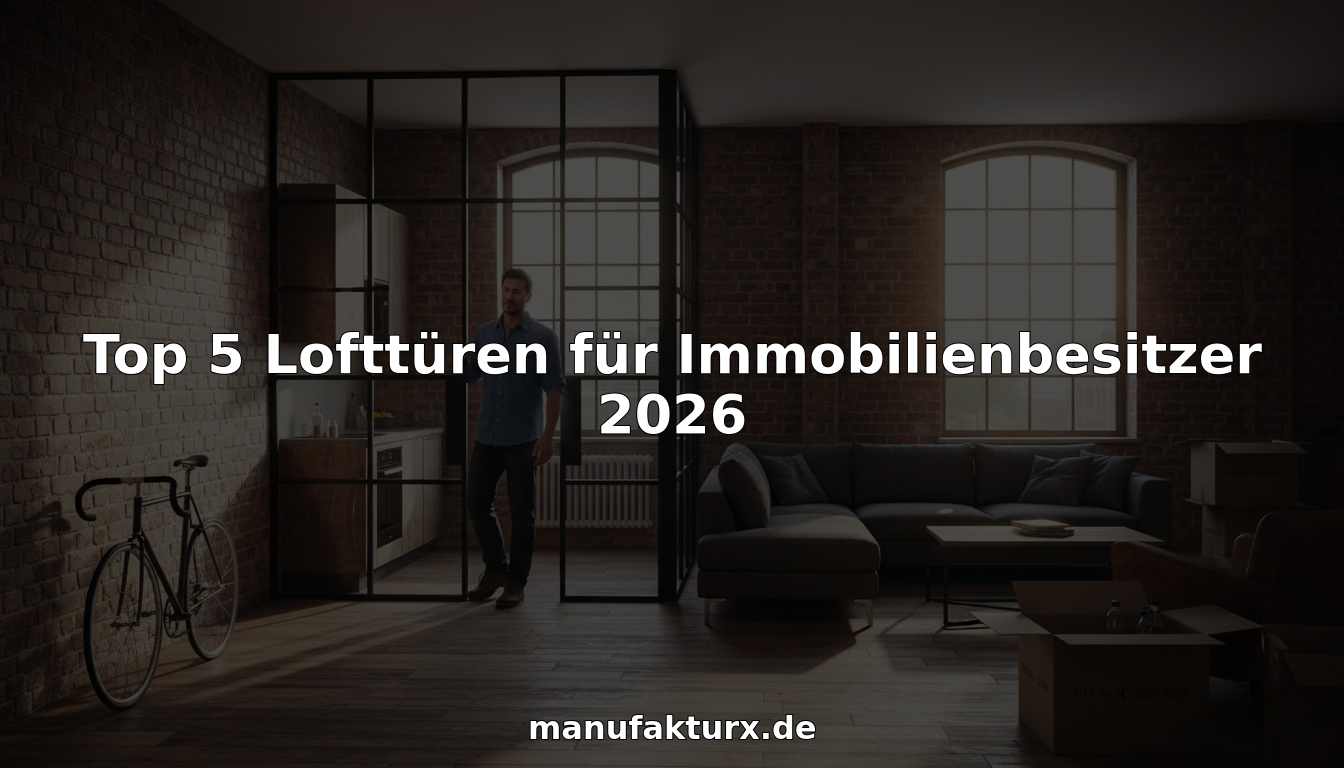
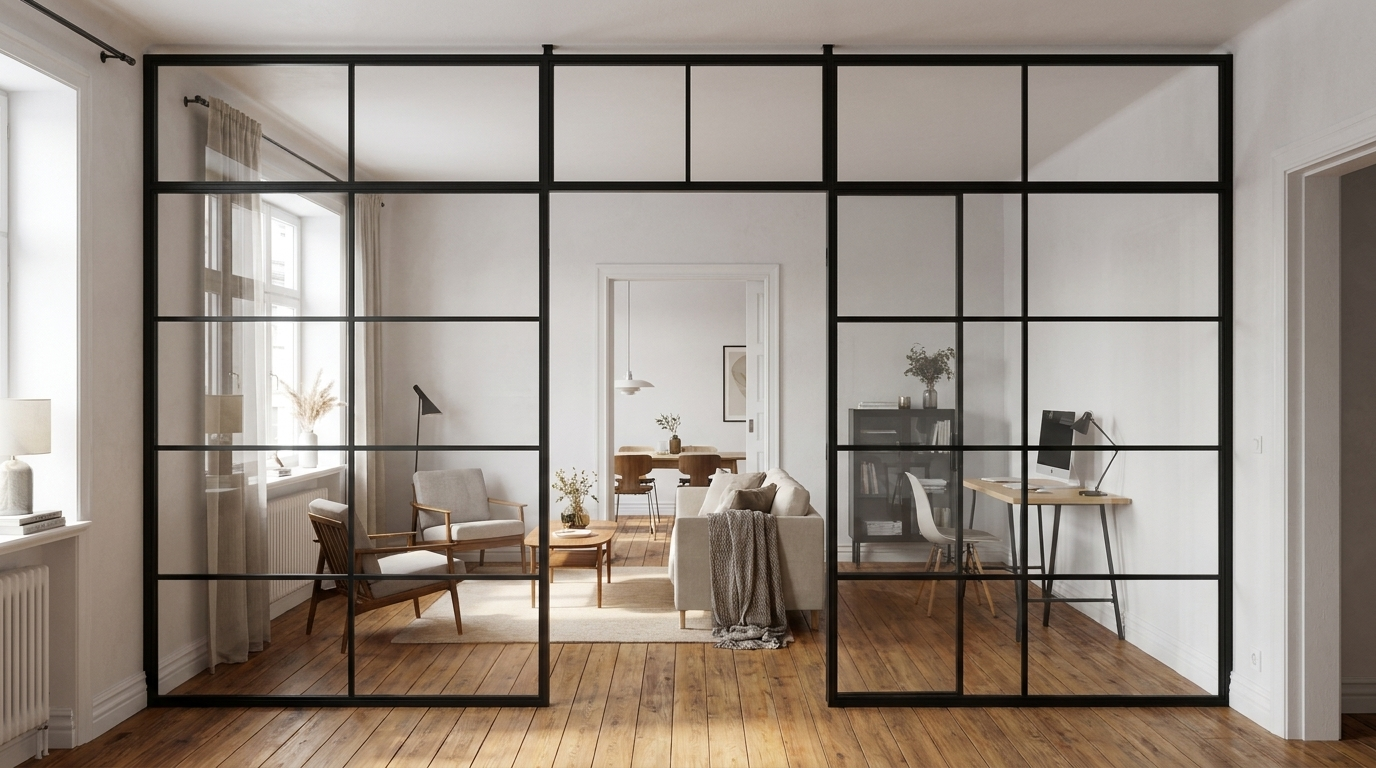
Open-plan living suits the industrial style naturally, but completely undivided space can feel lacking in definition. A steel-and-glass room divider creates zones without barriers — light flows through the glass panels, and the steel frame provides the visual structure the space needs. A loft door does the same thing with the added ability to fully close off a room when required.
The distinction is important: a room divider is a fixed partition wall, ideal when you want a permanent spatial structure. A loft door is a functioning door, ideal when you want flexibility — open or closed depending on the moment.
Combining Materials Effectively
- Steel: As frames, shelving structures, and table bases — with or without visible patina
- Solid wood: Natural or stained; as table tops, shelf boards, or bench seats
- Concrete and stone: Raw and unclad as flooring or feature walls — common in period conversions
- Glass: Always in combination with a steel frame, in loft doors and room dividers
The interplay between warm and cool, hard and soft, is precisely where industrial design gets its tension and appeal. A solid oak dining table on a steel base is the clearest possible illustration of this principle.
Colour: Restrained but Not Monotonous
The industrial palette works in layers of grey, from pale silver to deep anthracite, with black as a structural accent and warm browns and rusts bringing organic depth. White creates contrast and helps smaller spaces feel more open. The powder coating on Manufaktur X steel frames is available in any RAL colour — but the most compelling industrial interiors tend to stay within this restrained, material-led palette.
Making Industrial Feel Like Home
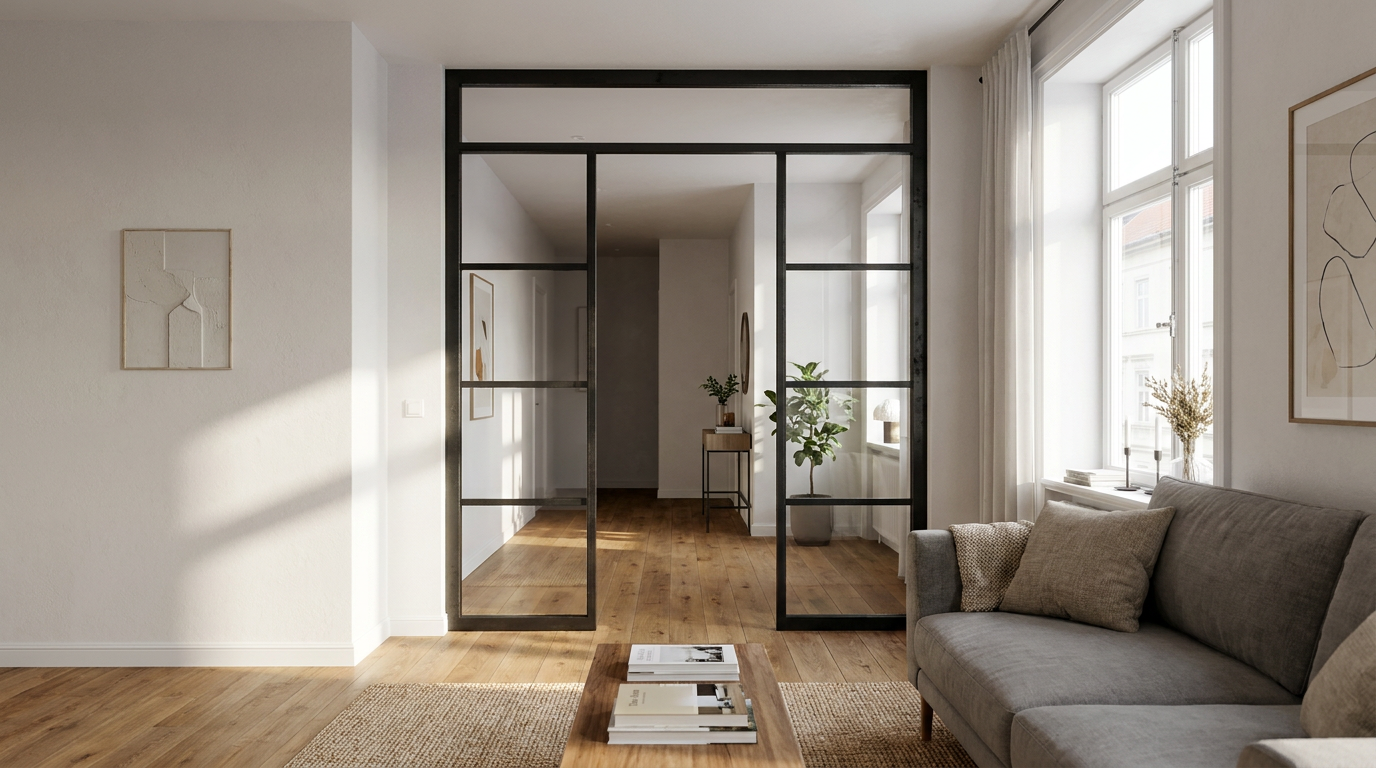
Raw materials can read as cold if they're not balanced with softer elements. In British homes, this often means:
- Deep, generous sofas — leather works particularly well against steel and wood
- Natural textiles: linen, cotton, and wool in neutral tones
- Vintage or Persian rugs that add pattern and warmth underfoot
- Indoor plants as an organic counterpoint to hard surfaces
- Filament bulbs and metal-shaded pendants for warm, directional light
Industrial Style in Smaller Spaces
Compact flats — including the kind of Victorian terrace conversions and ex-council blocks that make up a significant portion of UK urban housing stock — can carry the industrial style beautifully. A few well-chosen pieces do more work than a room full of compromises:
- Wall-mounted pipe shelving maximises storage without taking up floor space
- A loft door with glass panels borrows light between rooms, making both feel larger
- A single exposed brick wall or concrete panel is enough to establish the visual language
- Light surface colours elsewhere prevent the space from feeling heavy
How a Bespoke Piece Is Made: The Manufaktur X Process
Every piece starts with your dimensions and ends with a finished product made for your specific space. The process combines traditional craft with CNC precision and rigorous quality control.
Step One: Measuring Up
Measure at multiple points — walls and floors in older properties are rarely perfectly plumb or level. Always work from the smallest measurement to ensure the finished piece will fit. For loft doors, subtract the installation gap from your smallest dimension: approximately 5 mm clearance on each side (left, right, and top). You enter your exact desired dimensions directly into the configurator — not the rough opening size.
Step Two: Configure Online
The online configurator at manufakturx.co.uk lets you input dimensions, choose your wood species and stain, select your glass design and steel colour, and watch the price update instantly. What you see in the configurator is what you pay — no surprises at checkout, and no hidden charges. Delivery to the UK is included, with all customs duties and import costs already handled.
Step Three: Custom Requests via Sketch Upload
For unusual room configurations — an angled ceiling, a non-rectangular opening, or a genuinely bespoke structural requirement — a sketch upload service is available. The Manufaktur X team reviews the request and provides a tailored quote.
Step Four: Production and Delivery
Once your order is confirmed, production begins: CAD design for precision planning, CNC machining for accurate cuts and profiles, then manual finishing and quality checking. Production takes 5 to 6 weeks, after which your piece is delivered directly to your address in the UK. Every product is made in the EU to consistent quality standards.
Loft Door vs Room Divider: Understanding the Difference
These two products are frequently confused — and the confusion is understandable, since both involve steel frames and glass panels. But they are fundamentally different things.
| Feature | Loft Door | Room Divider |
|---|---|---|
| Function | A working door that opens and closes | A fixed partition wall — does not move |
| Door stop | Yes — left or right hinge configuration | No |
| Opening direction and angle | Yes — configurable | No |
| Handle | Yes — Elongated, Subtle, or Half-Moon | No |
| Hinges | Yes | No |
| Passage through | By opening the door | Optional walk-through gap without a door |
| Glass designs | Clear, Frosted, Smoked, Dark Smoked, Textured | Clear, Frosted, Smoked, Dark Smoked, Textured |
| Steel colour | Any RAL colour | Any RAL colour |
Pricing: What Does Bespoke Industrial Furniture Cost?
Because every piece is configured to individual dimensions with chosen materials and finishes, there is no single fixed price. The configurator shows your exact price in real time as you build your specification. All prices are shown in GBP, inclusive of delivery to the UK, with customs and import duties already included — so the price you see is the price you pay.
| Product | From | Note |
|---|---|---|
| Lofttür | £995 | Lowest possible option |
| Raumteiler | £1.900 | Steel + laminated glass, custom width |
| Großes Regal | £2.750 | Solid wood, steel frame, floor-to-ceiling |
| Esstisch | £1.360 | Solid wood, steel frame |
| Couchtisch | £995 | Solid wood, steel frame |
| Sitzbank | £945 | Solid wood, steel frame |
| TV-Board | £1.325 | Solid wood, steel frame |
| Rohrregal | £915 | Modular pipe shelf |
Industrial Design vs the Industrial Style: A Brief Clarification
These two terms are often used interchangeably, but they refer to different things. Industrial design as a professional discipline is a strategic process concerned with user experience, functionality, ergonomics, and manufacturability — it's how everything from a bicycle to a smartphone gets designed. The industrial style in interiors is a specific aesthetic sensibility: raw materials, exposed construction, functional beauty, and the visual language of the factory floor.
When we talk about bespoke industrial furniture, we mean the second: pieces made according to the principles of the industrial aesthetic — honest materials, visible structure, made-to-measure precision. That's what Manufaktur X does.
| Aspect | Industrial Design (Discipline) | Industrial Style (Interiors) |
|---|---|---|
| Focus | User experience, function, manufacturability | The aesthetic of industrial materials and construction |
| Goal | Products that work well for broad use | Characterful, authentic living spaces |
| Materials | Whatever suits the product | Steel, solid wood, concrete, glass |
| Process | Research, prototyping, testing, production | Material selection, craft, bespoke making |
Caring for Your Industrial Furniture
Bespoke industrial furniture is built to last decades. The maintenance required is less involved than most people expect — but it does need to be consistent.
Looking After Solid Wood
- Oil or wax the surface regularly to keep it supple and protect against moisture
- Avoid prolonged direct sunlight and extreme dryness, which can cause movement in the timber
- Minor surface scratches can be sanded back lightly and re-oiled
- Wipe up spills promptly — solid wood is resilient but not impervious to moisture
Looking After Powder-Coated Steel
- Powder-coated surfaces are easy to maintain — a damp cloth is sufficient for routine cleaning
- Avoid abrasive cleaners and scouring pads, which can damage the coating
- Any chips or scratches in the coating should be touched up promptly to prevent rust developing underneath
Cleaning the Glass
- Clean ESG and VSG panels with standard glass cleaner and a lint-free cloth
- Avoid anything abrasive on the glass surface
- Fingerprints on clear glass panels are worth wiping down regularly for the best visual clarity
Frequently Asked Questions
What exactly is bespoke industrial furniture and what makes it different?
Bespoke industrial furniture is made to your exact dimensions according to the design principles of the industrial aesthetic: raw materials such as steel and solid wood, visible construction, and a form-follows-function approach. Unlike mass-produced pieces, each one is unique to the customer and the space. At Manufaktur X, that means solid wood in oak, beech, ash, pine, walnut, or cherry, paired with powder-coated steel in any RAL colour.
Which wood species are available?
Manufaktur X works with solid hardwoods: oak, beech, ash, pine, walnut, and cherry. Over 50 stain finishes are available, from light naturals to deep, dark tones.
What is the difference between a loft door and a room divider?
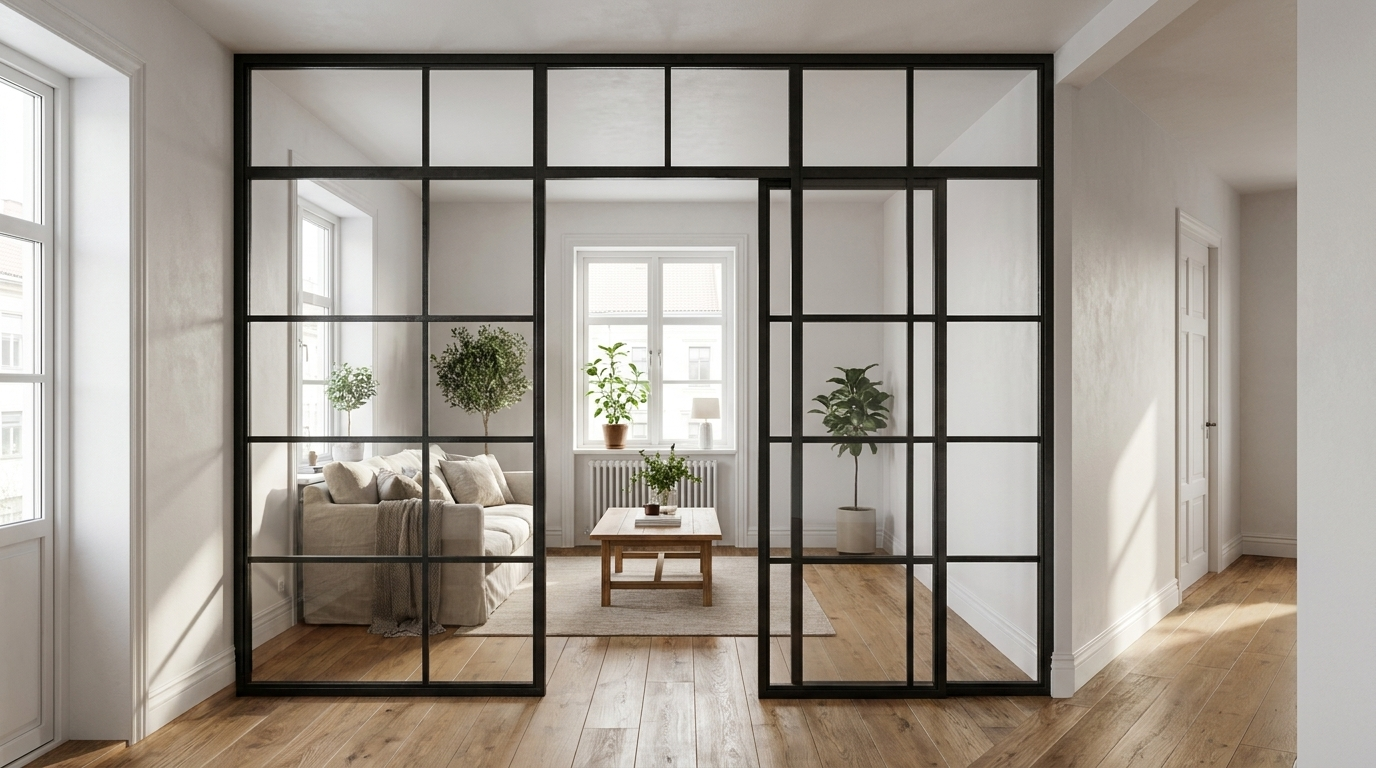
A loft door is a working door — it has hinges, a door stop (configurable left or right), an opening direction, and a handle in one of three designs: Elongated, Subtle, or Half-Moon. A room divider is a fixed partition wall with no moving parts — no hinges, no handle, no opening mechanism. An optional walk-through gap can be included in the divider design, but it doesn't have a door.
What glass options are available?
Five glass designs are available for both loft doors and room dividers: clear glass, frosted glass, smoked glass, dark smoked glass, and textured glass. Both ESG (toughened safety glass) and VSG (laminated safety glass) are offered as glass types; for larger dimensions, VSG is recommended for additional stability.
Do I measure the opening or the finished size I want?
You enter your exact desired dimensions into the configurator — not the rough opening measurement. For loft doors, measure at multiple points and work from the smallest dimension, then subtract approximately 5 mm per side for the installation gap. The configurator produces a piece made precisely to what you've entered.
How long does production take, and is delivery to the UK straightforward?
Production takes 5 to 6 weeks from order confirmation. Delivery is made directly to your UK address. All customs duties and import costs are included — there are no additional charges on arrival.
Can industrial style work in a period property or a smaller flat?
Absolutely. In fact, Victorian and Edwardian properties often have the architectural bones — high ceilings, large window openings, original timber floors — that make the industrial aesthetic particularly compelling. In smaller spaces, a few well-chosen pieces do the work: a loft door with glass panels borrows light between rooms, and wall-mounted pipe shelving adds storage without sacrificing floor area. A single exposed brick wall or feature panel is often all it takes to establish the visual language.
What are the sustainability credentials of bespoke industrial furniture?
Pieces made from solid wood and steel last far longer than anything built from chipboard or composite materials. The industrial aesthetic's relationship with patina means the furniture improves rather than degrades with age. Buy once, maintain it properly, and you'll still be using it in thirty years — that's the most honest sustainability argument there is.