Steel-Framed Glass Room Dividers: When Traditional Walls Simply Won't Do
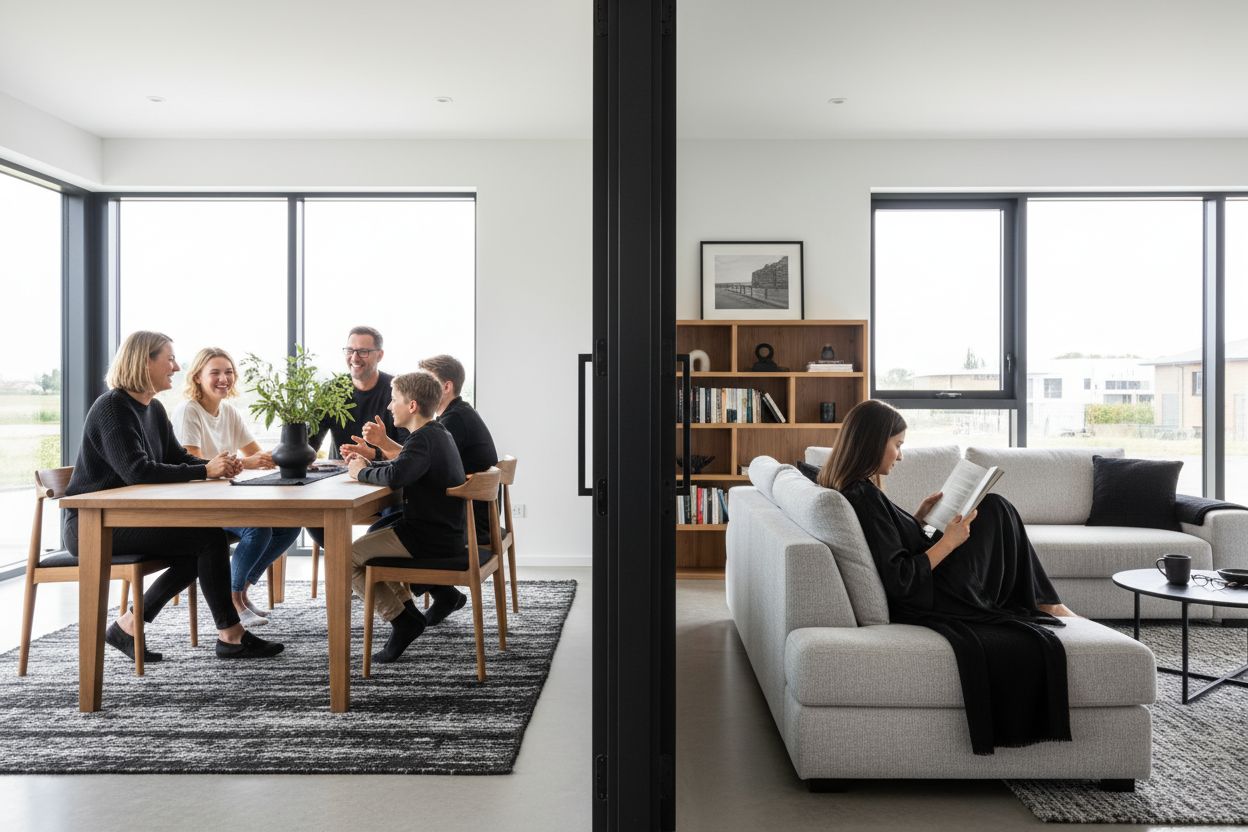
Victorian terraces, converted warehouses, and period properties across Britain present unique spatial challenges. Solid walls may solve functional separation, but they sacrifice precious natural light and destroy the elegant proportions that make these homes so desirable. A steel-framed glass room divider offers sophisticated space division whilst preserving the architectural character that drew you to your property in the first place.
The visible steel framework isn't merely structural—it's a deliberate design statement that celebrates Britain's industrial heritage. From Manchester's cotton mills to London's converted printing houses, steel and glass construction speaks to our manufacturing legacy whilst addressing thoroughly modern living requirements. Light flows freely between spaces, sight lines remain intact (or are selectively interrupted), and your home's unique character stays beautifully preserved.
"Contemporary British interiors increasingly embrace industrial references—but only precision fabrication delivers the proportional refinement that distinguishes quality design from mere pastiche."
RIBA Journal, Interior Design Supplement, Spring 2024
Fixed Panels, Door Options, and Combination Solutions
Not every opening requires daily passage. A purely fixed panel—completely glazed without moving parts—works brilliantly between your sitting room and study when the latter has independent access. For openings seeing regular foot traffic, a single loft door leaf handles widths up to approximately 900mm efficiently. Broader openings benefit from combining fixed side panels with a single door leaf—the side panel fills the remaining width whilst keeping the door itself to manageable proportions.
All configurations are immediately available through our online configurator, with real-time pricing and 3D visualisation showing exactly how your chosen specifications will appear.
Where Steel-Glass Partitions Excel in British Homes
Four scenarios account for the majority of Manufaktur X commissions:
- Kitchen-living separation in open-plan conversions: Two-leaf dividers or side panel plus door combinations, clear glass maintaining openness, RAL 9005 (jet black) frames complementing modern British interiors.
- Home office privacy within reception rooms: Side panel plus door leaf, frosted glass providing visual privacy whilst allowing light transmission, often in RAL 7016 (anthracite grey) for sophisticated contrast.
- Bedroom zones in warehouse conversions: Full-height partitions with transom lights, accommodating ceiling heights up to 3,000mm typical of industrial building conversions.
- Dressing room separation from master suites: Opal glass for complete visual separation with decorative effect, frames in RAL 9010 (pure white) for light, contemporary aesthetics.
Why Standard Dimensions Fail British Properties
Period British properties rarely conform to modern standard dimensions. Georgian townhouses average 2,700-3,200mm ceiling heights, whilst off-the-shelf products typically max out at 2,100mm—leaving awkward gaps that compromise the refined proportions these homes deserve. Additionally, over 65% of UK building work now involves existing properties rather than new construction, and their openings seldom match contemporary standards.
Consider a Victorian terrace conversion in Bath: sloping floors, settlement over decades, and multiple renovation layers meant opening dimensions varied by 20mm between top and bottom measurements. No standard product could accommodate this variation—only bespoke fabrication delivered the precise fit required.
Design Elements That Define Character: Glass Types, Frame Colours, and Grid Patterns
Selecting Glass for Function and Aesthetics
Clear glass maintains complete visual and light transmission—perfect for preserving open-plan living whilst defining distinct zones. Frosted glass diffuses light beautifully whilst providing privacy; you'll notice movement and brightness changes without seeing specific details. Tinted options add subtle colour whilst reducing glare, particularly valuable in south-facing rooms.
View all available glass types within our configurator, where you can switch between options and see immediate visual comparisons.
ESG Versus VSG: Equal Pricing, Personal Preference
ESG (toughened safety glass) fractures into small, relatively harmless fragments when broken. VSG (laminated safety glass) comprises two glass layers with plastic interlayer—if damaged, the interlayer holds fragments together. For residential room dividers, both meet safety requirements equally well.
"Choosing between toughened and laminated glass for decorative partitions is aesthetic rather than functional—laminated glass slightly softens reflections, whilst toughened glass appears marginally clearer. Both satisfy residential safety standards completely."
Glass Technology International, Issue 3/2023
At Manufaktur X, ESG and VSG cost identically—your choice is purely aesthetic, never budgetary. This contrasts with many suppliers who charge premiums for laminated glass, creating false economy pressures.
RAL Frame Colours: Defining Your Interior's Character
Frame colour influences overall impression more dramatically than any other single element. RAL 9005 (jet black) remains overwhelmingly popular—it emphasises the steel framework, creates crisp definition, and suits virtually any interior style from industrial chic to contemporary classic. RAL 9010 (pure white) and RAL 9016 (traffic white) work beautifully in light, minimalist schemes where the frame should recede rather than dominate. RAL 7016 (anthracite grey) bridges black and white, integrating smoothly with neutral contemporary palettes.
All RAL colours are available without surcharge from Manufaktur X—your choice is aesthetic, not financial.
Important note on colour selection: Monitor displays often render similar RAL colours nearly identically, whilst they appear distinctly different under natural light. RAL 9005 and RAL 9004 may look identical on screen but differ noticeably in your room, particularly regarding light reflection characteristics.
Grid Patterns: Proportion Matters More Than Preference
Grid layout—the number, division, and arrangement of glazing bars—defines a partition's character more than glass choice itself. A 4-panel grid suits a 2,200mm high opening beautifully; the same division in a 3,000mm opening creates squat, overly wide panels that compromise elegance.
Generally, panels with height-to-width ratios between 1.5:1 and 2.5:1 appear balanced in most settings. Manufaktur X's configurator displays your chosen grid in real-time with your specific dimensions, but we also recommend physical testing: tape paper strips matching steel profile width to your wall and assess from normal viewing distance of 2-3 metres.
Configuration Options: Doors, Side Panels, and Transom Lights
Available Combinations
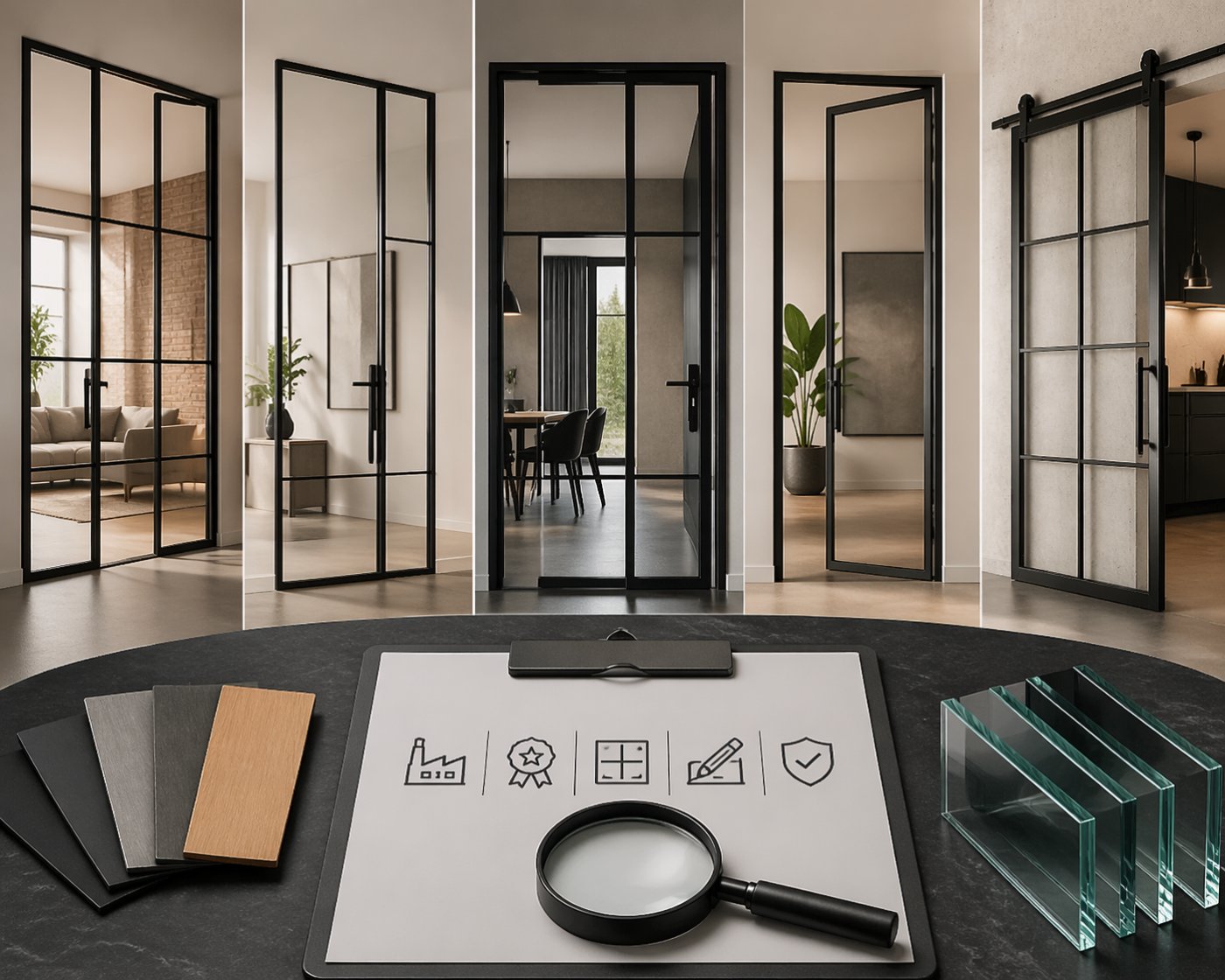
Manufaktur X offers these primary configurations, mixable as required:
- Fixed room dividers: No moving elements, entirely glazed. Ideal for separation without regular passage requirements.
- Single-leaf doors: Standard solution for openings up to approximately 900mm requiring daily access.
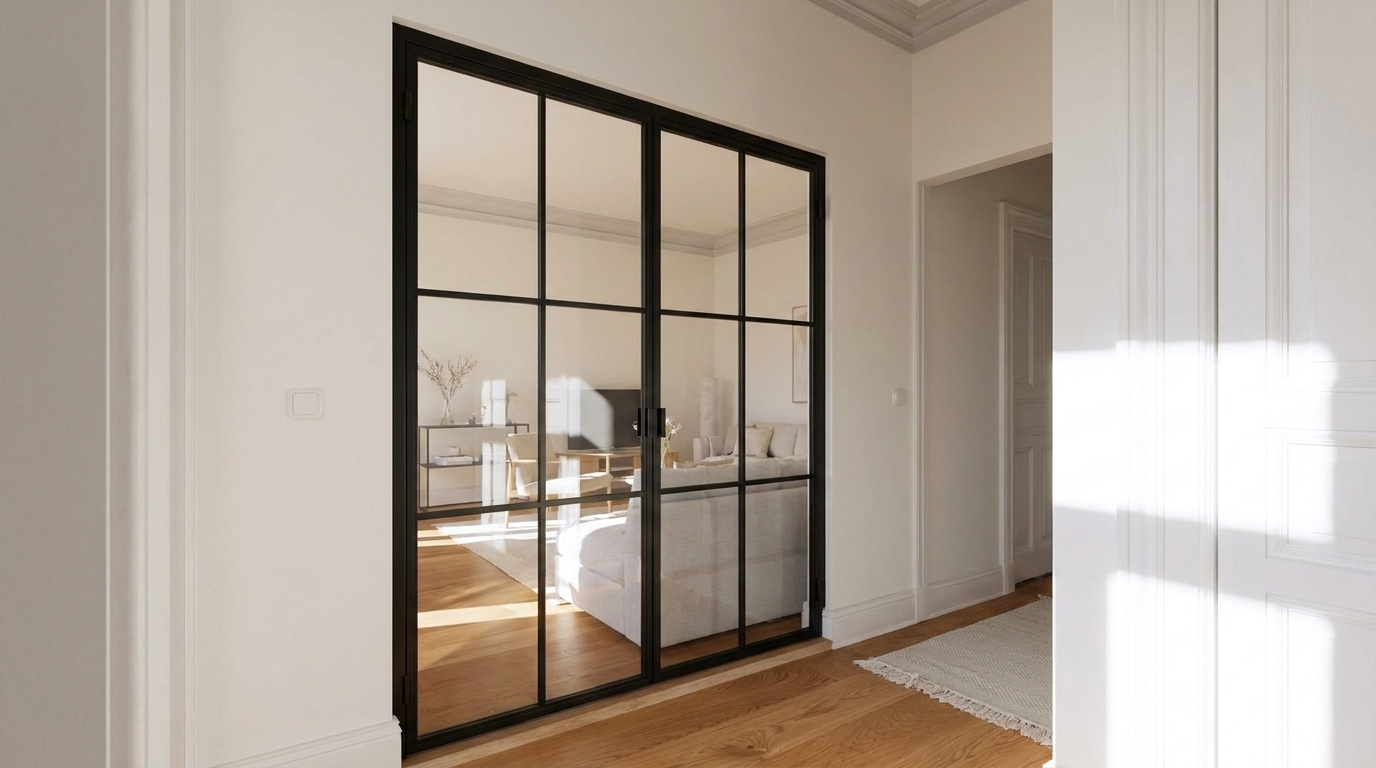
- Double-leaf doors: For wider openings without side panels; both leaves open towards same or opposite directions.
- Side panel plus door combinations: Most popular configuration for openings between 1,000-2,000mm width.
- Transom lights: Additional glazing above main partition for ceiling heights exceeding 2,400mm.
Side Panels for Proportional Balance
Openings broader than 1,200mm create proportional challenges with single door leaves—they become unwieldy and visually overwhelming. Fixed side panels solve this elegantly: total width divides sensibly, door leaves remain manageable, and the side panel provides additional glazed area.
For a 1,600mm opening, typical division might be 700mm side panel plus 900mm door leaf—precisely the arrangement chosen for a Cotswolds cottage home office separation, with RAL 7016 frame and frosted glass. Exact proportions are freely selectable within our configurator, and side panels can receive different glass types from door sections if desired.
Transom Lights for Generous Ceiling Heights
A partition ending at 2,100mm in a 3,000mm Victorian drawing room leaves 900mm of solid wall above—destroying the graceful proportions that make such rooms special. Transom lights complete the glazed area to ceiling level, remain fixed (no moving parts), and maintain light transmission throughout the opening's full height. Consider transom lights essential for ceiling heights above 2,400mm.
Bespoke Fabrication for Period Properties: Why Exact Dimensions Matter
Measuring Period Properties Accurately
Period British properties demand careful measurement technique. Take width measurements at top, middle, and bottom positions; height measurements at left, middle, and right positions. Victorian and Georgian buildings have typically settled, been replastered multiple times, and accumulated floor irregularities over decades—variations of 10-25mm between measurement points are normal, not exceptional.
Your partition will be fabricated to the smallest measurement; remaining gaps are closed with trim profiles and wall connections. Remember to account for installation clearance as detailed in our measurement guide.
Non-Standard Geometries and Special Situations
Sloping ceilings, irregular openings, and unusual geometries cannot accommodate standard rectangular products. A Regency townhouse conversion in Brighton required a partition with angled top section following the staircase line above—only bespoke fabrication could achieve this geometry.
Such challenges are exactly why Manufaktur X focuses on made-to-measure solutions rather than standard sizes.
Delivery Timing for Project Planning
Production time for room dividers from Manufaktur X is consistently 5-6 weeks from order confirmation. Orders should only be placed once structural work is complete and dimensions can be definitively measured. A partition delivered after decorating is finished installs without requiring touch-up work.
These 5-6 weeks must be treated as fixed project timeline—not contingency time. All deliveries to the UK include customs and duties handling, so no additional paperwork or charges arise upon arrival.
Investment and Pricing: What Bespoke Quality Costs
Entry Pricing and Example Configurations
Fixed glass room dividers from Manufaktur X begin at £945. A single-leaf loft door in RAL 9005, clear ESG glass, measuring approximately 900 × 2,100mm typically costs £1,500-2,000 depending on grid design. Transom light supplements calculate automatically in the configurator based on dimensions—no separate quotation process required.
Pricing Factors and Transparent Costs
Three elements determine pricing: your specific dimensions, chosen glass type, and grid design complexity. Importantly, several factors do NOT affect pricing: ESG versus VSG selection costs identically, all RAL colours are included without surcharge, and the configurator displays complete pricing immediately without hidden fees or subsequent quotation processes.
This transparent approach contrasts with many suppliers who use base pricing plus multiple supplements, making true costs difficult to assess until late in the process.
Market Position and Value Comparison
Non-bespoke alternatives from building merchants start around £200-500, but cannot accommodate non-standard dimensions, lack steel framework construction, and typically aren't EU-manufactured. System suppliers often begin around £2,500 for standard sizes with limited customisation options. Manufaktur X positions itself in the premium segment through unlimited dimensional flexibility and EU production standards, whilst maintaining accessible pricing for quality-conscious homeowners.
Common Planning Mistakes to Avoid
Insufficient Measurement Points
Measuring only once, typically at eye level, risks fit problems of 15-25mm in period properties. Such variations between top and bottom measurements are standard in buildings over 50 years old. Result: your finished partition either binds at one point or shows visible gaps requiring additional trim work. Always measure width and height at three points each, using the smallest dimension for ordering.
Grid Selection Without Proportion Testing
A 4-panel grid appearing elegant on screen may look clumsy and restless in a 3,000mm high opening. Proportions are best judged physically: tape paper strips matching steel profile width to your wall and assess from typical viewing distance. The configurator shows accurate scale, but cannot replace evaluation in your actual space under real lighting conditions.
Colour Choice Based Solely on Screen Display
RAL 9005 (jet black) and RAL 9004 (signal black) appear nearly identical on most monitors but differ clearly under daylight in your room. Same applies to grey tones like RAL 7015 versus RAL 7016. For investments starting at £945, request physical colour samples and evaluate under both natural and artificial lighting before final selection.
Door Swing Conflicts with Furniture Layout
A door opening towards kitchen units or seating creates permanent daily inconvenience. The approximately 900mm swing radius must remain permanently clear. This cannot be corrected after installation without replacing hardware. If swing clearance is impossible, consider sliding doors instead—these require no swing space but need adjacent wall area at least equal to door width.